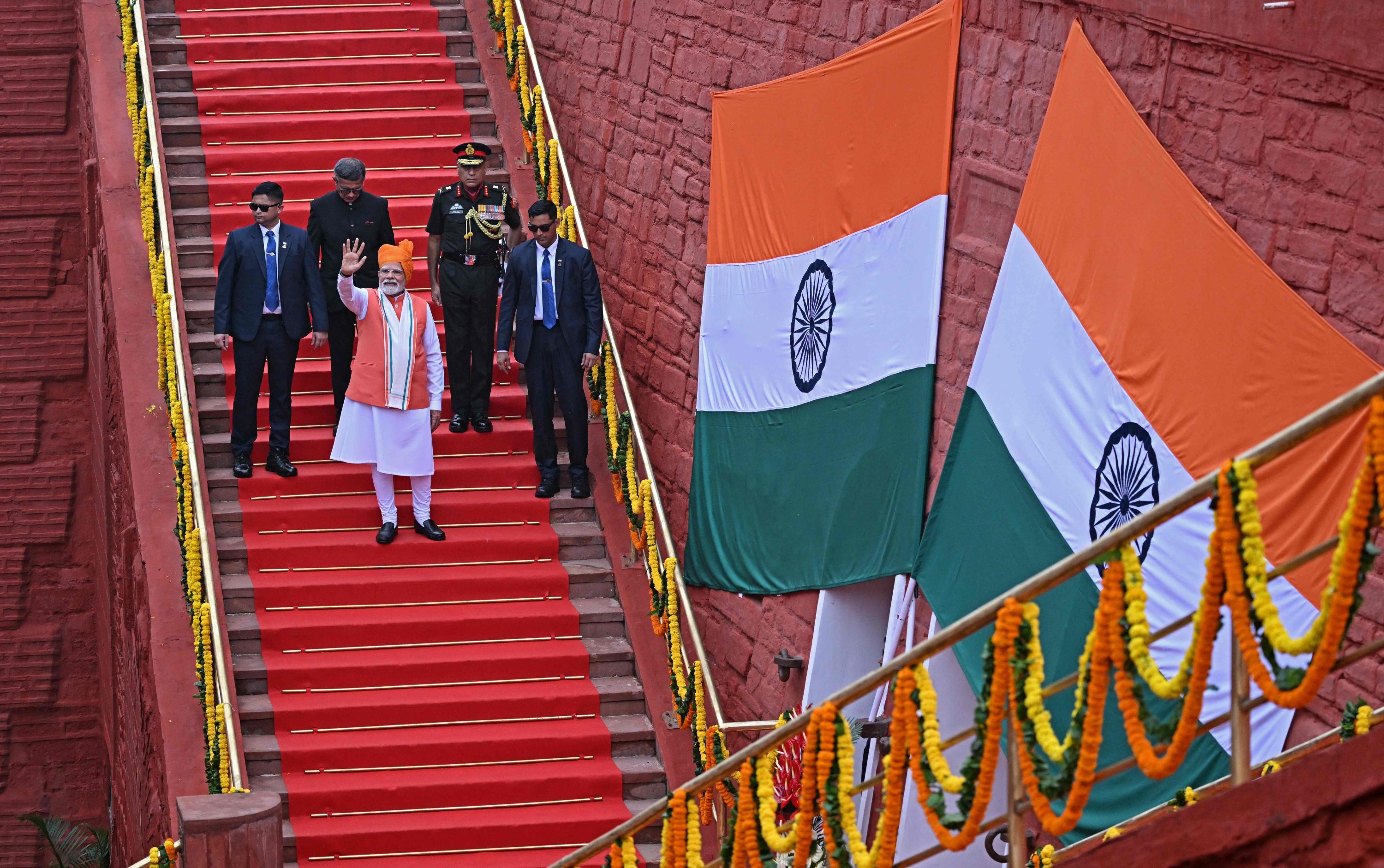
Indian Prime Minister Narendra Modi's administration announced the deepest tax cuts in eight years over the weekend, which are said could bolster his image amid an ongoing trade fight with the United States, but strain government revenues.
In the biggest tax overhaul since 2017, the government unveiled sweeping changes to the complex goods and services tax (GST) regime, with consumer, auto and insurance companies likely to emerge as the biggest winners when product prices drop from October, once the reform is approved.
India aims to slash taxes on small cars and insurance premiums as part of the reform, a government source said on Monday, sparking a rally in Indian stock markets.
The federal government has suggested lowering GST on small petrol and diesel cars to 18% from the current 28%, said the source who is directly involved in the matter.
The consumption tax on health and life insurance premiums may also be lowered to 5% or even zero from 18% currently, the same source said.
Shares of Maruti Suzuki, the biggest seller of small petrol cars in India, surged nearly 9% on Monday, leading a rally in auto shares that helped push India's benchmark Nifty index 1.3% higher, on course for its best day in three months.
Shares of other carmakers such as Mahindra & Mahindra, as well as motorbike manufacturers like Hero MotoCorp and Bajaj Auto, which will also benefit from tax cuts, jumped 2%-4% on Monday.
Stocks of insurance companies such as ICICI Prudential, SBI Life, and LIC rose as much as 2%-5% before paring some gains.
Modi's deep tax cuts will strain government revenues but have drawn praise from businesses and political pundits who say they will bolster his image in an ongoing trade fight with Washington.
In his Independence Day speech on Friday, Modi urged Indians to use more goods made domestically, echoing calls from many of his supporters to boycott U.S. products after Donald Trump hiked tariffs on imports from India to 50% as of Aug. 27.
The tax cut plan comes with costs, given that GST is a major revenue generator. IDFC First Bank says the cuts will boost India's gross domestic product (GDP) by 0.6 percentage points over 12 months but will cost the state and federal government $20 billion annually.
Modi has vowed to protect farmers, fishermen and cattlemen, following Trump's surprise tariff announcement after trade talks between New Delhi and Washington collapsed over disagreement on opening India's vast farm and dairy sectors and stopping Russian oil purchases.
Maruti Chairperson R.C. Bhargava said the tax rationalization is a "huge reform."
"With more affordability, more people will come into the purchasing system," said Bhargava, who declined to comment on proposed tax cuts on small cars until the fine print is out.
"This restructuring of the GST will increase competitiveness of Indian products and the opening of trade borders will bring in the necessary competition. Competition, combined with your ability to produce and sell at lower prices, makes for the best efficiency," he added.
Federal government officials over the weekend said New Delhi has proposed only two rates of taxation – 5% and 18% – under the revamped structure. The highest 28% rate will be abolished.
The new proposal, however, will impose a 40% tax on five to seven "sin-goods" like tobacco products and luxury items.
The announcement will not be effective until the GST Council, which is chaired by the federal finance minister and has representatives from all states, gives a nod. A meeting is expected by October.
Sales of small cars, defined as those having engine capacity below 1200cc for petrol vehicles and 1500cc for diesel and not exceeding four metres in length, have slowed over the last few years as buyers switched to bigger, feature-rich SUVs.
Small cars made up a third of the 4.3 million passenger vehicles sold in the world's third-largest automobile market last fiscal year, down from nearly 50% pre-COVID, industry data showed.
The segment makes up half of all cars sold by Maruti, majority-owned by Japan's Suzuki Motor, which saw its market share plunge to about 40% from over 50% in the last five years as sales of its Alto, Dzire and Wagon-R models dropped.
Carmakers Hyundai Motor India and Tata Motors also stand to gain.
Cars with higher engine capacity that currently attract 28% GST and an additional levy of up to 22% – resulting in total taxes of about 50% – may come under a new special rate of 40%, the source said.
The government source added that details are being firmed up to consider if any extra levies should be imposed over the 40% to keep the overall tax incidence for big cars the same at 43%-50%.
On the other hand, insurance penetration in India continues to remain low, at 3.8% of GDP, in 2024, according to research firm Swiss Re Institute. The companies believe lowering of GST will help boost sales of insurance products.