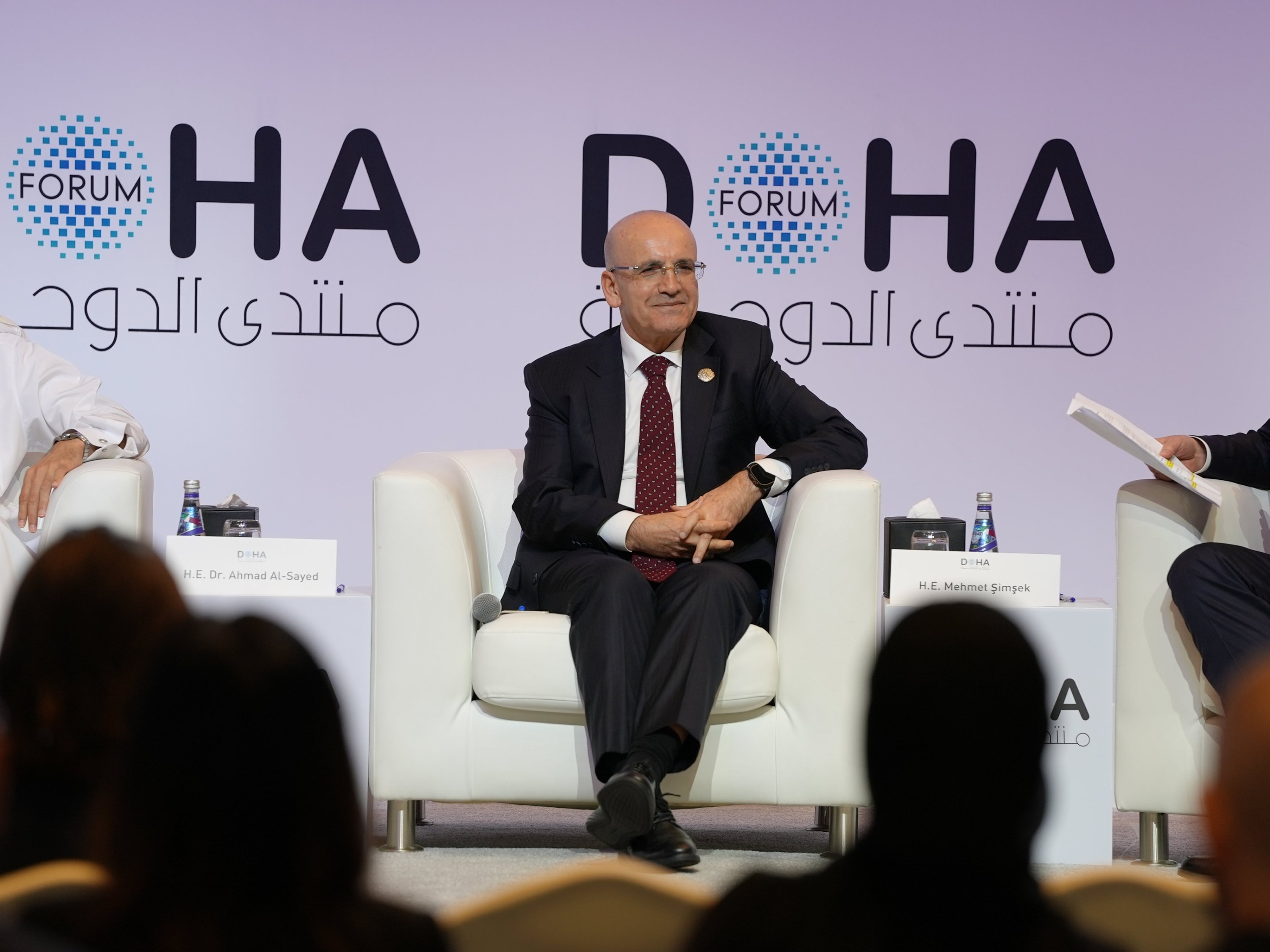
Structural transformation is a "key" remaining challenge that needs to be addressed to ensure Turkish economic gains are lasting, Treasury and Finance Minister Mehmet Şimşek suggested on Saturday.
Speaking at a panel titled "Shockwaves and Safety Nets: Rethinking Trade in the Age of Disruption," during the Doha Forum held in Qatar's capital over the weekend, Şimşek evaluated the issues of global fragmentation, the importance of trade deals and regional integration, while also touching upon domestic outlook.
"The biggest challenge is still inflation. That's what keeps me awake. It is down to around 31% from mid-70s ... But it is destined to single digits," he maintained.
"We've addressed lots of challenges. The key challenge is structural transformation – that will make all these gains lasting," the minister also said.
Answering the question on the economic outlook since he took the post, he said: "Two-and-a-half years ago it seemed like a mission impossible, but we are there."
"We fixed the fiscal, fiscal deficit is down to 3%, and debt-to-GDP (gross domestic product) ratio is at 24%," he said.
"The current account deficit has largely disappeared. We rebuilt reserves in tune with $120 billion ... growth remained sub-trend," he added.
"The real challenge now is to make these gains lasting through structural transformation. Our President (Recep Tayyip Erdoğan) has declared 2026 the year of structural reforms, and I am very optimistic," he said.
Also, pointing to how to deal with fragmentation, Şimşek highlighted that much of Türkiye's trade with the rest of the world is rule-based.
"Some 62% of our exports are destined to the countries where we have free trade agreements," he noted, adding that this covers almost two-thirds of exports.
"And when we look at the composition of our exports of goods and services, we are in the world's top 20 with exports of services, where tourism, medical tourism and logistics, transportation are our big ticket items," he explained.
"We are fourth in the world in terms of a tourist destination," he also said.
"So, we have a very large services surplus, which we would like to sustain by investing in hyperscaler data centers, becoming the region's hub for exports of digital services," said Şimşek.
While suggesting that Türkiye is not immune to global developments, he referred to nearshoring, friendshoring and rule-based trade, noting that it accounts roughly for 80% to 85% of Turkish exports.
Furthermore, he underscored the focus on services and industrial policies in terms of how to move up the value chain.
"We have identified eight areas and 30 products by 2030 and we call it HIT-30, and we are going to support these programs with $30 billion in coinvestments or investment incentives," he suggested, referring to the government's high-technology investment program.
"We continue to remain open, we favor rule-based trade and that's why we are seeking the free trade agreement with GCC countries," he added.
"If fragmentation is there, we are going to focus on regional integration as an antidote to fragmentation."
He also pointed to the Development Road project, highlighting the significance of connectivity, regional integration, industrial policies, and services exports.
On the issue of tariffs, he said, "The indirect impact of this tariff war is probably the most significant risk."
He also cited China's rerouting as a factor, noting the countries "do not destroy their capacity, they dump."
Similarly, he also noted that while Chinese exports to the U.S. are falling, they are increasing to other third markets.
Moreover, he said that more than half of the Turkish trade deficit comes from China, adding that they sought to address these issues with their Chinese counterparts to balance it.