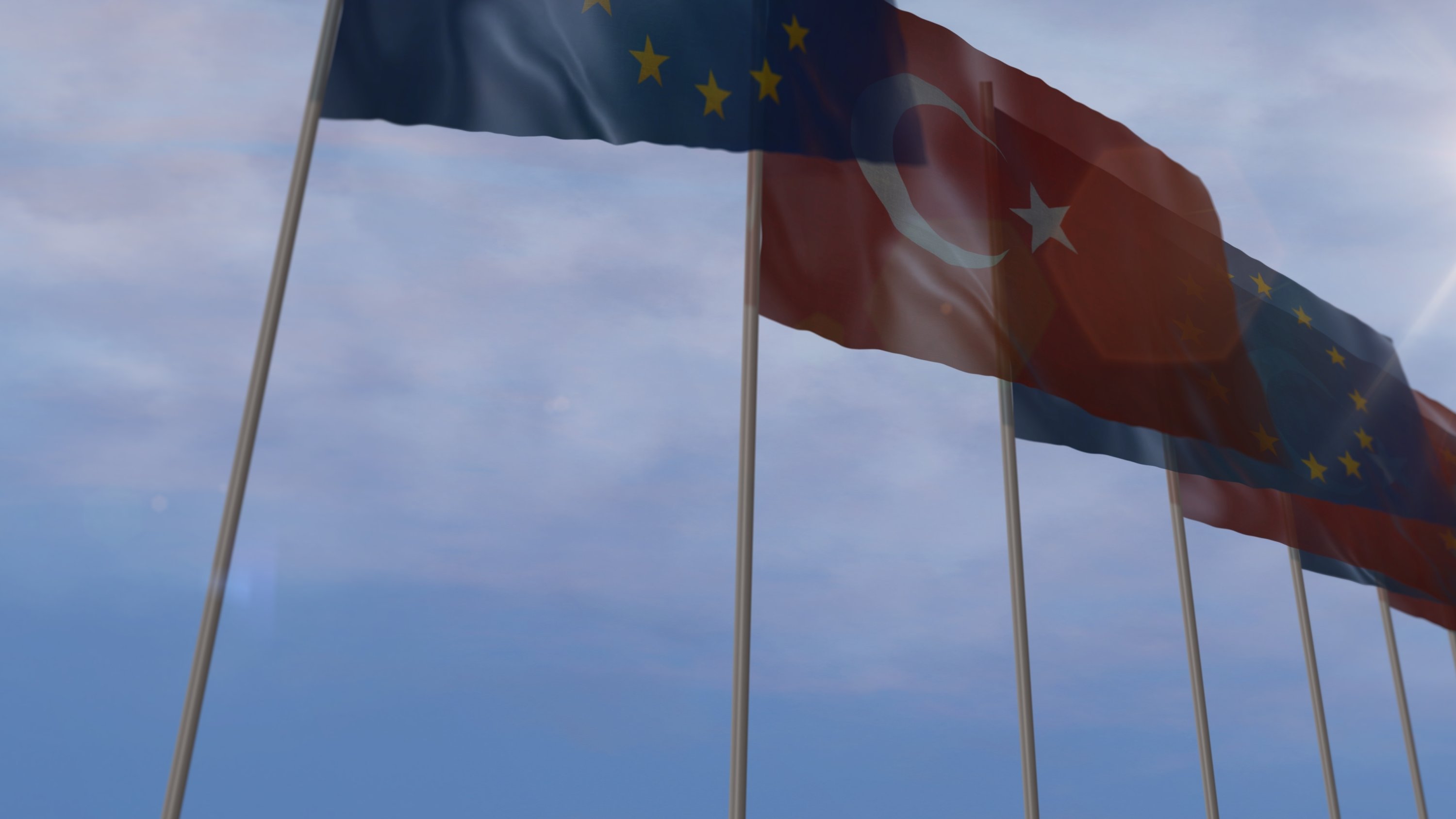
The chair of the Türkiye-Europe Business Councils of Foreign Economic Relations Board (DEIK) criticized remarks by European Commission President Ursula von der Leyen, linking Türkiye with Russia and China, saying the country should be seen not as a threat but as a strategic European partner and future EU member.
In a written statement on Wednesday, Mehmet Ali Yalçındağ, the coordinating chairperson of the Türkiye-Europe Business Councils, which represents dozens of business councils engaging with European nations, said that the founding spirit of the European Union was based on the courage to view differences not as threats but as a source of collective wisdom and shared prosperity.
"Its role within the NATO alliance, deep integration through the customs union, and strong interdependence in energy, migration, and security make Türkiye not a 'threat,' but a strategic European partner and a future member," he said.
He said the core idea behind the EU’s creation was to establish lasting peace through economic integration, build bridges and become a global actor through cooperation.
"In this context, placing Türkiye, an EU candidate country, a NATO ally, and a European nation, within the stated geopolitical category reflects an approach that is detached from reality," he said.
Yalçındağ underlined that Türkiye is "an integral part of Europe’s economic, security and societal fabric."
His remarks came after the EU chief's remarks at an event earlier this week. Von der Leyen mentioned her support for EU enlargement but said: "We must succeed in completing the European continent so that it is not influenced by Russia, Türkiye or China."
This drew criticism from Turkish officials who said the characterization did not reflect the country’s status as a key partner and NATO ally.
Türkiye, a long-time candidate for EU membership, has strong trade ties with the bloc, with the bilateral trade volume exceeding $200 billion a year. Türkiye and the EU base their commercial ties largely on a 30-year-old customs union trade agreement, whose overhaul has long been stalled but which Ankara earlier argued would be a win-win for both sides.
Turkish officials and businesses have long argued that the current agreement is outdated and no longer reflects global trade realities or the depth of today's economic relationship.
Moreover, Yalçındağ added that the language used and the categorical classifications made in this regard appear to be driven more by tactical considerations than by geopolitical realities, warning that such an approach could weaken Europe’s strategic capacity in the long-term.
He said that said the DEIK, within the framework of its private-sector initiative supporting Türkiye’s EU membership, has emphasized that the EU must become a stronger and more autonomous actor in energy, supply chains and security, and that this objective can be achieved together with Türkiye.
He also said debates in Europe over decision-making mechanisms, especially the constraints created by unanimity, highlight the need for a more agile and responsive union.
According to Yalçındağ, a transition to qualified majority voting and differentiated integration models is a natural outcome of this search, but their implementation still requires unanimity, making the reservations of some member states decisive.
"In this context, it would be beneficial to assess Türkiye not through the lens of domestic European politics, but from the perspective of Europe’s global interests in the 21st century," he said.
He added that addressing EU-Türkiye relations through the broader framework of the future of Western democracies, economic integration, rapid transformations in the age of artificial intelligence, security cooperation and global competition would offer a more rational and forward-looking approach.
Yalçındağ also pointed to what he described as more balanced and realistic views within the EU regarding Türkiye’s position.
He recalled that European Parliament rapporteur on Türkiye Nacho Sanchez Amor described von der Leyen’s remarks as "a geopolitically flawed analysis,” highlighting what he called a contradiction with recent messages calling for stronger cooperation with Türkiye in security and defense.
He also referred to remarks by European Commissioner for Enlargement Marta Kos, who told the European Parliament that Europe needs Türkiye in light of shifting geopolitical dynamics.
According to Yalçındağ, Kos emphasized that Türkiye is not only a candidate country but also a strategic partner, citing its role as one of the EU’s largest trading partners, its key position on trade routes between Europe and Asia, and its importance for Black Sea security and in the context of Ukraine.
He further said discussions during this year’s Munich Security Conference underlined Türkiye’s role on NATO’s southern flank, its capacity to manage regional crises and its strategic importance for Europe’s security architecture.
"This year’s conference marked one of the clearest articulations yet of the idea that Europe cannot move forward without Türkiye," he said.
Yalçındağ also noted that Türkiye will host COP31 in November, describing it as a major international conference on the global climate crisis.
He said there are significant opportunities for cooperation between Türkiye and the EU on alignment targets, climate policies and the development of joint solutions to global challenges.
"Rather than defining Türkiye through limiting geopolitical categories, positioning it as a strategic partner that will help shape Europe’s common future represents a more realistic and constructive approach," he said.
He added that by refraining from labeling an EU candidate country, a NATO ally and a European nation as a "threat," the European Commission could better advance its goal of building a stronger and more sovereign Europe in the global order.