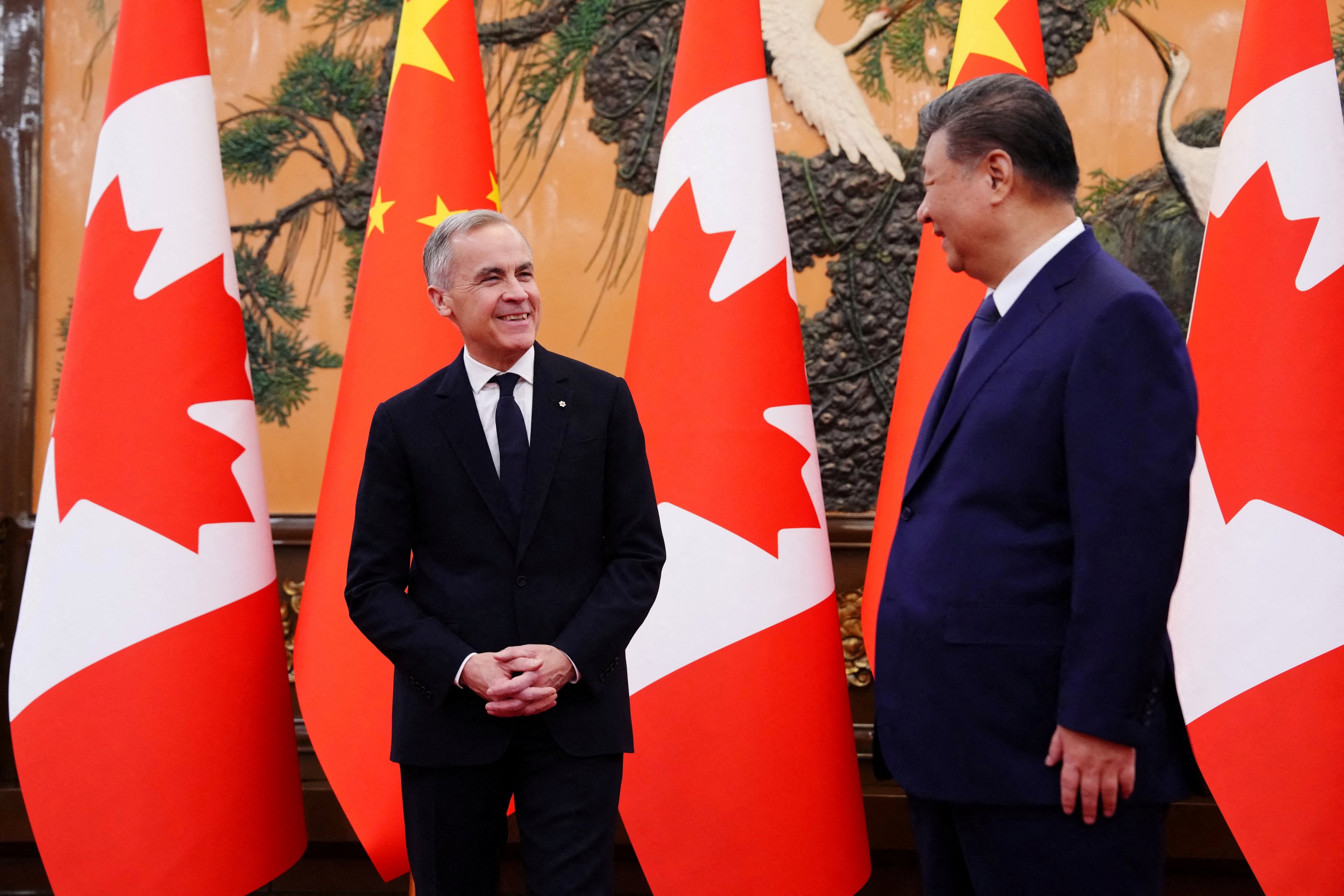
Washington's top trading partners, including major allies like Canada and the European Union, are responding to President Donald Trump’s belligerent and unpredictable trade policies by trying to take their business elsewhere.
Canada broke with the U.S. on Friday, slashing its 100% import tax on Chinese electric vehicles in return for lower tariffs on Canadian farm products, particularly canola seeds.
"It’s a huge declaration of realignment in Canada’s economic relations," said Edward Alden, who studies trade issues as a senior fellow at the Council on Foreign Relations. "The economic threat from the United States is now perceived by Canadians as far bigger than the economic threat from China. So this is a big deal."
Canada has repeatedly been the target of Trump’s impulsive wrath. In October, for instance, he said he was imposing a 10% tariff on Canadian imports as a reprisal for Ontario’s provincial government airing an advertisement that criticized the president’s go-to diplomatic tariff tool. He didn’t follow through on the increase, but tariffs on some key Canadian sectors like steel and aluminum remain.
But Friday's deal with China is a potentially perilous one for Canada’s prime minister, Mark Carney, who risks retribution from Trump on the eve of negotiations over the renewal of a North American trade pact that is crucial to Canadian businesses.
Carney, on Sunday, also visited Qatar, marking the first official visit to the Gulf nation and the first-ever visit by a sitting Canadian prime minister, suggesting Doha will make "significant strategic investments" in Canada.
"Canada is building big – and finding new partners who want to build with us," Carney posted on X, adding that Doha had committed to making "big investments" that would allow Ottawa to fast-track major infrastructure projects.
Canada is not alone in looking for alternatives to America’s large market as Trump slaps massive tariffs on imports in an attempt to strong-arm other countries into moving production to the United States.
The EU on Saturday signed a major trade pact with the South American alliance known as Mercosur, which includes the region’s two biggest economies, Brazil and Argentina. The EU is also pursuing a trade deal with India.
China, pounded by U.S. tariffs since Trump’s first term, has diversified its exports away from the world’s biggest economy to markets such as Europe and Southeast Asia. It seems to be working. China’s trade surplus with the rest of the world surged to a record $1.2 trillion in 2025, the Chinese government reported last week, despite tumbling exports to the U.S.
Since returning to the White House in January, Trump has overturned seven decades of U.S. policy favoring free trade. He’s imposed double-digit taxes on imports from almost every country on Earth, as well as singling out specific industries, such as steel and autos, for levies of their own.
Trump says tariffs will raise money for the U.S. Treasury, protect American industries, and bring investment into the U.S. On Thursday, in fact, Taiwan agreed to invest $250 billion in the U.S. in return for Trump reducing the tariff on its products to 15% from 20%.
However, the U.S. president's use of tariffs has often been arbitrary and unpredictable.
He targeted Brazil, for instance, for prosecuting his friend, former Brazilian president Jair Bolsonaro. On Friday, he threatened to slap tariffs on countries that don’t support his efforts to wrest control of Greenland from Denmark.
Friday’s deal in Beijing marks a turnabout in Canadian policy.
In 2024, Canada followed the U.S. by imposing 100% tariffs on EVs from China, reflecting fears that inexpensive Chinese cars would overwhelm domestic North American automakers.
But the deal with China delivers benefits to Canada.
First, its canola farmers are in need of export markets, and this pact lowers China’s tariff on canola from 84% to 15%. Canola farmers are hailing Canada’s new trade deal with China as great news that could restore exports for the major crop.
Second, the Trump administration, favoring fossil fuels over green energy, "is actively hostile to EV production in North America," said economist Mary Lovely, senior fellow at the Peterson Institute for International Economics. America’s opposition "threatens to make the North American (auto) industry obsolete in the future, as China moves ahead with rapid quality improvements in batteries and electronics for EVs."
"China’s strengths in the electric vehicle sector are undeniable," Carney said Friday. "China produces some of the most affordable and energy-efficient vehicles in the world. And in order for Canada to build our own competitive EV sector, we need to learn from innovative partners, access their supply chains, and increase local demand."
But Carney’s economic rapprochement with Beijing amounts to a gamble.
"This was an extraordinarily difficult thing for Carney to do," Alden said. "Relations between Canada and China have been extremely fraught."
In 2018, China detained two Canadians in retaliation for Canada arresting an executive of the Chinese tech firm Huawei at the request of the United States. All three were released in a 2021 swap. Canada also launched an investigation three years ago into whether the Chinese interfered in Canadian elections in 2019 and 2021.
The deal has also drawn criticism already for exposing Canadian autoworkers to competition with low-priced Chinese EVs. Ontario Premier Doug Ford, leading the province that is the center of Canadian auto production, blasted the deal.
"Make no mistake: China now has a foothold in the Canadian market and will use it to their full advantage at the expense of Canadian workers," Ford posted on social media. "Worse, by lowering tariffs on Chinese electric vehicles, this lopsided deal risks closing the door on Canadian automakers to the American market, our largest export destination.”
In response to the criticism, Carney noted that the deal is limited. China can only export 49,000 EVs to Canada at the reduced 6.1% tariff rate, rising to about 70,000 in five years.
At the same time, the agreement also drew criticism from top U.S. officials as well.
"I think they'll look back at this decision and surely regret it to bring Chinese cars into their market," U.S. Transportation Secretary Sean Duffy said.
And the biggest risk to Canada comes from how relations with the U.S. unfold ahead of the renewal of the free trade agreement with its southern neighbor and Mexico.
The U.S.-Mexico-Canada Agreement (USMCA) – a regional trade pact that allows many goods to cross North American borders duty-free – comes up for renewal this year.
Trump is almost sure to demand changes meant to shift manufacturing to the United States – and might threaten to pull out of the deal altogether, especially if he is inclined to punish Carney for reversing his policy with China.
That’s a scary thought for Canada, which sends 75% of its goods exports to the U.S.
The Canada-China deal "will make the talks more complicated," said William Reinsch, a former U.S. trade official now with the Center for Strategic and International Studies.
"Trump will not be pleased with the Canadian action, will probably take some retaliatory measure, probably against the Canadian auto industry, and will certainly make it an issue in the USMCA talks."
On Friday, anyway, Trump commended Carney: "If you can get a deal with China, you should do that.″ And Carney noted Friday that the China deal is preliminary, potentially giving him flexibility to seek changes if necessary to head off a conflict the U.S.
He also might be counting on getting a little help from U.S. businesses. American automakers depend on a network of plants across the U.S., Canada and Mexico, and "will fight tooth and nail" to defend USMCA.
American farmers also rely on the pact for access to the Mexican and Canadian markets. And U.S. tech companies like the way USMCA liberalized digital trade in North America.
For now, Lovely said, Carney’s deal with China sends "a big signal that Canada is looking to other partners and has options that would allow it to walk away from the USMCA before it makes humiliating compromises to serve only American interests."