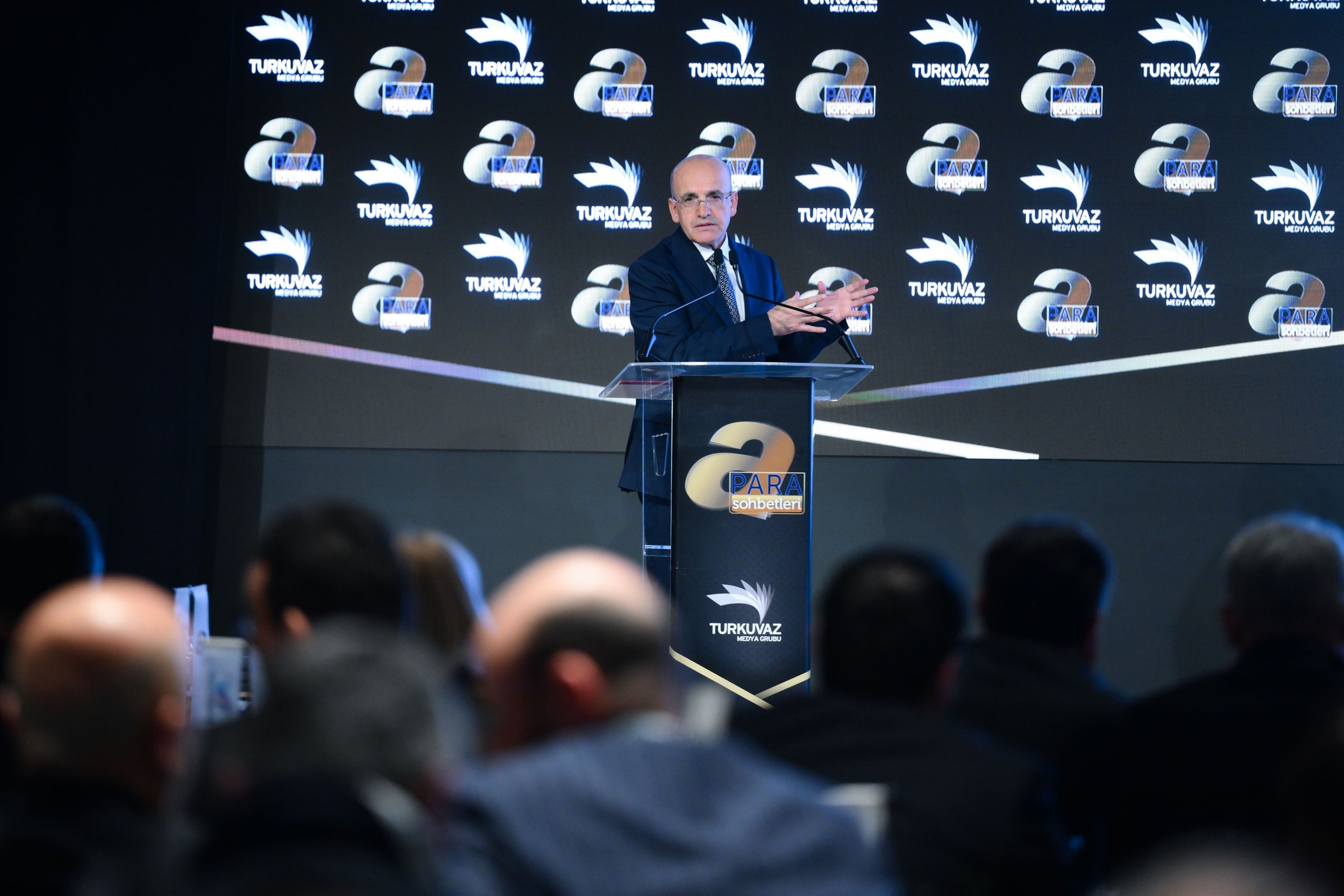
Türkiye's macroeconomic stability and reform program is heading into its final phase, focused on structural transformation and sustainable disinflation after a period of policy normalization and rebalancing, Treasury and Finance Minister Mehmet Şimşek said Friday.
Şimşek was speaking at the Future of Finance Summit, organized by Türkiye's leading media group and Daily Sabah's parent company, Turkuvaz Media.
The medium-term program, updated this September, aims at bringing inflation down to single digits, increasing predictability, achieving a sustainable current account balance and ensuring all these gains are permanent.
Şimşek said the three-stage road map – control, rebalancing and structural transformation – is progressing as planned. The first phase stabilized markets and curbed risks related to reserves and contingent liabilities, he said, while the second saw progress on inflation, an exit from the foreign exchange-protected Turkish lira deposit scheme, or KKM, and an improvement in the current account balance.
"The second phase is ending as of this month. We are entering the final phase. We are entering a period in which households and the real sector will feel the program's results more strongly," he said.
On inflation, Şimşek stressed upward pressure from agriculture-related shocks, including frost and drought, which had caused food prices to increase more than expected, and a decrease in fruit and grain production.
But he said Türkiye is likely to see annual inflation fall into the 20% range when early 2026 data is released, adding that the medium-term program target would be met on the upper band with a slight delay.
"When the January inflation figures are announced as of Feb. 3, it is highly likely that Türkiye will see figures in the 20s. Even with a slight delay, the inflation targets, at least the upper band, will have been met," he noted.
"Disinflation will continue in 2026. The reason is very simple: because monetary policy, fiscal policy, and income policies will continue to be supportive."
Earlier on Thursday, Türkiye's central bank lowered its policy interest rate by 150 basis points to 38%, cutting at the higher end of expectations, as data over the last two months suggested that disinflation is back on track after summer price pressure.
The Central Bank of the Republic of Türkiye's (CBRT) policy-making committee said inflation expectations and pricing behavior are "showing signs of improvement" even as they continue to pose risks to the disinflation process.
Consumer prices rose 31.1% year-over-year in November, with a 0.87% monthly increase, both readings below expectations and helped by easing food prices. Inflation had been above forecasts in August and September, but below them in October and November.
Last month's reading market the lowest level since November 2021. It has eased from the peak of about 75% in May last year.
After a policy reversal earlier this year due to market volatility, Türkiye's rate-cutting cycle resumed in July with a 300-basis-point move, followed by cuts of 250 points and then 100 in October amid rising food prices.
Analysts expect the central bank to continue easing next year.
The CBRT's end-2025 inflation target stands at 24%, with its forecast range at 31%-33%.
It has pledged to reach its 16% interim target by the end of 2026 – the same target included in the government's medium-term program. The bank projects next year's inflation between 13% and 19%, while market forecasts remain in the 20s.
Şimşek said the 2026 target's upper band remains "highly achievable" barring new shocks.
One decision that would affect both the inflation and rates path is how much the authorities decide to raise the minimum wage for next year, a debate in which workers are pressing for an increase that offsets past losses, especially for low-income households.
A commission of government, labor and employer members will open debate on the matter in Ankara on Friday.
Earlier on Thursday, President Recep Tayyip Erdoğan urged the employers' union TISK to show flexibility in the negotiations.
Şimşek went on to say that the relationship between housing prices and rents has normalized and that rent increases would moderate going forward.
He cited improving housing supply, including 350,000 homes delivered in southeastern provinces hit by the devastating 2023 earthquakes, and 1.4 million units under construction nationwide through social housing and urban transformation projects expected to finish in the next two years.
Şimşek also said past limits on education price increases have also lost their upward pressure on inflation, adding that both rent and education components, previously key drivers, are now on a downward trend.
The minister said fiscal discipline is delivering faster-than-expected results, pointing to the government's efforts to reduce tax expenditures, eliminate ineffective exemptions and fight the unregistered economy.
According to Şimşek, the 2025 budget deficit is likely to end the year near the government's forecast.
"The improvement in the budget is going better than anticipated. We will most likely complete the year close to the target – around 3.1% of GDP," he said.
As the deficit narrows, Şimşek said they will borrow less and leave more room for private-sector credit, he said, adding that Türkiye will meet its 2025 budget targets.
"Thanks to fiscal discipline, we will leave more resources in the markets so they can go to the private sector as credit. We are disciplining the public sector to leave more space for the real sector," he said.
"In inflation, we will be at the upper band with a one-month delay, but we will meet the budget targets. We will announce the results at the end of December."
Şimşek said the accelerating green transformation, services exports and domestic hydrocarbon output have helped nearly eliminate Türkiye's underlying current account imbalance, excluding gold.
"It may sound like an exaggeration, but the sustainable level of the current account deficit in Türkiye is already 2%-2.5% of GDP. Last year, we already had a current account surplus excluding gold imports. There is a structural transformation here," he said.
The government had projected a current account deficit of 2% for this year, but will likely close at around 1.5%, said the minister. "Therefore, we have also met the current account deficit target."
Türkiye’s resilience and reduced vulnerabilities have been supported by a $63 billion (TL 2.69 trillion) services trade surplus, rising renewable energy use, and increasing shares of high- and medium-high-tech production and exports, Şimşek said.
The minister explained that Türkiye's robust structure and resistance to shocks have reduced vulnerabilities, citing a $63 billion surplus in services foreign trade, rising renewable energy use and increasing shares of high- and medium-high-tech production and exports.
Stating that growth is moderate, Şimşek said the Turkish economy was on track to expand by around 3.7% this year.
"We had projected 4% growth. As of the third quarter, on an annualized basis, we are at 3.6%. It is highly likely that growth will be around 3.7% or perhaps slightly higher. We are close to 4%," he said.
"In today's global conjuncture, where our trading partners are growing at around 1.8%-2%, Türkiye's growth of nearly 4% is important and valuable."
Şimşek suggested that productivity-led growth in 2025 will be "disinflationary."
"Growth will accelerate with disinflation. Growth that comes from a productivity increase is generally not inflationary. This is a very valuable thing. In 2025, more than half of the total growth will come from factor productivity. This is not inflationary; it is disinflationary," he said.
According to the minister, Turkish companies can now roll over external debt more easily and at lower costs thanks to falling risk premia, improving reserves and better credit ratings.
"Previously, for every $100 repaid, firms could find only $70. Now, for every $100 repaid, they can find $165 at much lower interest rates," he said.
Şimşek said household debt has declined, Türkiye is moving up the value-added chain in industry, national income has risen, and Türkiye's share of the global economy has doubled to 1.3%.
He stressed that investments are likely to accelerate. "Despite complaints, investments increased by double digits in the third quarter. Therefore, the quality of growth is improving," he said.
Şimşek pointed to Türkiye's strong performance in services exports, particularly health tourism and TV series sales, and said free trade agreements and rule-based trade frameworks make the country more resilient to vulnerabilities in goods trade.
Among others, the minister said Türkiye is ahead of many developing countries in AI readiness and will participate in the next wave of technological transformation from the outset.
He also underlined Türkiye's enormous potential in global clean energy investments and the defense industry, noting that Turkish contractors are second only to China internationally.
"There is a $1 trillion reconstruction need in our near geography. So, how can you be pessimistic? I really have difficulty understanding. You shouldn't be. I am not. We are on the verge of a period where opportunities are abundant," he said.
"But it is clear that we also need to do business in a more productive, more innovative and different way. The state cannot carry all the burdens. The state is ready to help you in this transformation."
Şimşek added that he is "much more optimistic" about next year, saying the government has largely met its targets this year and expects that success to strengthen further in 2025.