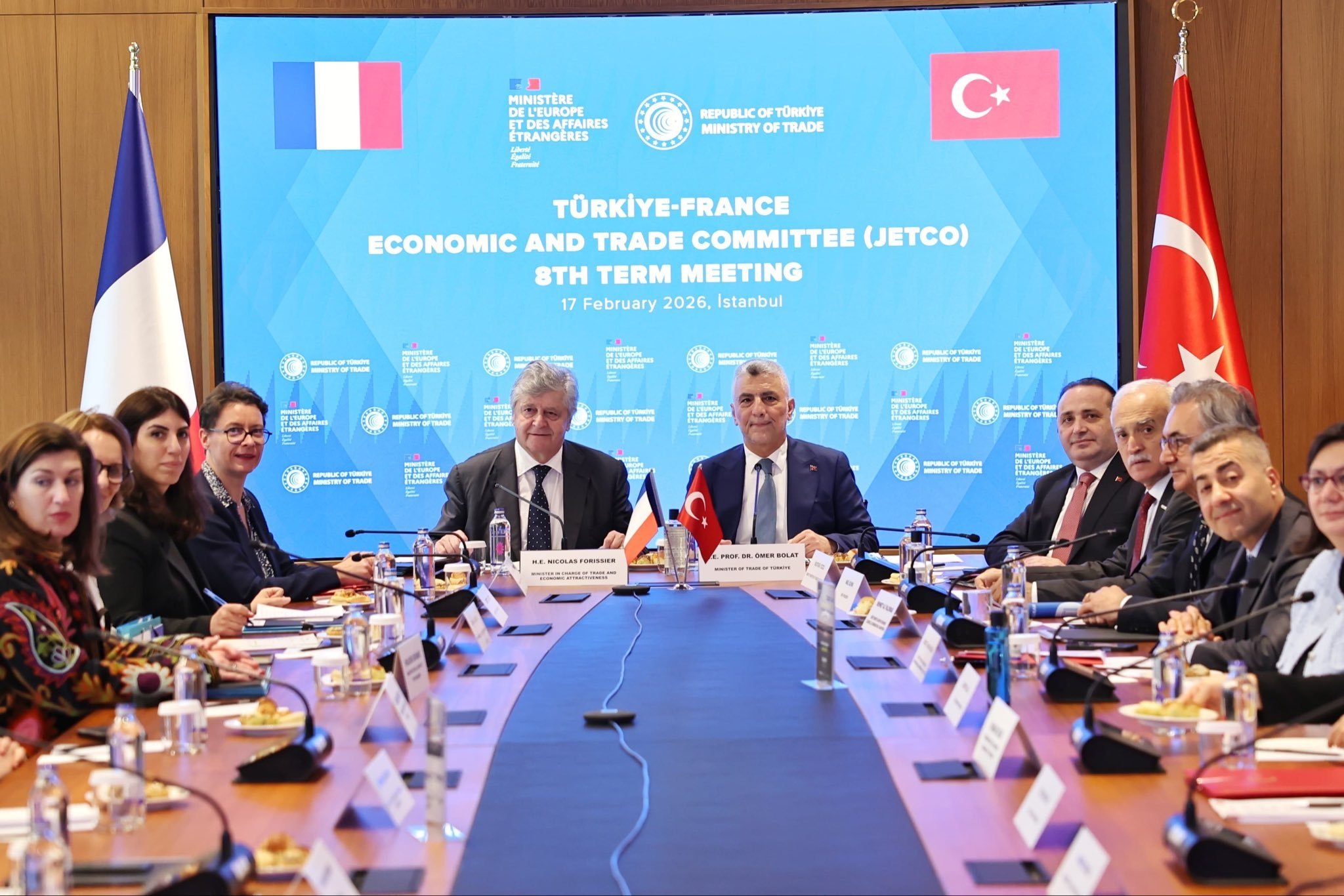
Türkiye and France discussed strengthening partnerships in contracting services, cooperation in third countries, including Africa, as well as energy, defense and logistics, Trade Minister Ömer Bolat said on Tuesday.
Bolat's remarks came following the Türkiye-France Joint Economic and Trade Committee (JETCO) meeting he chaired with French minister delegate for Foreign Trade and Economic Attractiveness Nicolas Forissier in Istanbul.
The sides held extensive discussions aimed at deepening Turkish-French cooperation across a broad range of sectors, the minister said.
"We held comprehensive discussions aimed at further developing the Turkish-French partnership in contracting services, joint ventures in third countries, partnerships, energy, transportation, environment, water, aviation, the defense industry and logistics sectors," he noted.
Bolat noted that bilateral trade between Türkiye and France rose sharply to $24.1 billion in 2025 from $14 billion in 2020, emphasizing that the trade structure remains balanced between the two countries.
He added that France's total investments in Türkiye have reached $8.7 billion, of which $4 billion came in the past four years, while officials are currently evaluating a pipeline of roughly $5 billion in additional French investment projects over the next three years.
Bolat said the expanding commercial and economic ties between the two countries have gained "strong momentum" with the eighth JETCO meeting and reaffirmed Ankara’s commitment to further strengthening cooperation. The next JETCO meeting is expected to be held in France in June, he added.
The minister emphasized that bilateral cooperation increasingly extends beyond national borders, particularly in Africa, Eastern Europe, Central Asia and the Middle East, where he says Turkish and French companies aim to pursue joint projects.
Both governments reaffirmed their readiness to support partnerships in these regions, encouraging firms to collaborate on infrastructure, energy and development initiatives, he said.
Existing cooperation spans automotive, aviation, pharmaceuticals, renewable energy, textiles, food, cement, construction, information and communication technologies, tourism, finance and insurance, Bolat said, emphasizing that they believe these will develop further and that new investments are being discussed.
In logistics, improved connectivity through air, land and sea routes, including the Ro-Ro line between Sete Port in southern France and Yalova in northwestern Türkiye, has helped facilitate trade flows and strengthen commercial links.
Bolat said Turkish logistics companies' growing presence in southern French ports is also contributing to deeper integration.
Bolat said he and Forissier also discussed broader Türkiye-EU relations, including progress toward resolving technical issues regarding the customs union.
The EU-Türkiye Customs Union entered into force in 1995, but is limited to industrial goods and processed agricultural products. Türkiye and the business world have repeatedly called for talks to modernize the deal to restart, but no concrete steps have been taken.
Türkiye has been an official candidate to join the EU since 1999, but its accession has been frozen for years over multiple disagreements. The sides have in recent months shown signs of increased engagement and economic cooperation.
Bolat said France had issued 163,000 visas to Turkish citizens last year, its second-highest worldwide after China, and officials noted that waiting times have declined and procedures have been eased, particularly for students and businesspeople.
"We reaffirmed that we will work together for the days when visas will be lifted," said the minister.