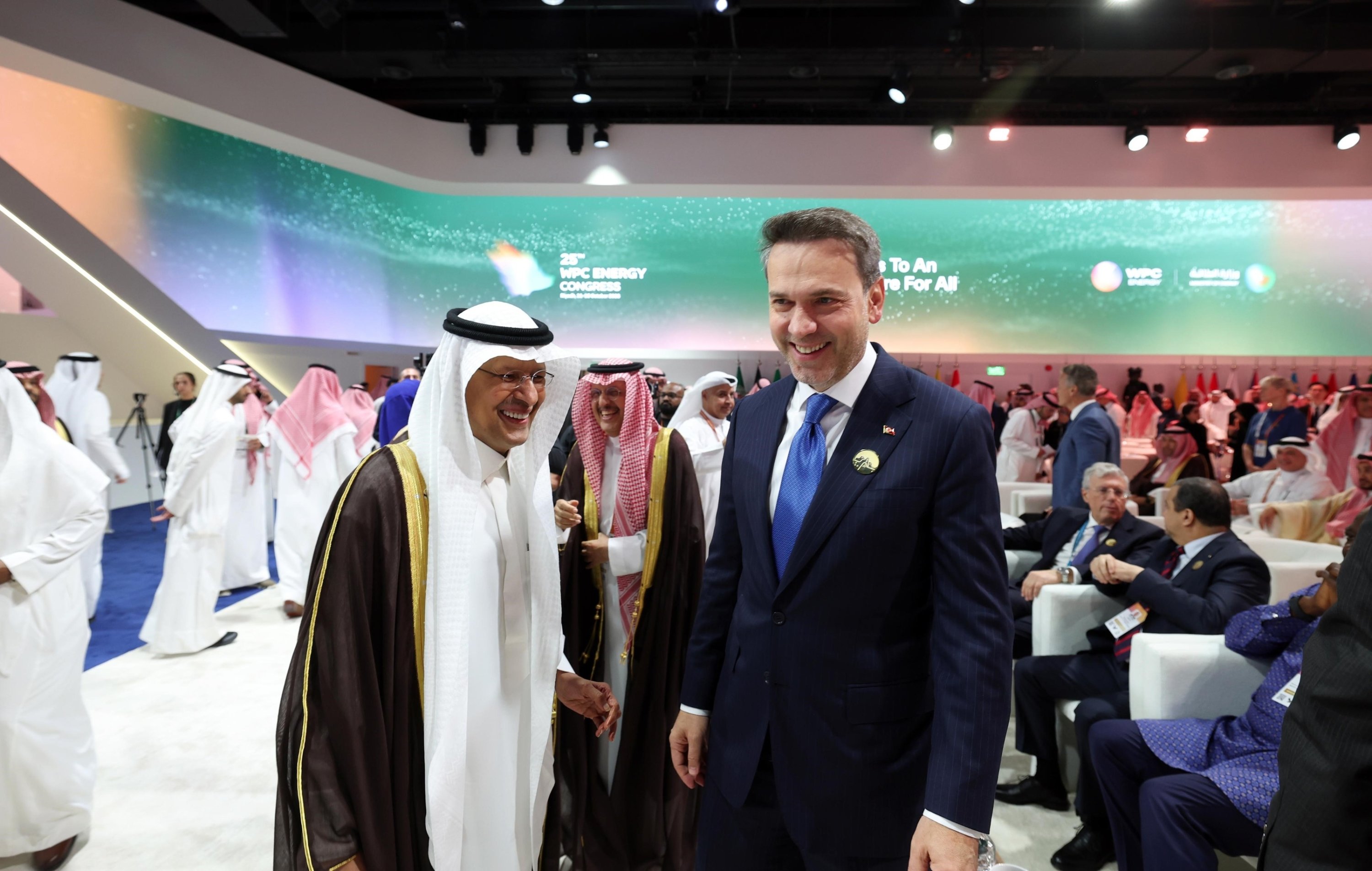
Türkiye is in talks with Saudi Arabia, Jordan and Syria on a large electricity transmission link connecting the four countries, Energy and Natural Resources Minister Alparslan Bayraktar said Monday.
Ankara views regional connectivity as a way to diversify energy supplies, pursuing pipeline projects with neighbors such as Iraq and Syria while seeking to expand cross-border links for oil, natural gas and electricity.
"We are discussing a major mega interconnection project, an electricity transmission line project, between Saudi Arabia, Jordan, Syria and Turkey," Bayraktar told Anadolu Agency (AA).
Bayraktar was speaking on the sidelines of the 25th World Petroleum Council (WPC) Energy Congress in Riyadh. He gave no details on cost, capacity or timing.
He added that Türkiye wants to expand energy cooperation with other countries as well, naming Libya, Iraq, Pakistan and Uzbekistan in particular.
Türkiye's investments in recent years have strengthened supply security in the region, according to Bayraktar.
He pointed to the Trans-Anatolian Natural Gas Pipeline (TANAP), TurkStream, the Baku-Tbilisi-Ceyhan oil pipeline and the Iraq-Türkiye oil pipeline, which together allow energy to move in different directions.
He said the aim is to use this infrastructure more fully. "We want to use our existing lines and infrastructure at the highest level. We want our lines to be full," he said. The Iraq-Türkiye oil pipeline has a capacity of 1.5 million barrels per day, and he said that capacity should be filled.
On natural gas, Bayraktar said Türkiye is considering filling spare capacity in TANAP with additional gas, so that more gas could be carried to Türkiye and, through it, to Europe.
He said Türkiye's investments in regasification terminals and liquefied natural gas infrastructure also create openings to bring in more LNG and send it on to Europe.
He said Türkiye continues to pursue a strategy of diversifying its energy sources, and is developing projects meant to support supply security on a regional and European scale, as well as meeting its own needs.
Bayraktar described world energy markets as facing one of the biggest crises of modern times. Despite this, he said, Türkiye has had no problems with the supply security of oil and oil products.
He said developments affecting production and supply in major oil producers such as Venezuela, Russia and Iran had increased pressure on global markets, and that price swings were hurting economies around the world.
"A prolonged contraction in energy markets could have serious consequences for the global economy, and international cooperation needs to be strengthened to get out of the crisis," he said. Energy markets could only become more balanced once regional tensions and war come to an end, he added.
Bayraktar also expressed solidarity with Saudi Arabia over recent attacks claimed by the Houthis on airports in the kingdom.
"We are here as Türkiye to show that we stand by our Saudi brothers," he said. He said he hoped the attacks would end and that the Turkish people stand with the Saudi people.
Saudi authorities pressed ahead with the WPC Energy Congress despite the deadly attacks, although several top energy executives were dropped from the schedule for the event.
The chief executives of ExxonMobil, TotalEnergies, Shell, Chevron and BP had all been expected at the event, which began on Sunday, but were no longer on the agenda that conference organizers released early Monday.
"To everyone who traveled to Riyadh, thank you," said Saudi Energy Minister Prince Abdulaziz bin Salman, who opened Monday's session of the gathering for energy policy and industry.
"You know this country is safe and that we hold your protection at whole heart... Our gathering here does not mean the risk is gone."
Prince Abdulaziz said the events of recent weeks were serious and that the kingdom's response must be "equally serious."
The WPC Energy Congress was originally scheduled for April of this year, but was postponed after the U.S. and Israeli war on Iran began in late February. Saudi Arabia was named host in October 2022, the first time the event, first held in Britain in 1933, has been held in the kingdom.
Chief executives of major energy companies are a regular fixture at WPC Energy events and had been scheduled to speak on stage this week about global oil and gas markets, energy security and the energy transition.
The WPC Energy Congress is taking place this week at a conference center some 10 kilometers (6 miles) from Riyadh's international airport, which has been attacked four times in the last week.
One person was killed and nearly a dozen hurt in a new attack on the airport on Sunday evening, Saudi authorities reported, a day after a strike claimed by Yemen's Iran-aligned Houthis killed 13 people and wounded more than 300, the deadliest attack in the kingdom in more than a decade.
Earlier on Monday, Bayraktar used a panel on the sidelines of the event in Riyadh to stress Türkiye's aim to put electrification at the center of its agenda for the 31st United Nations Climate Change Conference (COP31),
Bayraktar said Türkiye aimed to convey a message to the international community at COP31 on the need to advance electrification while addressing energy security and climate change.
Electricity demand in Türkiye is growing not only due to conventional consumption patterns but also emerging sources, including artificial intelligence-driven data centers, cooling needs, and desalination, he said.
Meeting this demand while advancing decarbonization would require investment across several areas, including renewable energy, energy efficiency, natural gas infrastructure and nuclear power, Bayraktar added.
Türkiye aims to achieve decarbonization by 2053 and is targeting 20 gigawatts (GW) of nuclear power generation capacity by 2050, he said.
Bayraktar said Türkiye was pursuing an ambitious renewable energy strategy covering solar, wind, offshore wind and geothermal power.
Energy efficiency was another key priority, with potential for improvements across the economy, including agriculture, transportation and buildings, he said.
Nuclear energy would also help Türkiye meet rising electricity demand while supporting its decarbonization and carbon neutrality goals, Bayraktar added.
He said the country's aging coal-fired power infrastructure needed to be transformed toward cleaner alternatives, while securing natural gas was becoming increasingly difficult under current market conditions.
Türkiye continues to invest in oil and gas infrastructure, including pipelines, underground storage facilities and regasification terminals, as well as offshore exploration and production activities at home and abroad, he said.
Bayraktar also stressed the importance of critical minerals, saying the energy transition depended on effective strategies for developing mineral resources.
Bayraktar said global energy markets had faced successive challenges since the COVID-19 pandemic, including supply chain disruptions linked to the Russia-Ukraine war, economic difficulties, high capital costs and the recent conflict involving Iran.
These developments have underscored the importance of resilient energy markets and international cooperation, he said.
Energy security would become a top priority, Bayraktar said, adding that countries needed more coherent policies to address energy security alongside climate change.