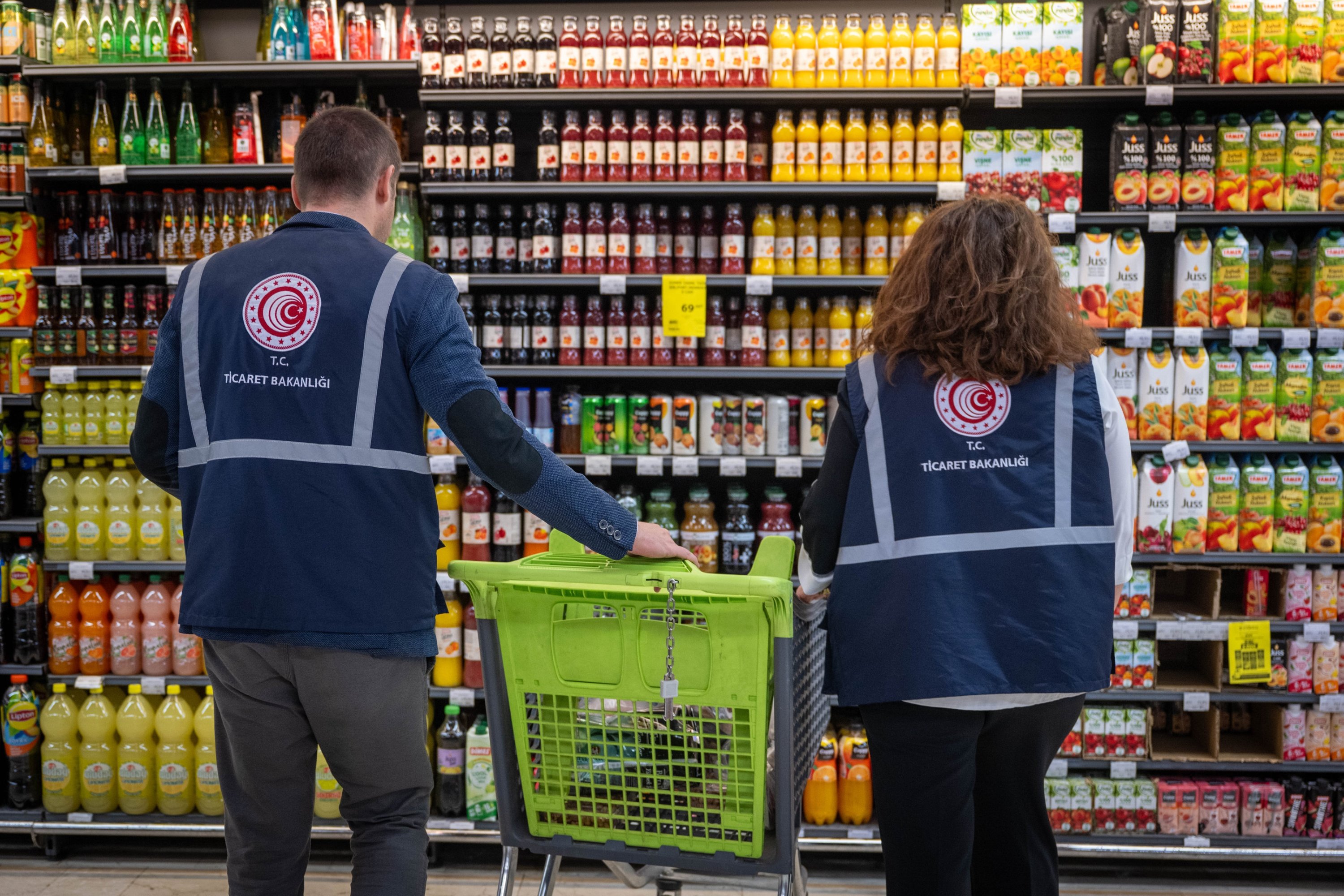
A top Turkish official reiterated on Sunday a warning against hiking prices under the pretext of the increase in the minimum wage, also suggesting that inspections in the field continue.
Trade Minister Ömer Bolat pledged that the authorities will show "no tolerance" toward companies that try to use the minimum wage as an excuse to raise prices.
Speaking to Anadolu Agency (AA), he warned that opportunists may emerge following the announcement of the new minimum wage, stressing that the wage will only take effect in 2026.
The net monthly minimum wage for 2026 in the country was raised by 27% to TL 28,075 (around $655). The government has sought to limit the inflationary impact of the increase amid an ongoing disinflation program, and the hike was close in line with the expectations of around 25%.
Annual inflation in Türkiye cooled to 31.1% in November, the lowest level in four years.
Bolat's remarks come following a statement issued by his ministry earlier in the week, warning of administrative and legal penalties on businesses engaging in excessive or unfair pricing.
"For this reason, we will not tolerate companies that try to increase prices, or impose hikes under the pretext of the minimum wage, opportunists, (those) who attempt to raise prices by the same amount as the wage increase," he said.
"We are conducting intensive inspections in the field; we have been carrying out inspections throughout the year. The Ministry of Trade's inspections continue in all 81 provinces against attempts at price gouging. Our government is on duty 24/7 to protect the purchasing power of our consumers and to ensure their welfare and peace," he added.
At the same time, Bolat evaluated the ministry’s activities and general trends in trade.
He noted that despite the slowdown in the global economy, growth has been recorded across many sectors in Türkiye, from manufacturing to agriculture and services, adding that the country’s economy has expanded uninterruptedly over the past five years.
Bolat said that exports, which declined in 2020 due to the COVID-19 pandemic, have continued to rise since 2021. He also stated that President Recep Tayyip Erdoğan’s export target of $390 billion for this year has been exceeded, reaching $393 billion as of the end of November.
"If this trend continues, we may even see $395 billion," he noted, referring to total goods and services exports.
"This year, we broke monthly export records in four of the past 11 months and recorded monthly increases in nine of them," he added.
"In two months, there was a slight decline in exports due to the calendar effect. By increasing exports every month, we achieved an added value of $ 8.8 billion in goods exports and approximately $ 5.5 billion in services exports in 11 months. In other words, we added $14.3 billion," he explained.
The minister, meanwhile, attributed the rise in imports during this period mainly to increases in gold and passenger car imports.
Emphasizing that Türkiye is a strong industrial, agricultural and services country, he said: "This year, the export-to-import coverage ratio will be around 75%. Our net surplus in services exports was $61.5 billion last year, and we estimate it could reach $63 billion or more this year. This will bring our current account deficit down to reasonable levels."
"The surplus generated by the services sector has played a significant role in reducing the foreign trade deficit. Türkiye ranks fifth globally among countries with a surplus in services trade."
Furthermore, Bolat pointed out that the post-pandemic disruption in global supply-demand balances and the resulting surge in demand caused serious inflationary pressures worldwide. He said that in this period, Türkiye provided substantial low-interest investment and business loans to stimulate the market and boost production.
As a ministry, he said, they introduced sector-specific regulations and stepped up inspections, particularly putting an end to manipulative practices in the automotive and real estate markets. He added that many measures were implemented, including price tag regulations, action against excessive pricing and stockpiling, and measures targeting misleading advertisements.
Bolat stated that in 11 months, fines exceeding TL 2.5 billion were imposed on businesses engaged in profiteering or unfair pricing. He also suggested that the Competition Authority (RK) worked intensively, indicating that it imposed TL 12.5 billion in fines on 211 companies over the same period.
Furthermore, he said that within the framework of budgetary resources, $90 billion has been spent in the earthquake zone over 2.5 years, equipping the region with livable, earthquake-resistant workplaces and housing.
Calling this a world record, Bolat said: "After the earthquake, a Japanese official came and told a local administrator, 'When we faced the Kobe earthquake, it affected only one province and casualties were fewer. We could only clear the debris in 4.5 years. You would only be able to clear the debris of this earthquake, which hit 13 provinces, in five years.' Under the directives of our president, we completed search and rescue, debris removal, identification of new reserve areas, groundbreaking, and the delivery of homes and workplaces to rightful owners within 2.5 years."
He also stated that they provided TL 154 billion in support to tradespeople with a 50% interest subsidy through Halkbank in the first 11 months of this year, adding that this amount was TL 104 billion last year.
Also explaining that they reduced the loan interest cost from 29% to 25% compared to last year, Bolat reminded that they increased the repayment period of loans for tradespeople from three to four years and the loan installments from three months to six months this year. He expressed that the financing cost will fall below 25% in 2026.
Concluding his remarks, Bolat stated that they provided TL 33 billion in support to exporters this year and noted that they will have provided $53 billion in loans through Türk Eximbank by the end of the year.