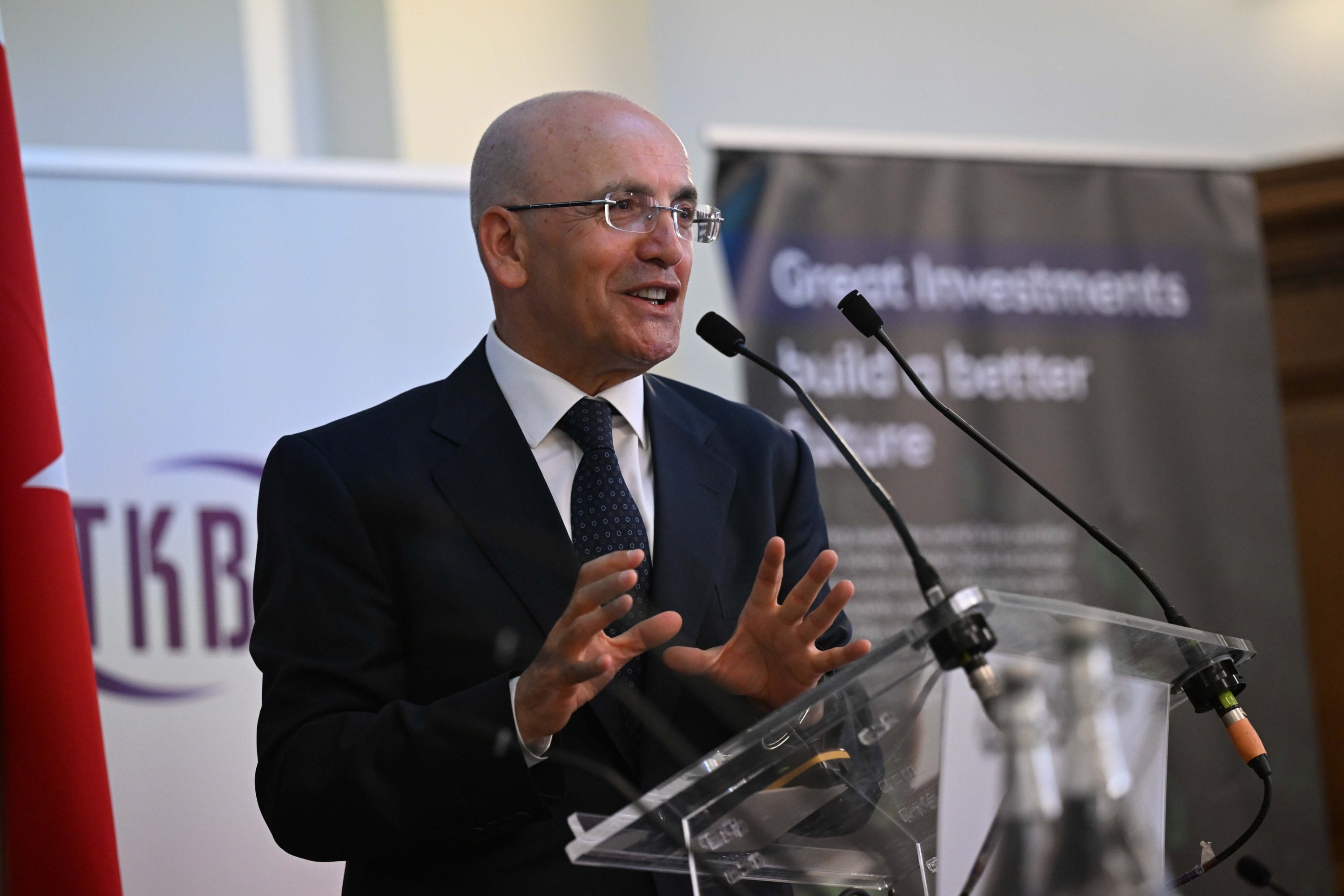
The Turkish government will not allow disinflation to be derailed, according to Treasury and Finance Minister Mehmet Şimşek, who says the process is continuing in a determined manner that will bring inflation into single digits in two years.
Inflation is expected to remain within the range of the central bank's year-end forecast, Şimşek said, adding that it would fall below 20% next year, backed by income policies aligned with inflation targets and supply-side measures in food, housing and energy, and to single digits in 2027.
"We maintain our year-end inflation forecast; the necessary conditions for disinflation are largely in place," he told an interview with Reuters. "Disinflation is progressing along our projected path. What matters to us is that this improvement is lasting and stable," he added.
Official data on Monday showed consumer price inflation slowed to 33.5% in July, the lowest rate since November 2021, having peaked at 75% in May last year.
Food inflation dropped to 28%, core goods inflation to 20.7% and for the first time in over three years, service inflation dipped below 50%, said Şimşek. All components of core inflation declined year-over-year, while monthly increases in producer prices reached their lowest levels since the beginning of the year.
Last month, the Central Bank of the Republic of Türkiye (CBRT) cut its key policy rate by 300 basis points and relaunched an easing cycle that was disrupted by political turmoil earlier this year, as markets calmed and disinflation continued.
Şimşek said coordination of monetary, fiscal, income and supply-side policies would help Türkiye achieve its goals.
"Monetary policy provides strong support to disinflation through the channels of demand, the exchange rate, and expectations, while increased coordination with fiscal policy reinforces this effort," he said.
Improved expectations and reduced inflation rigidity reflect the results of the government's determined stance, Şimşek said.
He cited the latest survey by the central bank that showed market participants' expectations for inflation in 12 months' time fell to 23.% in July, compared to 45% in October 2023.
"The market expectation for the end of 2026 is around 20%. Of course, this figure reflects an average, and we're seeing an increase in the number of participants anticipating a rate below 20%," he added.
"We aim to achieve single-digit inflation in 2027. We will achieve this target through the coordination of monetary, fiscal, income and supply-side policies."
Externally, the overall picture signals cautious optimism, according to Şimşek.
While oil prices, foreign trade tariffs and unprocessed food posed limited upside risks to inflation, he said the government was prepared to "prevent any obstacle to disinflation by taking the necessary steps to counter potential shocks."
He suggested that risks related to global trade have relatively diminished recently.
Regarding U.S. tariffs, Şimşek said bilateral agreements and customs regimes implemented by Türkiye's main trade partners may present both opportunities and challenges.
Last week, U.S. President Donald Trump issued a new set of tariffs that will apply to dozens of countries as of Thursday and that include higher duties on Turkish imports.
Under the new measures, tariffs on Turkish products were increased to 15%, compared to 10% that was announced by Trump as a baseline duty in April.
Şimşek said Türkiye was still among the countries subject to the lowest tariffs. "This situation could create us a significant advantage compared to many nations, especially in Asia and Latin America," he noted.
The minister added that they closely monitor how geopolitical developments impact inflation via commodity prices, particularly volatility in oil prices.
The rise in oil prices in June exerted upward pressure on domestic fuel and transportation services. In July, this pressure eased somewhat with falling prices, said Şimşek.
Despite short-term relief, according to Şimşek, the new oil price equilibrium around $70 is higher than pre-geopolitical tensions.
"This situation indicates that upward risks to inflation remain present," he noted. However, current indicators and outlook still suggest inflation will remain within the central bank’s forecast range, he added.
The central bank's year-end inflation midpoint estimate currently stands at 24%, in a forecast range of 19% to 29%.
The government's medium-term economic program has helped "significantly" reduce external vulnerabilities, increase resilience against shocks and strengthen macro-financial stability, Şimşek noted.
"The program has proven its success through a real stress test against multiple and sequential shocks. We now have a solid foundation for permanent and sustainable high growth; the Turkish economy has entered a positive cycle," he noted.
Şimşek said economic growth this year could be "slightly below" the medium-term program target of 4%, in what he said was a "temporary slowdown" rather than a sharp economic downturn. In the first quarter, Türkiye's economy grew 2%.
Despite the temporary slowdown in the short term, Şimşek stressed there is no trade-off between growth and inflation in the medium and long term. "On the contrary, price stability is a prerequisite for sustainable high growth," he said, according to a Turkish transcript of the interview.
Şimşek went on to cite past performance that he said clearly illustrates this.
In the 1993–2002 period, average inflation was 71.8%, while growth averaged only 3.1%. Between 2003 and 2012, inflation dropped to single digits, averaging 9.3%, and growth rose to 5.7%. In the period 2013–2024, inflation rose to 25.1% on average, while growth fell to 5.1%.
While private consumption slowed on an annual basis in the first quarter, total investments contributed positively to growth. The services and construction sectors maintained strong performance, and the contraction in industrial production was largely due to fewer working days, said Şimşek. Quarterly data showed weakened domestic demand due to tight financial conditions, while the external balance improved, he noted.
In the second quarter, industrial and service production remained flat; demand indicators like retail sales volume and credit card spending performed below trend, according to the minister.
"We expect the output gap to remain in negative territory as of the second quarter and persist through year-end," Şimşek said.
The current account deficit will be below the program targets, Şimşek said, adding that budget revenues would fall short of projections due to slower growth and inflation accounting, but the government would remain disciplined on spending.
He said external financing secured under favorable conditions from international financial institutions for development-focused projects reached a total of $17.4 billion in 2023 and 2024, and some $7 billion had been secured so far this year.
"We have established our medium-term cooperation framework with the World Bank, the Islamic Development Bank, and the Asian Infrastructure Investment Bank (AIIB). With the contributions of other institutions, we aim to secure over $40 billion in external financing in the next three years," he said.