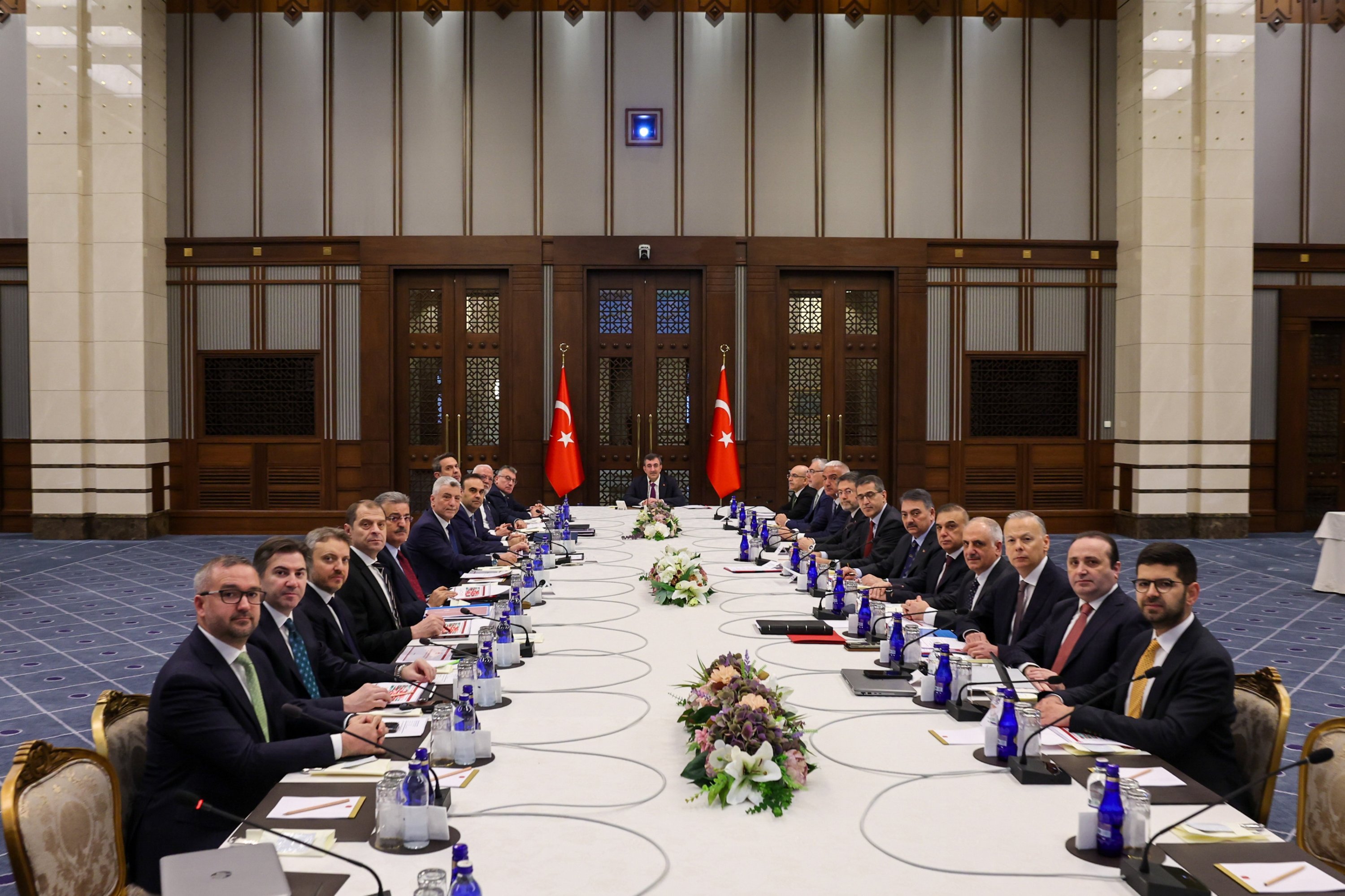
Turkish authorities pledged to continue taking necessary measures in strong coordination to limit the possible effects of global uncertainties and geopolitical tensions on the country's economy, while also pursuing the inflation fight, according to a written statement shared by the Economic Coordination Council (EKK) on Tuesday.
The council held the meeting under the chairmanship of Vice President Cevdet Yılmaz and was attended by other top officials, including Treasury and Finance Minister Mehmet Şimşek and the governor of the Turkish central bank, Fatih Karahan.
In the written statement issued after the meeting, it was noted that the global economy "is going through a period of increased uncertainty and geopolitical tension."
"In this conjuncture, the Turkish economy maintains its resilience to shocks, thanks to its strong macroeconomic fundamentals," the statement read.
"With the program we are implementing, financial stability has been strengthened, and macroeconomic balances have improved significantly," it added.
The Turkish government has been pursuing an economic program aimed at lowering inflation while focusing on sustainable growth. Since 2023, the authorities have adopted tighter monetary and fiscal policies, and inflation has regressed notably to around 30%.
The statement further emphasized that the Turkish economy "stands out positively" compared to many countries with its low public debt and budget deficit, strong reserve position, decreasing current account deficit, increasing inflow of external resources, and solid banking sector.
However, Türkiye, which shares a land border with Iran, also warned earlier that a prolonged conflict may weigh on the current account balance and inflation.
The conflict launched by the U.S. and Israel against Iran has resulted in higher oil prices and major disruptions in the Gulf region, which also risks supplies of fertilizers and thus poses a direct threat to global food prices and global inflation as well.
"On the other hand, the possible effects of geopolitical developments in our region and rising oil prices on the current account balance and inflation are being closely monitored," the EKK statement also said.
Moreover, it also recalled that the so-called "sliding-scale pricing system" has been temporarily implemented to limit the impact of rising oil prices on inflation.
"In addition, through measures taken to ensure the supply of agricultural inputs and strategic stock management, the strong structure of agricultural production is being maintained," it added.
On the side of energy, the statement noted that investments in domestic and renewable energy, which have been prioritized to reduce external dependence on energy and to permanently lower the current account deficit, "are being accelerated."
"In this way, it is aimed both to strengthen energy supply security and to increase competitiveness," it added.
Similarly, citing the rising uncertainties and protectionist trends in global trade, the statement suggested that this necessitates "the reshaping of external trade strategies."
"In this context, efforts to update the customs union and adapt to green transformation policies with our most important trading partner, the European Union, are continuing."
In this context, the statement reported that the Economic Coordination Council meeting evaluated macroeconomic developments, considered the potential effects of the U.S.-Israel-Iran war on the global economy and Türkiye, and discussed recent developments in Türkiye's trade relations with the EU.
"To limit the possible effects of global uncertainties and geopolitical tensions on our economy, we will continue to take necessary measures in strong coordination," EKK said.
"We will resolutely pursue our fight against inflation until permanent price stability is achieved. We will continue to take steps to protect our competitiveness and production capacity in the face of changing global trade conditions."