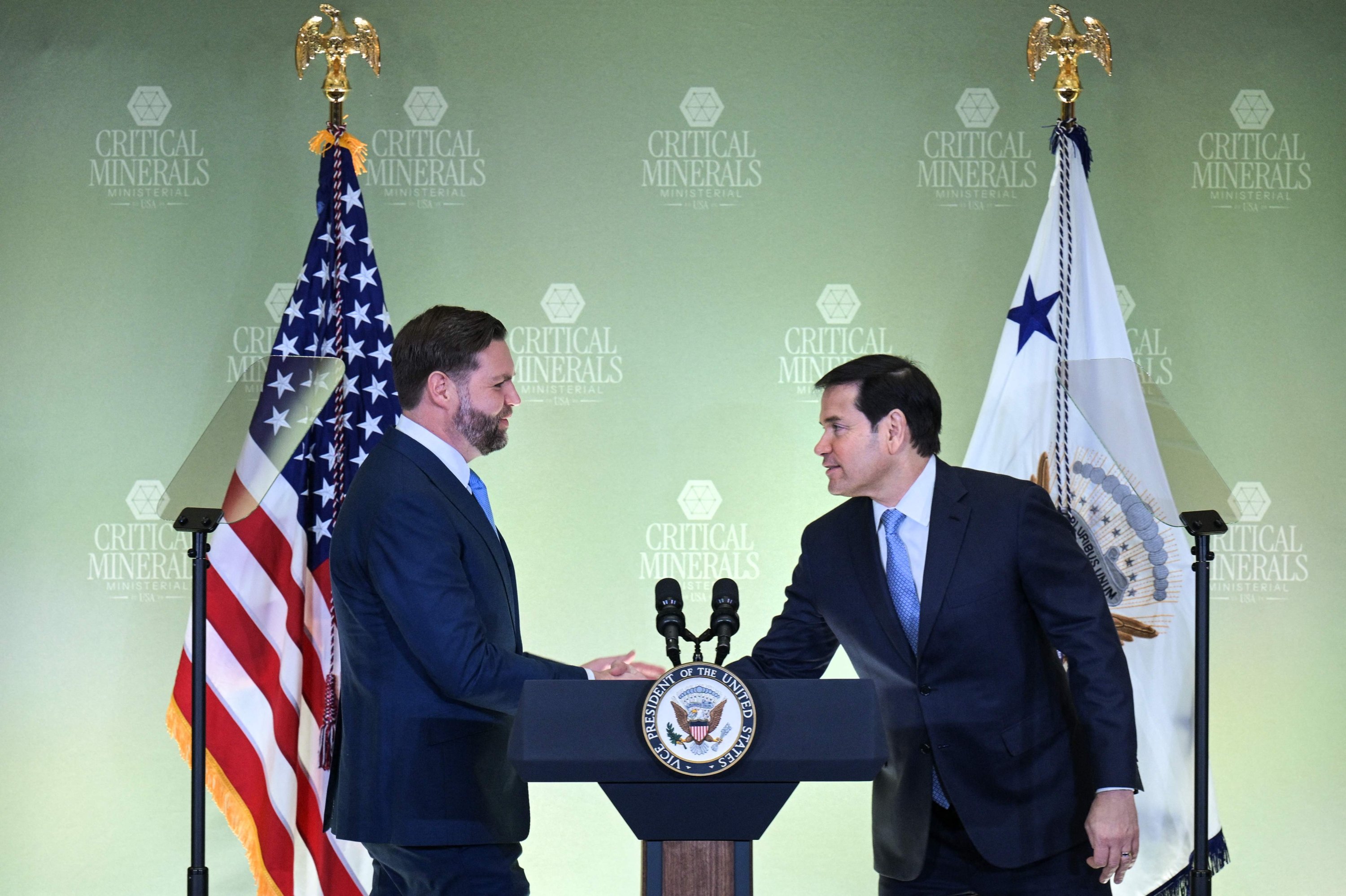
U.S. Vice President JD Vance outlined a plan on Wednesday to marshal allies into a preferential trade bloc for critical minerals, proposing coordinated price floors as Washington intensifies efforts to loosen China's dominance on materials crucial to advanced manufacturing.
China has wielded its chokehold on the processing of many minerals as geo-economic leverage, at times curbing exports, suppressing prices and undercutting other countries' ability to diversify sources of the materials used to make semiconductors, electric vehicles and advanced weapons.
"We want to eliminate that problem of people flooding into our markets with cheap critical minerals to undercut our domestic manufacturers," Vance told a gathering of visiting ministers in Washington without mentioning China.
"We will establish reference prices for critical minerals at each stage of production, ... and for members of the preferential zone, these reference prices will operate as a floor maintained through adjustable tariffs to uphold pricing integrity," Vance said.
U.S. President Donald Trump's administration has stepped up efforts to secure American supplies of critical minerals after China rattled senior officials and global markets last year by withholding rare earths required by American automakers and other industrial manufacturers.
Trump on Monday launched a U.S. strategic stockpile of critical minerals, called Project Vault, backed by $10 billion in seed funding from the U.S. Export-Import Bank and $2 billion in private funding.
U.S. Secretary of State Marco Rubio said 55 countries attended the talks in Washington, among them South Korea, India, Thailand, Japan, Germany, Australia, and the Democratic Republic of Congo, all with varying refining or mining capabilities.
The minerals are "heavily concentrated in the hands of one country," Rubio said, without referencing China, adding that the situation had become a "tool of leverage in geopolitics."
At the meeting, U.S. Trade Representative Jamieson Greer announced a bilateral plan with Mexico and a trilateral agreement with the European Union and Japan to strengthen critical mineral supply chains and set the stage for a broader agreement with other allies.
The plans aim to explore specific measures such as price supports, market standards, subsidies, and guaranteed purchases to encourage production.
The U.S., EU, and Japan also said they would pursue other avenues, including discussions within the G-7 and the Minerals Security Partnership.
Argentina's foreign ministry separately announced it had agreed on a framework agreement with the U.S. to strengthen and diversify supply chains as the South American nation looks to boost its copper and lithium exports.
A multi-country effort to establish price floors of critical minerals is the Trump administration's latest move to exert control over private business. The White House has taken stakes in several mineral companies as well as chipmaker Intel and has negotiated deals with drugmakers for lower prices.
Shares of mineral companies plunged on news of the trade bloc. MP Materials, Critical Metals, NioCorp Developments, and USA Rare Earth posted losses ranging from 6% to 14%.
By guaranteeing minimum prices through coordinated trade rules, Washington hopes to unlock private investment in mining and processing projects that have struggled to compete with cheaper Chinese supply.
Administration officials recently told the industry the U.S. is moving away from granting price floors to individual domestic projects as it seeks a global solution.
The approach could reshape global supply chains for materials essential to electric vehicles, semiconductors and defense systems, while raising costs for manufacturers in the short term and escalating trade tensions with Beijing.
"China has long played an important and constructive role in keeping the global industrial and supply chains of critical minerals safe and stable and is willing to continue to make active efforts in this regard," China's embassy in Washington told Reuters when asked about the meeting.
China's expanded export controls on rare earths last year caused production delays and shutdowns for auto manufacturers in Europe and the U.S., and a China-generated glut of lithium has stalled plans to expand production in the U.S.
Such dependencies have unnerved Washington and its partners, which have struggled for years to implement policies to stand up durable domestic mining and processing alternatives for lithium, nickel, rare earths and other critical minerals.
Trump, who is expected to visit China in April, posted on Truth Social that he had an "excellent" call with Chinese President Xi Jinping on Wednesday morning to discuss a range of trade and security issues from soybeans to Iran, but he made no mention of minerals.
China's leverage over critical minerals was on full display in October when Trump agreed to trim tariffs on Chinese goods in exchange for Beijing's pledge to hold off on stricter restrictions on rare earths exports.
Wednesday's gathering underscores a broader U.S. push to work with partners to counter China's dominance in the sector by coordinating policy tools at a time when Trump has angered allies with his sweeping "America First" tariff policies.
"I think this is a recognition by the United States that it must act in concert with others to reduce its vulnerability in areas where China has supply dominance," said Scott Kennedy, who leads the Chinese business and economics program at the Center for Strategic and International Studies in Washington.
Interior Secretary Doug Burgum said on Tuesday that 11 more countries would be named to a critical minerals trade club this week, joining the U.S., Australia, Japan, South Korea, Saudi Arabia and Thailand. He said 20 more countries showed "strong interest" in joining the coalition.