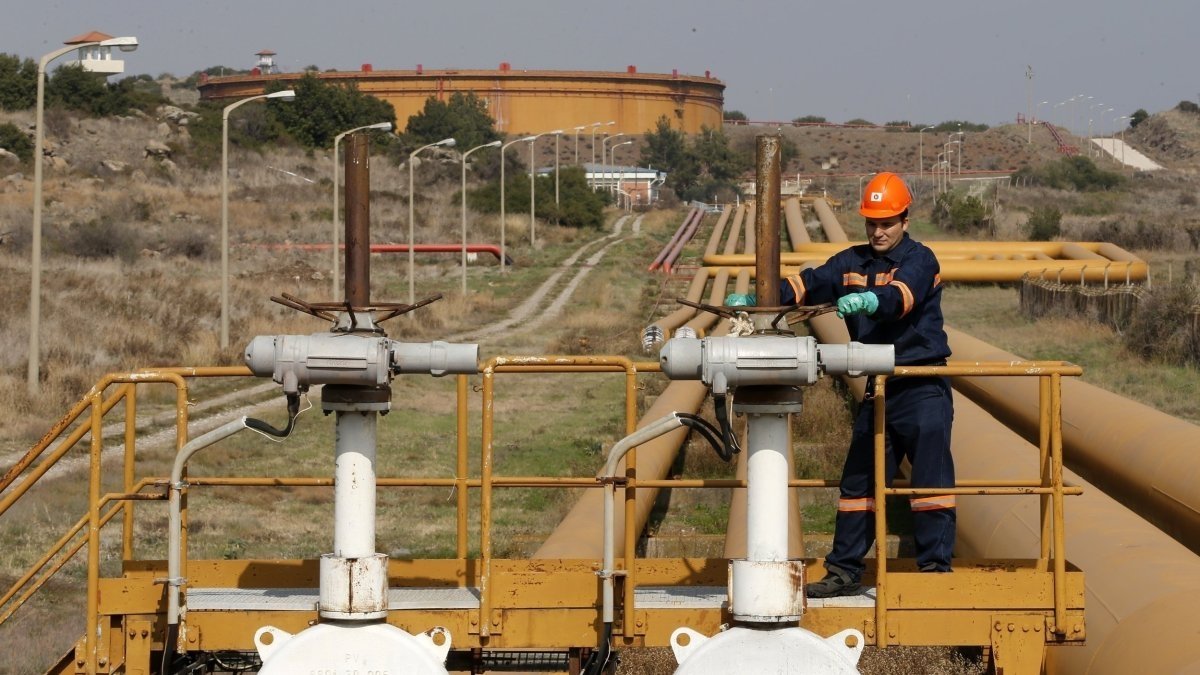
Iraqi authorities announced on Wednesday the resumption of oil exports of 250,000 barrels per day (bpd) from Kirkuk fields through the Turkish port of Ceyhan after Baghdad and Iraq's northern semi-autonomous region agreed on Tuesday to restart flows.
Oil prices have retreated slightly in response to the development, providing modest relief to global markets concerned about supplies from the Middle East.
Brent crude futures fell to around $102 per barrel early on Wednesday, reversing gains from the previous session despite new attacks by Iran in response to the killing of Ali Larijani, a key figure in the country’s wartime leadership.
Iraq’s federal government and the Kurdistan Regional Government (KRG) have reached an agreement for shipments "after a period of suspension that posed a significant challenge to the oil sector," the Iraqi Ministry of Oil said, according to the statement shared by the Iraqi News Agency on Wednesday.
A founding member of the Organization of the Petroleum Exporting Countries (OPEC) cartel, crude oil sales make up 90% of Iraq's budget revenues.
Before the outbreak of war on Feb. 28, Iraq mainly shipped its oil, roughly 3.5 million barrels per day, from the southern Basra fields via the Strait of Hormuz. However, the country's output plunged due to disruptions in the Strait of Hormuz.
The state-owned North Oil Company said on Wednesday it "has begun operating the Sarlo pumping station to resume pumping and exporting Kirkuk oil to the port of Ceyhan with an initial capacity of 250,000 barrels per day."
Iraq resumed oil exports from its fields in the northern Kirkuk province "after a disruptive period that posed a significant challenge to the oil sector," and in agreement with the KRG, through which the pipeline to Türkiye's port of Ceyhan runs.
Iraq has been scrambling to find a solution to export its oil, and there have been long-running talks with the KRG authorities to ship it through the region.
KRG Prime Minister Masrour Barzani also confirmed that an agreement had been reached with Baghdad to send Iraqi oil to Türkiye via the region.
"Discussions with Baghdad will continue to urgently lift restrictions on imports and trade to the region, and to provide the necessary guarantees to oil and gas companies to ensure they can resume production in a safe environment," he said in a post on X.
The KRG sources told Agence France-Presse (AFP) that the Sarlo oil station began operating at 6:30 a.m. (3:30 a.m. GMT) to enable exports via the pipeline passing through the KRG region to the port of Ceyhan.
North Oil Company sources separately told Reuters that crude exports from Kirkuk fields to Ceyhan port resumed via the pipeline.
Iran has closed the Strait of Hormuz, through which as much as a fifth of the world's global crude oil and liquefied natural gas (LNG) is normally shipped, to vessels from most countries after the outbreak of the conflict with the U.S. and Israel.
The U.S. has since also stepped up efforts to push for the reopening of the strait, though allied nations have so far rejected President Donald Trump’s call to help safeguard shipping through the narrow waterway.
Still, Iran has allowed safe passage for some vessels depending on their affiliations.
Iraq's Oil Minister Hayan Abdel Ghani said his country was in contact with Iran to try to arrange passage for some of its oil tankers through the waterway.
The Turkish energy minister also confirmed the resumption of flows from Iraq in a live interview on Wednesday.
"Oil flow from Iraq to Türkiye has now begun. The flow will be approximately 170,000 to 240,000 to 250,000 barrels per day. I'm talking about daily flow. But the capacity of this pipeline is 1.5 million barrels," Energy and Natural Resources Minister Alparslan Bayraktar told the private NTV broadcaster.
"We have been saying this for years, asking where Iraq will export its oil if the Strait of Hormuz is closed. We proposed extending the pipeline, which currently goes to Kirkuk, to Basra," he said.
Earlier on Tuesday, the Iraqi presidency urged both the Iraqi federal government and the KRG to cooperate to resume crude oil exports, a presidency statement said.
Iraq's parliament also called on the federal government to find outlets for Iraqi crude to avoid economic damage as a result of the current security conditions, the state news agency reported.
The parliamentary decisions appeared aimed at reinforcing Baghdad's authority over the country's oil sector and followed a meeting late on Tuesday with the oil minister to assess the impact of halted oil exports from the closure of the Strait of Hormuz.
In a statement, parliament said it was prepared to approve any measures needed to support that effort and called on the federal government to assert control over all sources of oil production, transport and distribution.
Oil production from Iraq's main southern oilfields, where most of its crude is produced and exported, has plunged 70% to just 1.3 million barrels per day, sources told Reuters on March 8.
Iraq's Oil Ministry sent a letter in early March to the KRG seeking permission to pump at least 100,000 bpd of crude from Kirkuk oilfields through the pipeline network to Türkiye's Ceyhan energy hub, two oil officials told Reuters last week.