Saudi Arabia's Saudi Aramco, the world's biggest oil exporter, warned on Tuesday that global oil markets could face "catastrophic consequences" if the Iran war continues to disrupt tanker traffic through the Strait of Hormuz.
Oil shipments have been largely blocked from traversing through the shipping artery, where, normally, roughly 20% of the world's oil would pass daily. Iran's Revolutionary Guards said on Tuesday they would not allow "one liter of oil" to be shipped from the Middle East if U.S. and Israeli attacks continue.
"There would be catastrophic consequences for the world's oil markets and the longer the disruption goes on ... the more drastic the consequences for the global economy," Aramco CEO Amin Nasser told reporters on an earnings call.
"While we have faced disruptions in the past, this one by far is the biggest crisis the region's oil and gas industry has faced."
The crisis has not only upended the shipping and insurance sectors but also promises to have drastic domino effects on aviation, agriculture, automotive and other industries, he added.
Global crude benchmark Brent, which rocketed to a more than three-year high of nearly $120 a barrel on Monday, was trading around $92 on Tuesday following comments by U.S. President Donald Trump predicting the war could end soon.
Trump warned that the U.S. would hit Iran much harder if it blocked exports from the vital energy-producing region.
He has also said the U.S. Navy could escort ships in the Gulf to guarantee safe passage. But the Navy's capacity to do that is unclear, with some vessels engaged in carrying out strikes against Iran and shooting down its missiles.
Asked about U.S. Navy escorts and whether they were possible on the scale required, Nasser said there are sizable volumes involved, adding that Aramco's customers assume the risk of delivery.
"Of course, we would support any actions or measures that would help to deliver our products to our customers, to the global market," he said.
Another top Gulf energy official, however, expressed skepticism over the idea, saying that stopping the war was the only solution to reopen the strait for oil and gas exports.
Nasser noted global inventories of oil were at a five-year low and said the crisis will lead to drawdowns at a faster rate, adding that it was critical that shipping in the strait resumed.
"Unfortunately, for global markets, most of the spare capacity is in this region," Nasser told analysts on a call, noting that incremental demand throughout the year will keep the market tightly balanced.
At present, Aramco is not exporting oil from the Gulf as ships cannot load cargoes there. But the company, which does not disclose its exact crude output, is meeting the majority of its customers' needs, he said, partly by tapping into global inventories.
"Now, that cannot be used – that inventory – for an extended period of time, but for the time being, we are capitalizing on it," he said.
The East-West pipeline is being used to transport Arab Light and Arab Extra Light crude grades to the Red Sea port of Yanbu. The pipeline is expected to reach its full capacity of 7 million barrels per day in the next couple of days as customers reroute, he added.
"Even with our ability to export through the western region, you're talking about close to 350 million barrels of disruptions that will come off the market," he said.
In addition to the pipeline, Aramco is also able to direct crude toward domestic demand, he noted. Close to 2 million bpd of the pipeline's 7 million bpd capacity is going to western domestic refineries, which are net exporters of products, Nasser added.
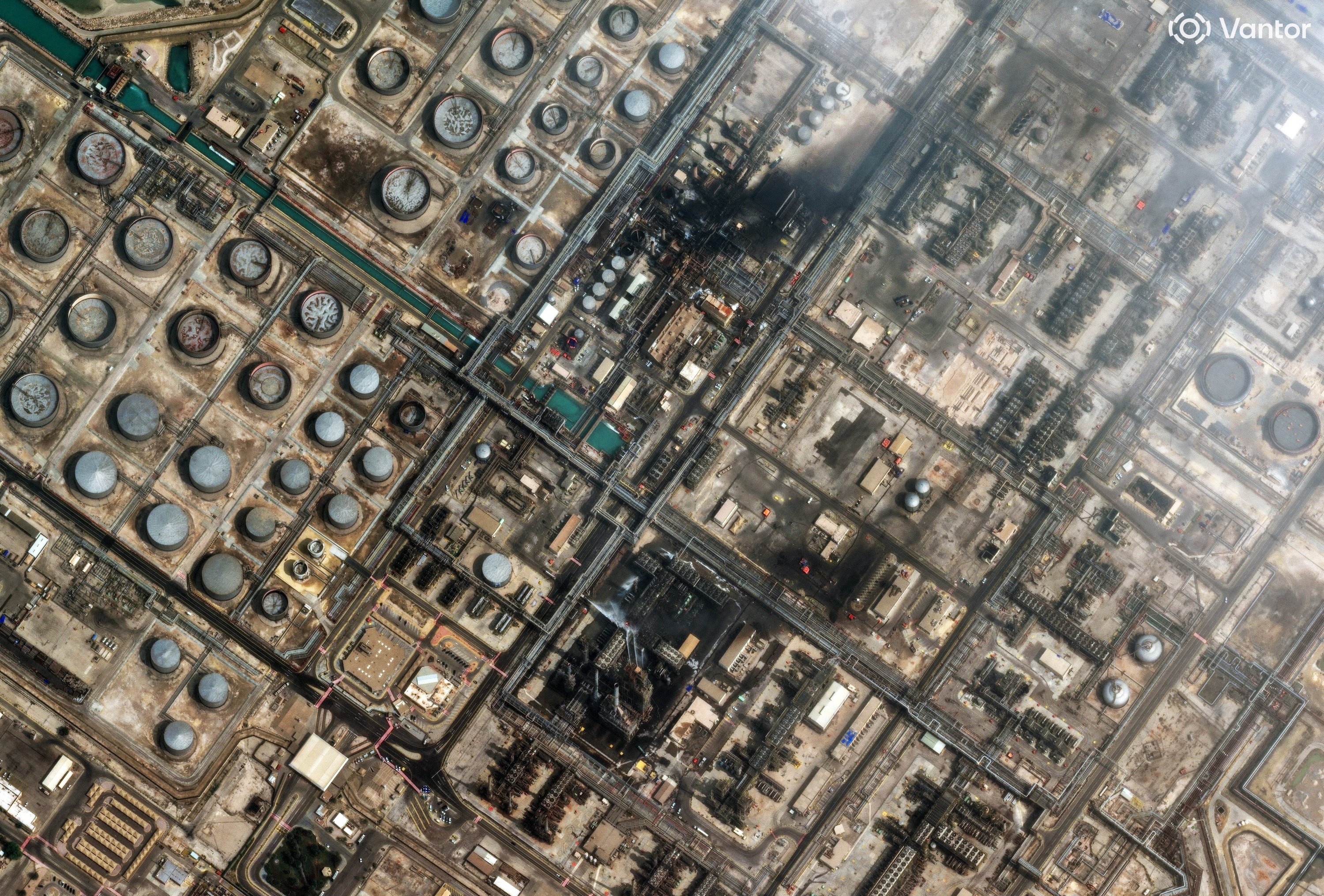
Since the U.S. and Israel launched strikes on Feb. 28, Iran has fired at energy installations across the Gulf, including Aramco's sprawling Ras Tanura facility, which halted some operations after being targeted by drones.
Nasser said a small fire from the attack last week was quickly extinguished and brought under control, adding that the refinery was in the process of being restarted.
The massive complex on the Gulf coast is home to one of the Middle East's largest refineries and is a cornerstone of the Saudi energy sector. Saudi oil fields have also been targeted in Iran's reprisal attacks.
Nasser's comments come after Aramco reported a 12% drop in annual profit in 2025, mainly due to lower crude prices. It also announced it would repurchase up to $3 billion worth of shares in its first-ever buyback.
The company said its net income reached $93.38 billion, compared to $106.24 billion in 2024.
Stripping out exceptional items, adjusted net income was $104.65 billion in 2025 compared to $110.29 billion in 2024, a slide of 5.1%.
However, Nasser said in a statement: "Following another year of record oil demand in 2025, we believe ongoing investments in our operations position us well for the future."