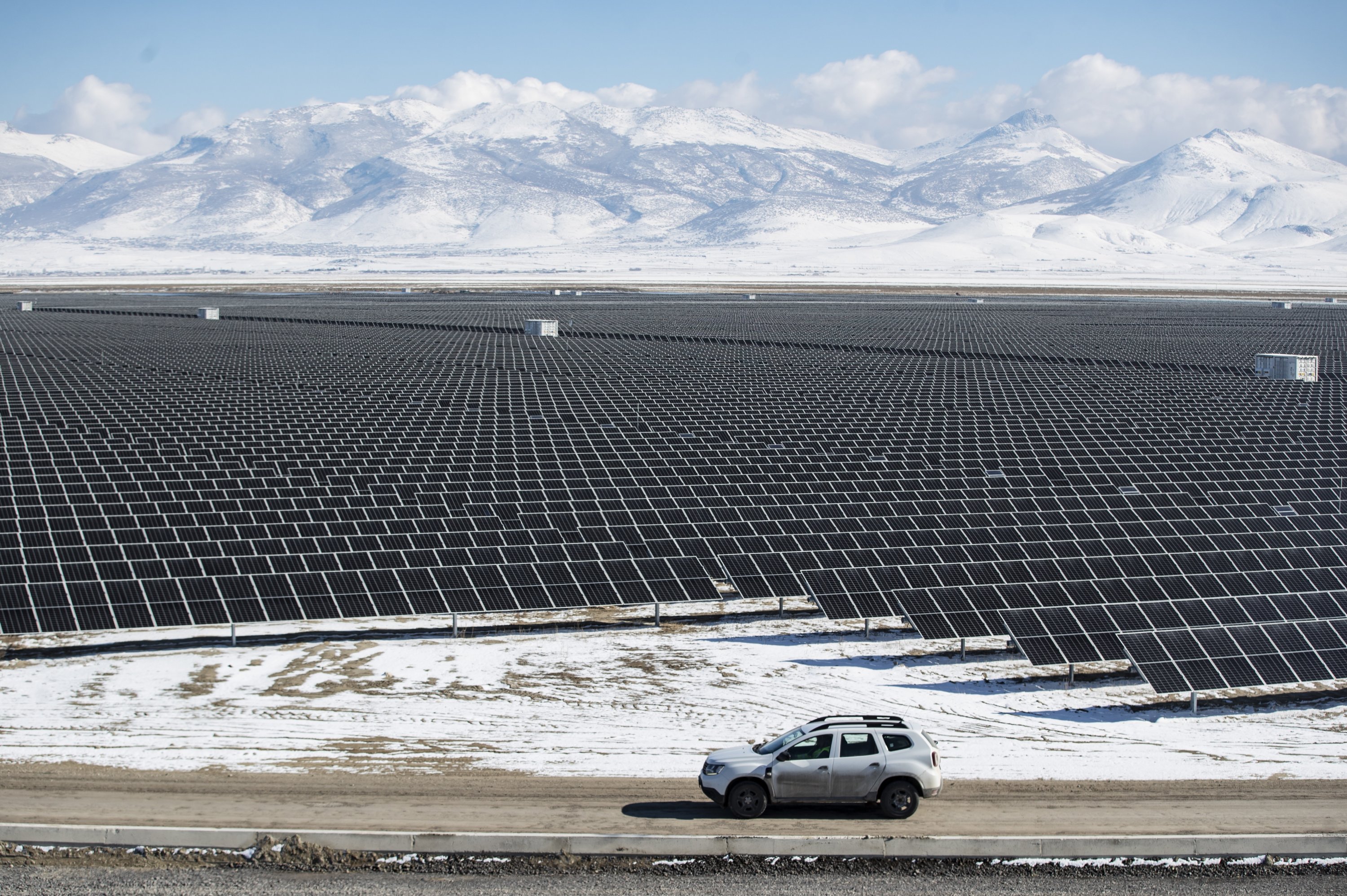
Türkiye on Tuesday awarded contracts for the construction of solar power plants with a total installed capacity of 800 megawatts (MW), which are estimated to bring in about $500 million in investment.
The tenders under the Renewable Energy Resource Zone (YEKA) auction mechanism cover six plants in central Konya, south-central Karaman, southern Antalya, eastern Malatya and Van, and western Kütahya provinces.
The winning companies will have the right to sell the electricity they produce at a fixed price in foreign currency for 20 years.
At the tender, the initial price for the sale of electricity was set at $5.5 cents per kilowatt/hour. However, all the bids ended up at a minimum price of $3.25 cents per kilowatt/hour, half of the current electricity price in the free market.
The YEKA scheme was introduced in 2016 to facilitate land allocation for investors, ease the deployment of large projects and encourage the domestic production of renewable energy technologies.
The largest two solar plants have been awarded to Kalyon and Temmuz Güneş. Kalyon will build a 385 MW plant in Konya, while the latter won the right to construct a 200 MW plant in Karaman.
The government unveiled updates to the YEKA model in 2024 to draw greater investor interest. Key enhancements included simplifying post-tender permitting procedures and introducing financial incentives like exemptions from transmission fees.
All parties will make a one-time payment for each MW capacity of the solar plant they will establish, ranging between $67,000 and $270,000. Approximately $101 million in total is expected to be paid to the Energy and Natural Resources Ministry for the rights to build the plants.
According to the Energy Ministry, an investment of approximately $500 million will be made for the implementation of the plants.
The electricity produced will prevent the import of approximately 280 million cubic meters of natural gas annually, reducing energy imports by $140 million at current prices.
Türkiye has limited oil and natural gas resources and suffers from a high current account deficit due to vast energy imports.
It has been incentivizing private sector investments in renewable power plants since 2005 to reduce its high import bill and insulate itself from geopolitical risks.
While Türkiye's electricity consumption has tripled in the last two decades, it is expected to increase even faster in the coming years due to the long-term energy transformation, which involves replacing fossil fuel energy with electricity.
A week ago, Türkiye completed tenders to allocate 1,200 MW of wind energy power plants, which are envisaged to bring in $1.2 billion in investment.
Once completed, these plants will increase Türkiye's wind and solar installed capacity, currently standing at around 32,000 MW, by 6.3%.
The government plans to lift this figure to 120,000 MW by 2035. The Energy Ministry aims to hold YEKA auctions of at least 2,000 MW annually.
Under the YEKA scope, about 5,850 MW of solar and wind energy tenders have been conducted to date. Some of the projects have been canceled, some have been completed, and some are in the investment phase.