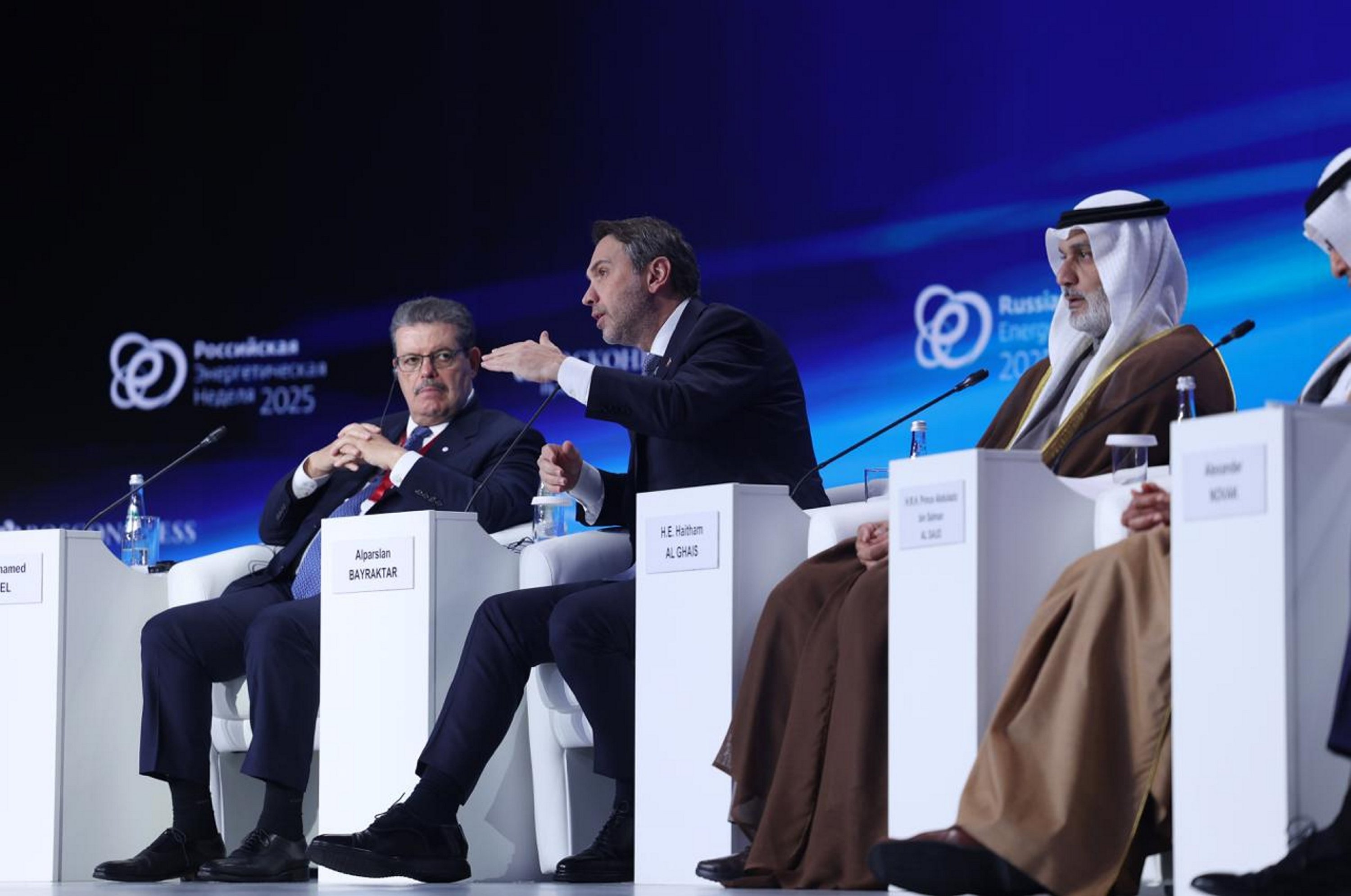
Türkiye is pursuing a comprehensive, pragmatic and flexible "Turkish way" in its energy strategy to meet the rapidly growing demand over the next three decades, Energy and Natural Resources Minister Alparslan Bayraktar said Wednesday, highlighting major investments in renewable energy, nuclear power and natural gas diversification.
Türkiye's power consumption has tripled in the last two decades and is expected to increase even faster in the coming years due to the long-term energy transformation, which involves replacing fossil fuel energy with electricity.
The global energy landscape has become increasingly uncertain, making secure and affordable energy access a growing challenge, Bayraktar told a session on the sidelines of the Russian Energy Week in Moscow.
"Providing reliable energy at an affordable cost is becoming increasingly difficult because we face so much uncertainty," he said, according to a Turkish transcript of his speech cited by Anadolu Agency (AA).
"Look at the last five years – COVID-19, supply chain disruptions, volatility in commodity markets, trade wars, conventional wars and geopolitical tensions across the world. In such an environment, investing in the energy sector has become far more difficult," Bayraktar noted.
In this volatile global context, Bayraktar says Türkiye has charted its own path, calling it "the Turkish way."
"Our goal is to meet our energy demand, reduce import dependency and become a carbon-neutral country by the middle of the century. This is one of the greatest challenges ahead. Our energy policy is shaped in line with these objectives," he said.
"That's why I call it the Turkish way. We adopt an inclusive and adaptable approach. We do not exclude any source of energy. We must be open to all fuels and sources while maintaining the flexibility to adjust our policies as market dynamics evolve, and of course, we must be rational."
Türkiye has limited oil and natural gas resources and suffers from a high current account deficit due to vast energy imports. It has been incentivizing investments in renewable power plants and has sought to develop domestic resources and expand international partnerships in oil and gas exploration.
Its energy policies are based on rational decision-making rather than ideology, according to Bayraktar, who said that electricity demand is projected to triple over the next 30 years under conservative forecasts.
The demand will be driven by electric vehicles, transportation, artificial intelligence data centers and cooling systems, which means Türkiye will need every available source of energy, the minister said.
The country aims to quadruple its solar and wind capacity to at least 120 gigawatts by 2035 while fully utilizing its renewable resources and investing heavily in nuclear power generation. It currently has around 36 gigawatts (GW) of installed wind and solar capacity.
"We are making major investments in renewables. Every year, Türkiye adds 8 to 9 GW of renewable capacity," said Bayraktar. "We aim to increase this to 120 gigawatts by 2035, but at the same time, we are also investing in nuclear energy."
Türkiye plans to build three conventional plants. The first one, Akkuyu, is being built by the Russian conglomerate Rosatom in the southern province of Mersin.
The $20 billion, 4.8 GW, four-reactor Akkuyu will bring Türkiye into the small club of nations with civil nuclear energy. Once fully operational, it is expected to generate around 10% of Türkiye's electricity.
The first reactor is set to go online next year, Bayraktar said.
"We will not stop there," he added. "We need to build at least 12 large-scale conventional reactors and about 5 GW of small modular reactors (SMRs)."
"While placing renewable sources at the center of our energy system, we are also incorporating nuclear into our energy mix," Bayraktar noted.
The country aims to reach 7.2 GW of nuclear capacity by 2035 and 20 GW by 2050. It plans to build the second and third plants in the northern Sinop and Thrace regions.
Türkiye has also made major progress in natural gas and oil infrastructure, transforming itself from an importer to a regional gas exporter, according to Bayraktar.
Since 2016, Türkiye has expanded its liquified natural gas (LNG) regasification capacity from 32 million cubic meters per day to 161 million, while constructing new domestic and international gas pipelines, including TurkStream and Trans-Anatolian Natural Gas Pipeline (TANAP).
Investments over the years have enabled Türkiye to reach the capacity where it can now procure energy from many countries, said Bayraktar.
Over the past five years, Türkiye has discovered 785 billion cubic meters (bcm) of natural gas in the Black Sea, the largest in the country's history.
Gas from the Sakarya field has been flowing to shore through the Filyos processing plant since last year. It now meets the needs of 4 million households. That is projected to rise to 8 million in 2026 and 16 million by 2028.
"Our annual gas demand is about 60 billion cubic meters," Bayraktar said. "That's why we are focusing on exploration and production in the Black Sea, where output is steadily increasing. We aim to produce 16 billion cubic meters of gas by 2028."
Bayraktar said Türkiye is also working with international oil and gas companies in regions ranging from Pakistan and Libya to Somalia, Iraq and the Caspian Sea, while strengthening its LNG partnerships with major suppliers. "The majority of global LNG supply essentially comes from North America, Mozambique, Australia and Russia," he said.
Bayraktar underlined Türkiye's growing role as a bridge for European energy security, citing TANAP, which carries gas from the Caspian Sea to Europe, and the TurkStream pipeline.
"LNG provides us with great flexibility and competitiveness," he said. "When this abundant LNG supply is integrated into our energy mix, we will see more competitive prices in the market. We will be able to offer affordable gas to our citizens."
Through what he called the "Turkish blend" model, created by mixing gas from different countries, "we will be able to export this surplus gas, especially to Southeast European markets, where there is a significant need for gas."
However, he said energy cooperation must be mutual, calling on Europe to expand interconnection capacity and deepen its engagement.
"A similar approach is needed on the European side as well. In addition to oil and natural gas, the goal is to increase electricity interconnection capacity between Türkiye and Europe," said Bayraktar.
"There is much that can be done in this area, but strong political will and determination are essential."