Türkiye is expanding its cooperation with major international energy companies as it seeks to transform its national oil company, the Turkish Petroleum Corporation (TPAO), into a more globally active player and reduce reliance on imported hydrocarbons, according to experts.
The strategy reflects Ankara’s broader effort to diversify energy partnerships, access advanced technology and improve operational efficiency while increasing domestic oil and natural gas production.
In addition to working in domestic fields such as the Sakarya Gas Field in the north of the country and oil production at the Gabar site, Türkiye is now increasing its activity in cross-border exploration and production areas through these agreements.
Brenda Shaffer, a professor at the U.S. Naval Postgraduate School, said that diversification is a key principle of effective energy policy.
“Türkiye applies this to all its energy security policies: a diverse fuel mix and diverse suppliers of energy, especially natural gas,” Shaffer told Anadolu Agency (AA) in remarks published on Thursday.
She said Ankara is applying the same approach in its engagement with global oil and gas majors.
By partnering with multiple international firms, Türkiye gains access to advanced technology while avoiding dependence on a single company, she added.
“I assess that Ankara wants to turn its national energy companies into international energy companies, active in diverse locations around the globe,” she said. “The cooperation with international energy companies helps to facilitate this goal.”
Shaffer also opined that Türkiye may offer advantages to foreign firms operating in complex regions.
“Türkiye can also open up and manage better than the international companies on their own in challenging geographic locations where Türkiye has a strong diplomatic and/or military presence,” she said.
Furthermore, she suggested that cooperation with Chevron in the Eastern Mediterranean could carry both technological and strategic benefits.
Chevron is one of the several companies with which Türkiye signed a memorandum on cooperation in the energy field in recent months.
“Chevron operates in several countries in the Eastern Mediterranean, including Israel. That creates opportunities to avoid conflict while advancing exploration,” Shaffer said, adding that international partnerships could increase the likelihood of discoveries.
John Roberts, a senior fellow at the Atlantic Council, said Türkiye’s renewed emphasis on joint ventures reflects lessons learned from developing the Sakarya Gas Field in the Black Sea.
“Joint ventures with big companies are very good and practical. It's particularly appropriate in the Black Sea, where Türkiye will primarily be looking for the quickest return,” Roberts said.
He described the Black Sea as an emerging energy province, citing Romania’s Neptun Deep project and Türkiye’s Sakarya field.
Türkiye currently meets about 90% of its oil and natural gas demand through imports. According to Sohbet Karbuz, director of oil and gas at the Mediterranean Organization for Energy and Climate, exploration activity remains limited relative to the country’s geological potential.
“The oil and gas exploration campaign is very important for Türkiye’s energy security and future,” Karbuz said, noting that only about one-fifth of onshore areas and roughly 1% of offshore territory have been explored.
He said cooperation with international energy companies, which bring financial strength, technical expertise and operational experience, could help unlock new reserves while supporting TPAO’s ambition to expand abroad.
Against this backdrop, TPAO has signed a series of agreements in recent months.
On Wednesday, TPAO signed an agreement with Shell to jointly explore for oil and gas in the Khan Tervel field in Bulgaria’s Black Sea waters.
Prior to that, the company signed a memorandum of understanding with BP on Feb. 12 to enhance regional and international cooperation in hydrocarbons.
Energy and Natural Resources Minister Alparslan Bayraktar said the agreement primarily focuses on projects in Iraq, particularly in Kirkuk, while also considering opportunities in Libya, Kazakhstan and Azerbaijan.
Also, under a Feb. 5 memorandum with Chevron, TPAO plans to pursue joint exploration and production projects in potential fields in Türkiye and abroad.
An earlier agreement signed Jan. 8 with ESSO Exploration International Limited, a subsidiary of ExxonMobil, targets cooperation in the Black Sea and Mediterranean, as well as other mutually agreed international areas.
Last year, TPAO also signed a joint venture with TransAtlantic Petroleum and Continental Resources to develop unconventional resources in the southeastern province of Diyarbakır.
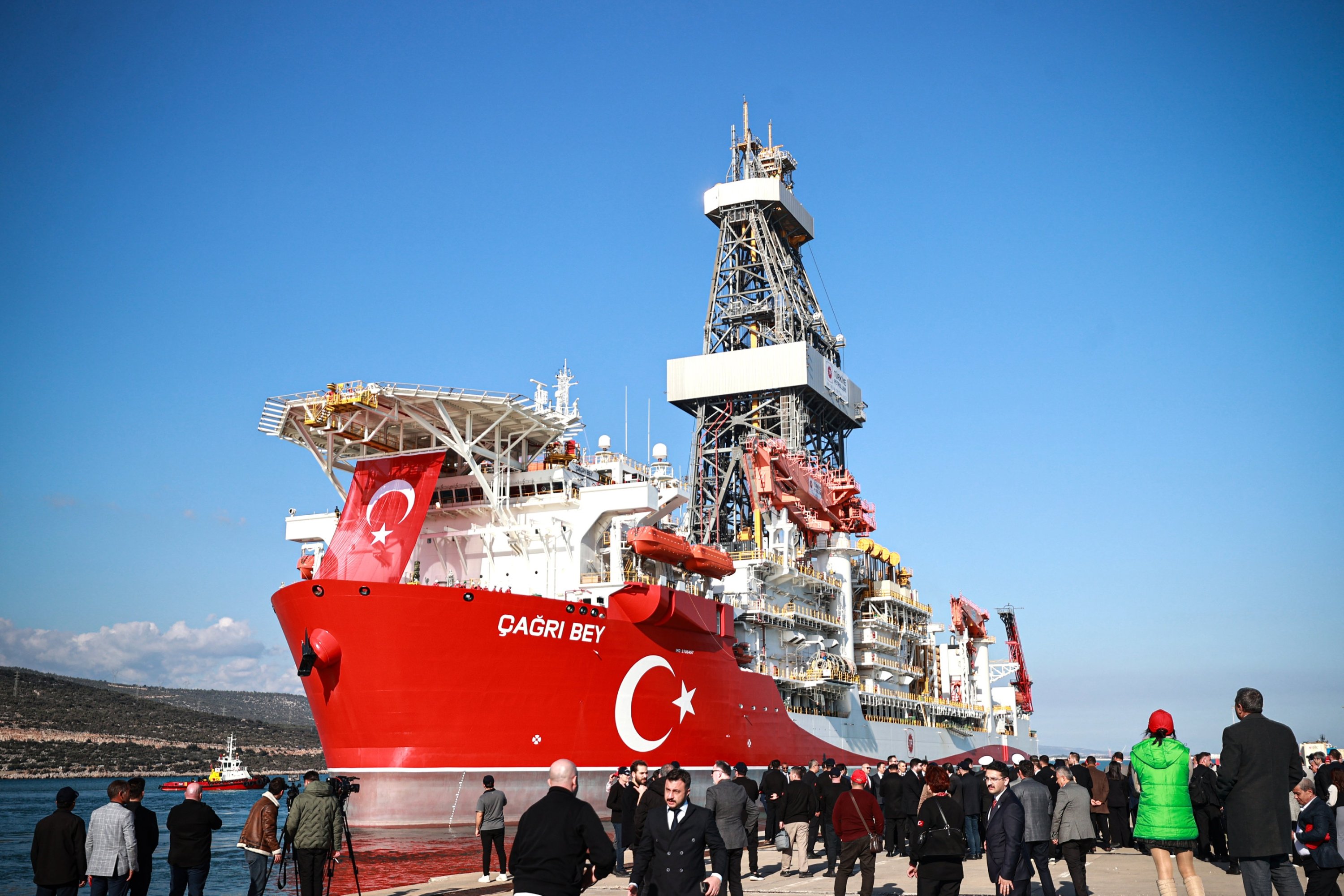
At the same time, the company is expected to begin offshore drilling in Somalia in April, following previous seismic surveys. On Sunday, Ankara sent its new drillship Çağrı Bey to Somalia as part of what officials described as a "historic moment" and the first offshore exploration mission outside its maritime zone.
It also plans hydrocarbon exploration in two blocks in Libya through partnerships with Repsol and MOL, and in five fields in Pakistan.
Domestically, Ankara is ramping up exploration and production at the Sakarya Gas Field in the Black Sea and in the Gabar region in southeastern Türkiye.
TPAO aims to increase output from roughly 300,000 barrels of oil equivalent per day to 500,000 by 2028 and 1 million in the longer term.
Analysts say whether the strategy succeeds will depend on translating partnerships into tangible production gains.
“If it can deliver actual results in terms of increased production, particularly increased production of oil, then that has a significant effect because it reduces Türkiye's need to import,” Roberts said.
He added that cooperation with major firms could also support Ankara’s longer-term ambition to evolve from an energy transit country into a genuine energy trading hub.