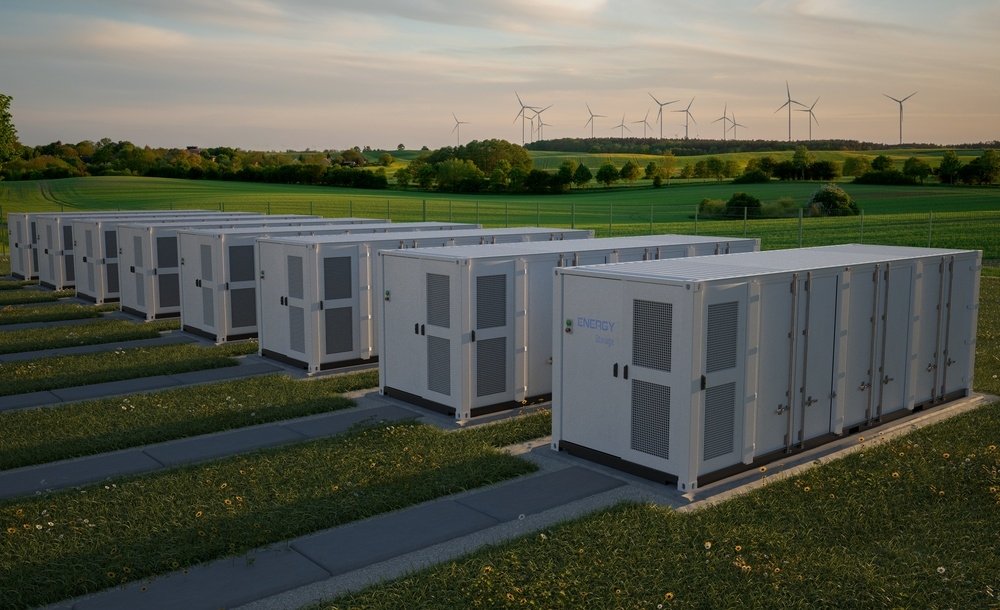
Disruptions in global energy supply caused by the war between the U.S., Israel and Iran have strengthened the strategic role of battery energy storage systems (BESS), with Türkiye standing out in Europe in this regard, according to a report on Sunday.
Following the attacks launched by the U.S. and Israel against Iran on Feb. 28, ship passages through the Strait of Hormuz were largely disrupted. The disruption at this critical point, through which approximately one-fifth of the world's oil and liquefied natural gas (LNG) trade passes, increased uncertainties and made energy security risks more visible.
In this process, it has become clear that not only the diversity of resources but also the continuity of supply chains and system resilience are decisive in energy security. Accordingly, energy storage systems have come to the forefront as a critical infrastructure element that bolsters the flexibility of electricity systems against supply shocks and supports grid stability.
Likewise, as the variability of production increases with the rise of renewable energy investments worldwide, managing the supply-demand balance becomes more important, while battery storage systems play a key role in maintaining this balance.
Notably, storing electricity generated during periods of low demand and supplying it to the system when needed supports energy security and the sustainability of the transition.
Global battery storage capacity is expected to increase 14 times compared to 2023 and reach 1,200 gigawatts (GW) in 2030, a report by Anadolu Agency (AA), citing data from the International Energy Agency (IEA), said.
At the same time, investments are expected to increase by 400%.
Looking at this field, Türkiye draws particular attention with its comprehensive plan.
According to think tank Ember, Türkiye stands out in Europe in battery projects that will increase grid security by supporting the growing share of wind and solar energy in production. To date, Türkiye has allocated 33 gigawatts of project capacity, corresponding to 83% of its existing solar and wind capacity, Ember suggested in a recent report.
Can Tutaşı, chairperson of the board of the Energy Storage Systems Association (EDSIS) said that due to geopolitical developments, the issue of energy supply security has once again become one of the priority agenda items for countries.
Tutaşı, in his assessment to AA, stated that renewable energy, which reduces external dependency and provides resilience against supply shocks, plays a critical role in countries' energy security strategies, but that the production of these resources is inherently variable.
Pointing to the importance of continuity in energy supply, Tutaşı said that with battery storage systems integrated into renewable energy, electricity can be stored and supplied back to the grid when needed, thereby strengthening energy supply security.
Tutaşı noted that recent geopolitical developments have made the strategic importance of the sector more visible and that market reactions have also demonstrated this.
"Following the start of tensions between the U.S., Israel and Iran, there was an increase of approximately 20% in the market values of major Chinese battery manufacturers. This increase corresponds to a value of approximately $70 billion," he noted.
"This rise, which occurred in a very short time, shows how strategic battery technologies have become in a period when energy supply security has once again come to the forefront," he added.
Moreover, he pointed out that the process has not yet had a major impact on the battery supply chain, adding: "There is currently no bottleneck in the supply chain, but this does not mean that there will not be one in the future."
Drawing attention to the fact that electricity systems are increasingly transforming into a more distributed structure, Tutaşı said that rooftop solar power plants, where electricity is generated at the point of consumption, electric vehicles, and battery systems of different scales have become important parts of this structure.
Emphasizing that countries that have taken rapid action on batteries share a common point in that they need batteries on a large scale to manage this distributed structure, Tutaşı said that Türkiye is also among these countries.
Also explaining that as renewable energy increases in Türkiye, system management also becomes more critical, Tutaşı elaborated on steps taken so far in this direction.
"In order to manage possible risks, the foundations of the storage regulation were laid in 2022," he said.
"Installations have now begun, and the first battery systems were commissioned in 2025. Our goal is to reduce the negative effects on the grid by making renewable energy power plants battery-supported," he added.
Referring to the 33,000 megawatts of storage capacity allocated to date, Tutaşı said this is a "very large amount."
"Domestic investors were very eager. Indeed, applications were made for approximately 10 times the capacity. Although we are still at the beginning of capacity installations, 2026 will be a critical turning point for the sector," he furthered, adding that it will be a period of investment and commissioning.
"We expect that a portion corresponding to approximately 10% of the 33,000 megawatt capacity, that is 2,000-3,000 megawatts, will be commissioned in 2026."
Furthermore, referring to the interest of foreign investors, Tutaşı conveyed that investors and technology manufacturers from many countries, especially China and Europe, have started to closely follow the Turkish market.
Pointing out that a large portion of global battery production is concentrated in Far Eastern countries, Tutaşı said they have also initiated a process of technology and knowledge transfer from these centers to Türkiye.
"Today, efforts are underway in our country for domestic battery cell production. With the integration of these efforts, partially domestic products have begun to be produced," he said.
Separately, in an interview with AA, published on Sunday, Istanbul Chamber of Commerce (ITO) President Şekib Avdagiç also underscored the potential for the production of batteries in Türkiye.
In the statement, Avdagiç said that the Ministry of Industry and Technology's expansion of the definition of critical raw materials to include lithium-ion batteries in the strategic scope reveals how critical the timing is for Türkiye's claim to be a "regional production hub" between Europe and Asia.
Avdagiç stated that the current conjuncture is working in Türkiye's favor, especially at a time when Europe is seeking alternatives to Asian producers.
"The inclusion of lithium-ion batteries in the strategic scope constitutes the most critical pillar of Türkiye's strategy to become a regional hub for battery production."