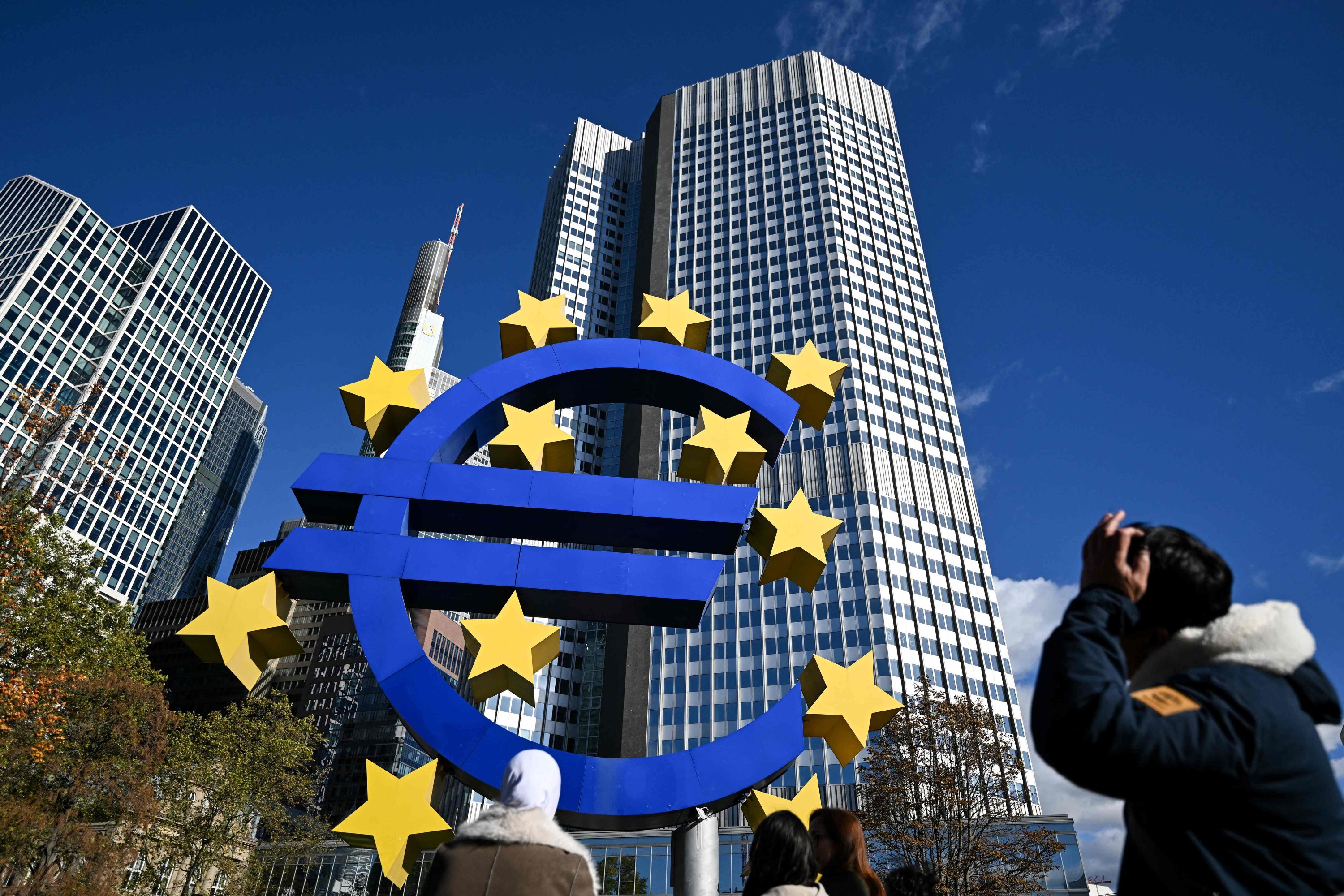
The European Central Bank (ECB) kept interest rates steady on Thursday, in line with market expectations, but warned of an "uncertain" economic outlook amid trade disputes and geopolitical tensions.
Following a year-long series of cuts, the ECB has kept its key deposit rate steady at 2% since July.
Inflation has settled around the central bank's 2% target and Europe has weathered U.S. President Donald Trump's tariff onslaught better than initially feared.
"Inflation remains close to 2% medium-term target and the Governing Council's assessment of the inflation outlook is broadly unchanged," the ECB said in a statement.
"However, the outlook is still uncertain, owing particularly to ongoing global trade disputes and geopolitical tensions," it added.
Officials did little before the meeting to signal that a change in rates was on the cards.
Jose Luis Escriva, Spain's central bank chief and a member of the ECB's rate-setting governing council, told El Diario newspaper in a weekend interview that the "current level of interest rates is appropriate."
ECB officials gathered in Florence, Italy, on one of their regular tours away from the central bank's Frankfurt headquarters, and all eyes will now be on President Christine Lagarde's news conference and any hints on the future trajectory of rates.
In contrast to the ECB, the U.S. Federal Reserve (Fed) has started reducing borrowing costs again, and on Wednesday cut rates for its second straight meeting – by a quarter point – as concerns grow about the cooling labor market.
With the long-struggling eurozone economy on a better footing than some had feared – the ECB raised its eurozone growth forecast for this year at its last meeting in September – there was little immediate pressure for a rate cut.
But the central bank for the 20 countries that use the euro faces headwinds, from the French political crisis that has pushed up borrowing costs in the eurozone's second-biggest economy to the risk of a further flare-up in trade tensions and signs of slowing wage growth.
Such concerns are fueling debate about whether the ECB may need to make more cuts later.
Rate-setters appear "split with regard to the balance of risks to inflation and, therefore, on the need for an 'insurance' cut over the coming few months," UniCredit analysts said this week.
Lithuanian governing council member Gediminas Simkus weighed in on the debate in September, calling for a cut at the ECB's next meeting in December.
"From a risk-management perspective, it's better to cut than not," he said in an interview with Bloomberg, warning of a strong euro and slowing wage growth dragging inflation down.
Andrew Kenningham, an economist at Capital Economics, told Agence France-Presse (AFP) he expected the ECB to cut rates further in 2026 as inflation and wage growth cool.
"There are now very few reasons to fear a resurgence of inflation – the economy remains so weak, the labor market is loosening," he said.
Separately, the ECB said on Thursday it will press ahead with plans to introduce a digital euro by 2029, aiming to offer an electronic alternative to cash and private payment systems across the eurozone.
The introduction of the digital currency is conditional on a legal framework being in place by then.
"If legislation is in place, in the course of 2026, a pilot exercise could start in 2027 and the Eurosystem should be ready for a potential first issuance of the digital euro during 2029," the ECB said in a press release following the meeting of its governing council in Florence.
The euro's monetary authorities have been working for years on a digital means of payment, which would rival private payment systems such as PayPal, Mastercard and Visa.
The digital euro would be stored in a digital wallet and could be used to make payments free of charge in the eurozone in a matter of seconds, either via a smartphone or a card.