Türkiye has announced tax incentives for individuals and companies affected by the Gulf crisis due to the Iran war. It is now preparing a broader package centered on energy continuity and fiscal advantages to attract AI data centers negatively impacted by the Middle East conflict.
The disruption triggered by the Gulf crisis could accelerate AI data center investments in Türkiye. Iran has also reportedly designated 11 U.S. technology companies as targets, including Microsoft, Google, Apple, Meta, Oracle and Nvidia.
Gulf countries had aimed to build a $500 billion ecosystem by 2030 under the Stargate project, leveraging tax incentives and low-cost energy. Regional instability, however, has disrupted those plans.
Between Feb. 28 and March 31, around 500,000 foreign residents reportedly left the region with their families, primarily from Dubai and Doha, while 15,000 companies either suspended operations or relocated to safer jurisdictions.
Companies that move their regional headquarters to the Istanbul Financial Center (IFC) will be granted corporate tax exemptions on profits generated from overseas operations for 20 years.
Foreign professionals who had not resided in Türkiye during the previous three years before relocation will also receive income tax exemptions on foreign earnings for the same period.
If these incentives are followed by AI infrastructure and data center investments, Türkiye could strengthen its appeal as a new technology hub.
The first tangible commitment came from Google Cloud, which signed a deal for a $3 billion hyperscale data center in Ankara, with groundbreaking scheduled soon under a partnership with Turkcell.
The move marked the first major hyperscale cloud investment entering the country.
Meanwhile, Amazon Web Services (AWS) and Microsoft are reportedly reassessing partnership structures and waiting for the most favorable conditions before making commitments.
With energy continuity, infrastructure incentives and tax advantages, Türkiye is increasingly positioning itself as a potential magnet for data center investment.
In recent weeks, Treasury and Finance Minister Mehmet Şimşek said Türkiye is making an intensive effort to attract large-scale data centers, adding that one of the main motivations behind the country's nuclear energy investments is meeting the enormous power needs of such facilities.
A similar message was delivered by Vice President Cevdet Yılmaz at the opening of an AI data center project established through cooperation between NGN and Cerebrum Tech.
Data centers directly influence the technology startup ecosystem. Energy and water consumption are critical factors in such investments, as large-scale facilities require vast electricity resources alongside intensive cooling systems.
Wherever computing power scales globally, the number of AI startups reaching valuations of hundreds of millions or even billions of dollars tends to rise alongside it.
Türkiye is introducing tax incentives to attract skilled professionals relocating due to the Gulf crisis. Now, it has an opportunity to attract a second wave: AI infrastructure investments.
CoreWeave has scaled from zero to $5 billion in annual revenue. Nebius saw revenue growth of $500 million, fueling a 524% stock market surge. Nscale raised $1.3 billion.
Their shared formula is simple: they secured GPU capacity early and built ecosystems around it.
A clear pattern has repeated itself throughout the last three years of AI history: Compute infrastructure is built first, and startup ecosystems grow around it later. The sequence has remained remarkably consistent.
Türkiye could gain priority in capturing delayed Gulf-related compute orders, but there is a practical constraint. Data centers are resource-intensive not only in electricity demand but also in water consumption for cooling.
This means long-term planning is essential. Without proper forecasting, cities could face strain on water and energy systems while feeding the growing infrastructure "monster."
For that reason, locations outside major metropolitan centers are emerging as stronger candidates. Beyond Istanbul and Ankara, provinces such as Konya, Karaman, Niğde, Aksaray and Nevşehir stand out due to lower year-round cooling requirements and stronger sustainability profiles.
With infrastructure exceeding 550,000 kilometers (341,750 miles) and carrying nearly 80% of the country's fiber network, Türk Telekom has helped propel Türkiye into the global top tier of digital infrastructure.
According to the latest data published by the FTTH Council Europe, Türkiye is now emerging as one of Europe's fastest-rising fiber markets.
The FTTH/B Market Panorama report covering the September 2024-September 2025 period confirmed Türkiye's accelerating rise in digital infrastructure. According to the report, Türkiye ranked second in Europe after Germany in annual growth of fiber-to-the-home/building (FTTH/B) household coverage.
Türkiye also entered Europe's top five fastest-growing markets in annual fiber household coverage growth, alongside Belgium, Malta, Germany and Switzerland.
The data showed that the operator contributing most significantly to this surge was Türk Telekom.
Türk Telekom's fiber strength extends beyond fixed-line infrastructure into next-generation mobile communications.
The company has raised the fiberization rate of LTE mobile base stations, a critical enabler for 5G deployment, to 62%, already surpassing the global benchmark targeted for 2030.
This expansion creates a stronger infrastructure backbone for delivering seamless 5G connectivity across Türkiye.
Türk Telekom said its strategy is built on a "not just the center, but everyone" approach, emphasizing nationwide inclusion rather than purely urban-focused deployment.
Ebubekir Şahin, CEO of Türk Telekom, said the company is not only addressing today's connectivity needs but also building a robust digital backbone capable of supporting the 5G ecosystem, artificial intelligence applications and broader advanced technologies.
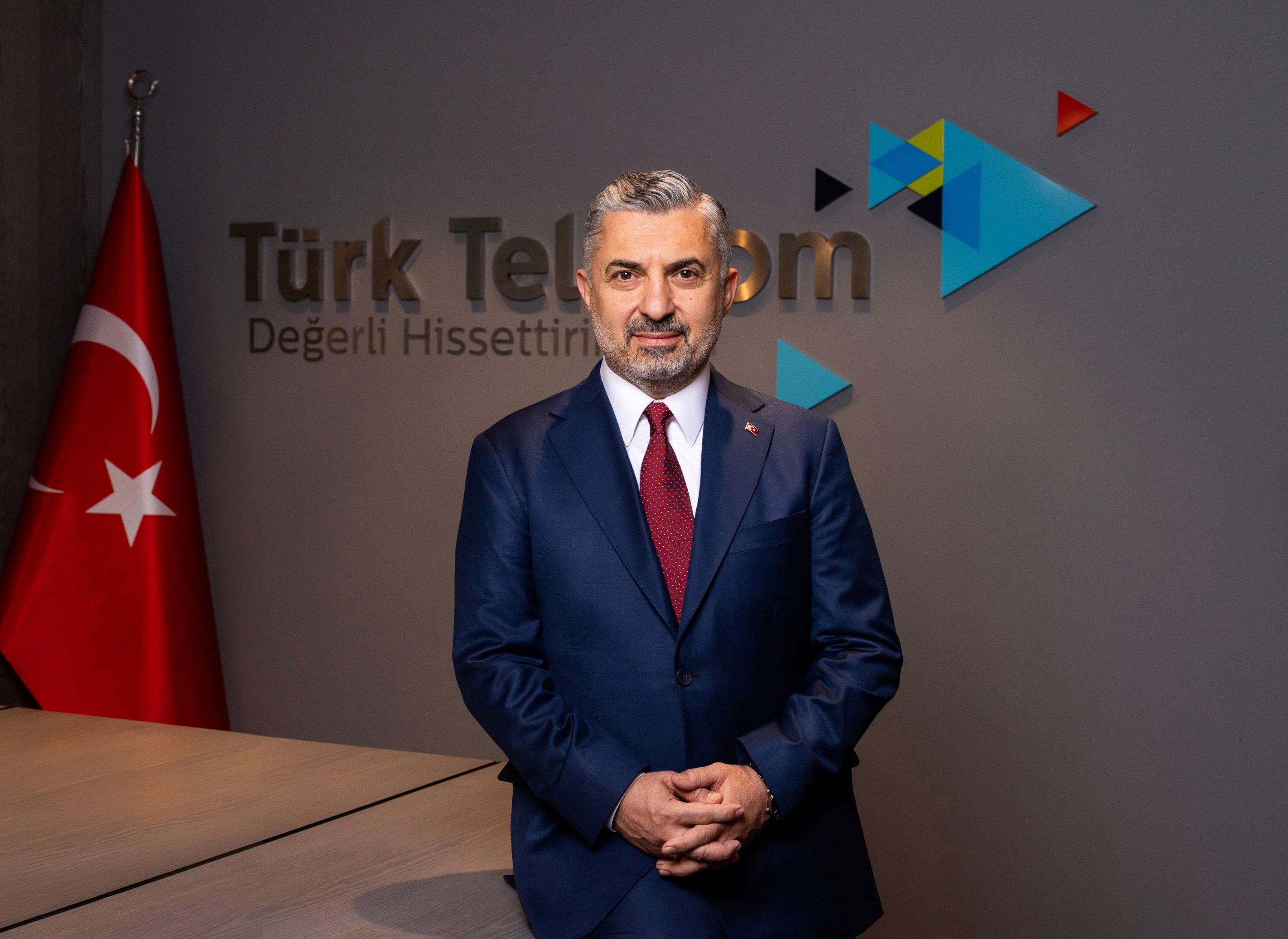
"As Türk Telekom, which leads Türkiye's digital transformation, we are carrying our country into the future through human-centered investments and uninterrupted efforts," Şahin said.
"Our activities do not simply meet today's connectivity requirements. We are also building a powerful digital backbone that will support the AI ecosystem of the 5G era, advanced technologies and our national technology production vision."
He added that the company is extending this digital backbone even into Türkiye's most challenging geographies.
"Türkiye ranked second in Europe in annual FTTH/B growth, and we are proud to have made the largest contribution to this increase. The FTTH Council report stands as a concrete reflection of our vision and proves that Türkiye is becoming a game-changing force in Europe's digital transformation journey."
Türk Telekom, he added, remains committed to positioning Türkiye as one of the central hubs of the global digital economy.
As part of this strategy, Türk Telekom has also expanded investments into regions with lower population density.
According to the SEGE-2022 Socio-Economic Development Ranking report, fiber household coverage in 343 districts classified as less socio-economically developed rose from 671,000 households in 2020 to 1.2 million households by 2025.
In the same regions, 6,600 new mobile base stations were deployed over the last five years, increasing mobile population coverage from 76% to 99%.
These large-scale infrastructure investments led by Türk Telekom further reinforce Türkiye's role as a digital infrastructure player at the European level, while supporting the country's longer-term ambition of becoming a strategic hub in the global digital economy.
Türkiye's list of homegrown unicorn candidates has continued to expand in recent years, and Grand Games is emerging as one of the strongest contenders to join it in record time after raising $103 million across three funding rounds in just two years.
A mobile gaming company from Türkiye has managed to capture the attention of major global investors while climbing the ranks in one of the world's most competitive digital markets.
Since its founding roughly two years ago, Grand Games has raised $103 million and recently posted 500% growth, making it one of the sector's standout performers.
Founded by Bekir Batuhan Çelebi, Mehmet Çalım and Mustafa Fırtına, Grand Games has taken an unconventional path in the mobile gaming industry. Rather than getting lost in a crowded field of dozens of titles, the company focused on the hybrid casual puzzle segment, a niche still seen as underpenetrated.
Today, with six active games and more than 50 million downloads, the company has climbed as high as the top two spots on the U.S. iOS download charts with titles including Magic Sort and Block Out.
The U.S. market remains the mobile gaming industry's largest revenue generator and also its most fiercely competitive arena. Reaching the top of those rankings means competing directly against companies backed by multimillion-dollar marketing budgets and years of accumulated brand recognition.
Grand Games secured a $70 million Series B investment in May 2025, led by Balderton Growth Fund. Existing investors, including Bek Ventures, Laton Ventures, and angel investor Mert Gür also participated in the round.
The raise came roughly one year after its Series A, also led by Balderton Early Fund, making the follow-on investment particularly notable as a renewed vote of confidence from the same lead investor.

Three funding rounds completed in just two years and a total of $103 million in capital have placed Grand Games among Türkiye's fastest-growing technology startups.
The central question behind investor enthusiasm is straightforward: why does the same investor continue doubling down on the company with increasingly larger checks?
At the heart of Grand Games' rapid growth lies not only product quality and market selection, but also its organizational philosophy.
The company has built a structure consisting of five independent studios in which teams developing the games have direct authority over product decisions. Each studio carries full responsibility for its own title, while infrastructure, data and production systems are centrally shared.
This model enables the company to combine speed and quality without the bureaucratic drag often associated with larger organizations.
CEO Çelebi says this approach reflects the company's founding philosophy: "In many companies, teams remain purely executors. We built a model where the people developing the games have real ownership over the product."
Laton Ventures Founding Partner Görkem Türk echoes this point, noting that launching a successful hit game is already difficult enough, but turning that success into a repeatable platform is far rarer. Grand Games' ability to reach six active titles in such a short period suggests it is not dependent on a single breakout success.
In startup terminology, unicorn status refers to a $1 billion valuation. How close Grand Games is to crossing that threshold has not been publicly disclosed, but the signals point strongly in that direction.
A fivefold increase in revenue within a year, top-two rankings on the U.S. App Store, two consecutive rounds with the same lead investor, and $103 million in total funding all represent strong indicators in valuation discussions.
More importantly, the company has demonstrated an ability not only to scale existing games but also to consistently produce new titles. In the mobile gaming sector, where investors prioritize sustainable platforms over one-off hits, that distinction is critical.
The Series B funding is expected to be used primarily for team expansion and scaling existing games to broader audiences, reinforcing the company's ambition to sustain its growth trajectory in the near term.