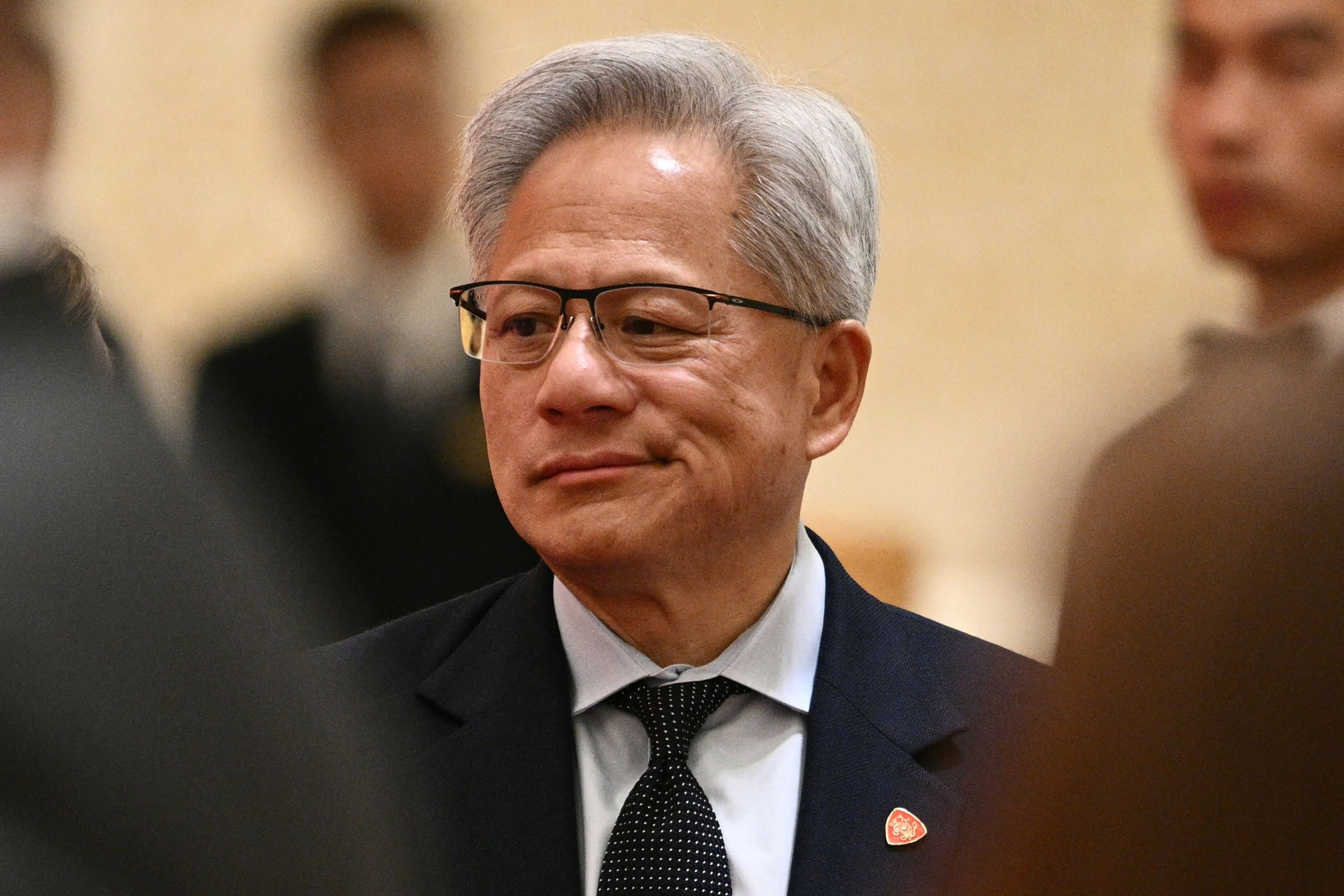
Nvidia confirmed Thursday that its founding CEO Jensen Huang was stepping down following an affair with a suspected Chinese spy that raised national security concerns in the U.S.
His exit will leave the AI industry without its biggest champion and clouding the future of the chipmaker he built into an AI powerhouse.
Chief Financial Officer Colette Kress will take over as interim CEO as Nvidia seeks a permanent successor, the company said Thursday. It named Harvey Jones, former CEO and board member of Synopsys, its first board chairman.
Huang, co-founder of Nvidia and its fourth-largest investor with a stake of about 3.61%, will also exit the board.
Nvidia shares fell more than 10% in premarket trading, weighing on the broader market.
Pressure had mounted on Huang in recent days following reports that the 63-year-old, who is married, had an affair with a Chinese businesswoman U.S. authorities suspect of spying for Beijing.
Nvidia's board met Wednesday to consider his ouster, according to a person familiar with the matter, after earlier reports that Huang also had an extramarital affair with a senior company executive who reported to him.
Huang's exit plunges the $4-trillion company into uncertainty and threatens to disrupt an AI ecosystem he helped bankroll by pouring Nvidia's swelling cash pile into cloud providers, suppliers and the industry's biggest labs.
"The risk is not that Nvidia suddenly loses its technology roadmap – that roadmap is largely visible for the next several years. The risk is execution. Jensen has been the chief conductor of an extraordinarily complex system," Michael Feldman, a portfolio manager at ClearBridge Investments, said.
"In a world with real bottlenecks, that coordination is a competitive advantage in itself."
Investor sentiment toward AI stocks is already shaky as soaring cash burn and rising debt at traditionally cash-rich tech giants fuel doubts about whether the AI boom will pay off.

The departure also could have far-reaching consequences for U.S. chip export policy, given Huang's push to preserve access to the Chinese market and his close ties with U.S. President Donald Trump.
Trump said Sunday that Huang had "done an amazing job for our country" and that the Nvidia chief told him he had no idea the Chinese woman with whom he had an affair was a spy.
For years, Nvidia was best known to gamers seeking top-tier graphics. But its chips' ability to perform many calculations at once has made them the oil of the AI boom and a strategic prize in the U.S.-China race to dominate the technology. This also made Nvidia the world's most valuable company.
That turned Huang into a rock-star CEO, mobbed by fans in Taiwan and South Korea who ask him to sign books, posters and sometimes even their bodies. Such is his pull that stocks moved at his mere mention of company names at events.
But scrutiny of his conduct has intensified in recent days following reports of his relationship with Alice Huang, a former executive at Singapore-based cloud company Megaspeed whom U.S. authorities have concluded was a Chinese intelligence asset.
The two, photographed together in Taiwan, Singapore and California, are not related.
Washington has also investigated Megaspeed, a coveted official Nvidia cloud partner with priority access to its chips, on suspicion it helped China obtain advanced AI chips restricted under U.S. export controls, according to media reports. Beijing has denied Alice Huang is a spy.
Earlier this month, Nvidia's board launched a probe, led by independent directors with outside legal counsel, into whether Jensen Huang had been targeted by a foreign intelligence operation. It also expressed confidence in him at the time.
The controversy escalated Wednesday when The New York Times reported Huang also had an affair with Kimberly Powell, Nvidia's vice president of healthcare, who reported to him.