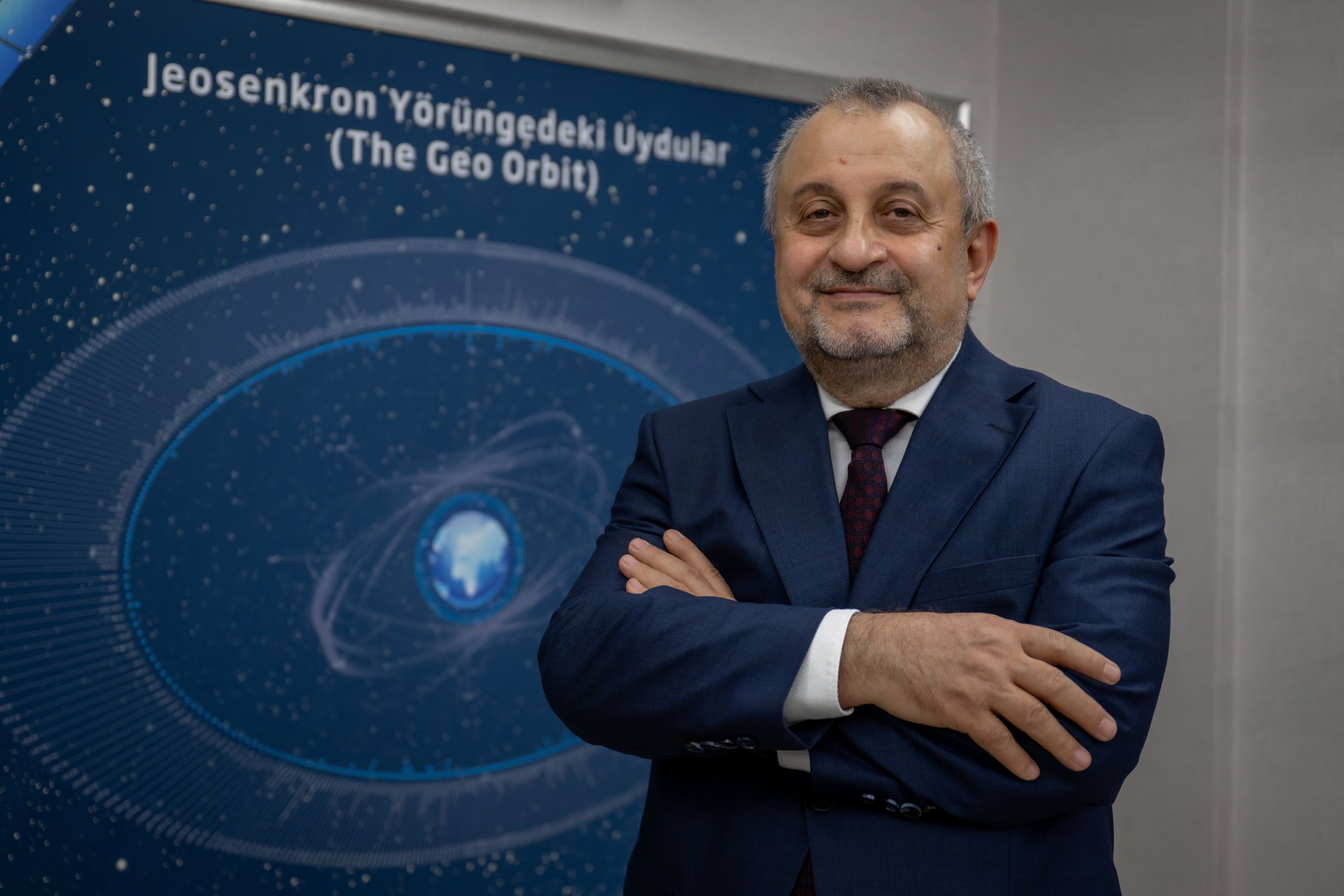
Türkiye's satellite operator, Türksat, aims to become a global player in satellite services and beyond by 2026, through initiatives such as expanding the e-Government system to neighboring countries, Türksat CEO Ahmet Hamdi Atalay said.
He recently stated that the firm focused on corporate transformation this year, carrying out infrastructure work to expand into other areas.
"We started working on an in-flight Internet connection (IFC) project, which will position us as a regional and then a global player," he told an interview with Anadolu Agency (AA).
"We signed an IFC project deal with AJet, in which we developed our own proprietary software, which we will be rolling out next year on AJet aircraft in the first quarter," he said, referring to Türkiye’s low-cost airline.
Atalay stated that Türksat’s satellite internet connection service for AJet was done in collaboration with TCI Aircraft Interiors, a Turkish Airlines subsidiary.
"Previously, there was no internet service in the 'low-cost, regional' airline segment, so that ours will be a first," he said. "We established an infrastructure to provide internet connectivity at higher speeds than other airlines; many value-added services can be provided through this service.”
Atalay also mentioned that Türksat 7A would replace Türksat 3A, which is scheduled for 2023 and is currently operating on 3A in its 13th year in orbit, as the latter component has extended its life.
"We also have a rapidly growing need for capacity in the internet and live broadcasting sectors, so we are implementing the Türksat 7A project, which has higher capacity and more features; we will send the new satellite by 2030 at the latest," he said.
Atalay suggested that data has become the most valuable asset for all institutions and countries, with the global data volume doubling in the last two and a half years. He emphasized the need for data centers in Türkiye.
"As Türksat, we serve many institutions, producing and hosting different types of services. We began a few years ago to deliver on the rapid demand for data centers, and we are in the tender process now; we will probably finalize our tender in January," he further said.
"The data center we will establish in Gölbaşı will have a very high storage capacity, and it will be eight times larger than Türksat’s current data storage capacity. It will also contain servers with high data processing capabilities, and we are in the final stages of creating this data center that will be vital in services like artificial intelligence (AI)," he added. "The construction will begin next year."
Moreover, Atalay noted that many public services in Türkiye have been digitalized and are accessible on the country’s e-Government Portal.
"Some 8,800 services are offered on e-Government, and around 4 billion operations have been made by citizens this year alone," he said.
He noted that many services previously available through various public institutions are now accessible through the e-Government portal, regardless of time or location.
"We developed a much more compact version of this with newer technology for the Turkish Republic of Northern Cyprus (TRNC),” he said. "We wish to sell this experience to allied countries-many are interested, too."
He stated that next year will be important for Türksat, as the firm is set on bringing the e-Government experience to other countries. "Discussions are ongoing with our neighbor, Romania, and we are working closely with countries in our immediate vicinity," he said.
He mentioned that the firm spent the entirety of this year working on preparing to reach beyond, as it is no longer "confined to Türkiye’s borders."
"Until now, we mainly focused on domestic activities, and we reached a certain point-our goal for 2026 and beyond is to become a regional and then a global player in both satellite services and other service sectors," he added.