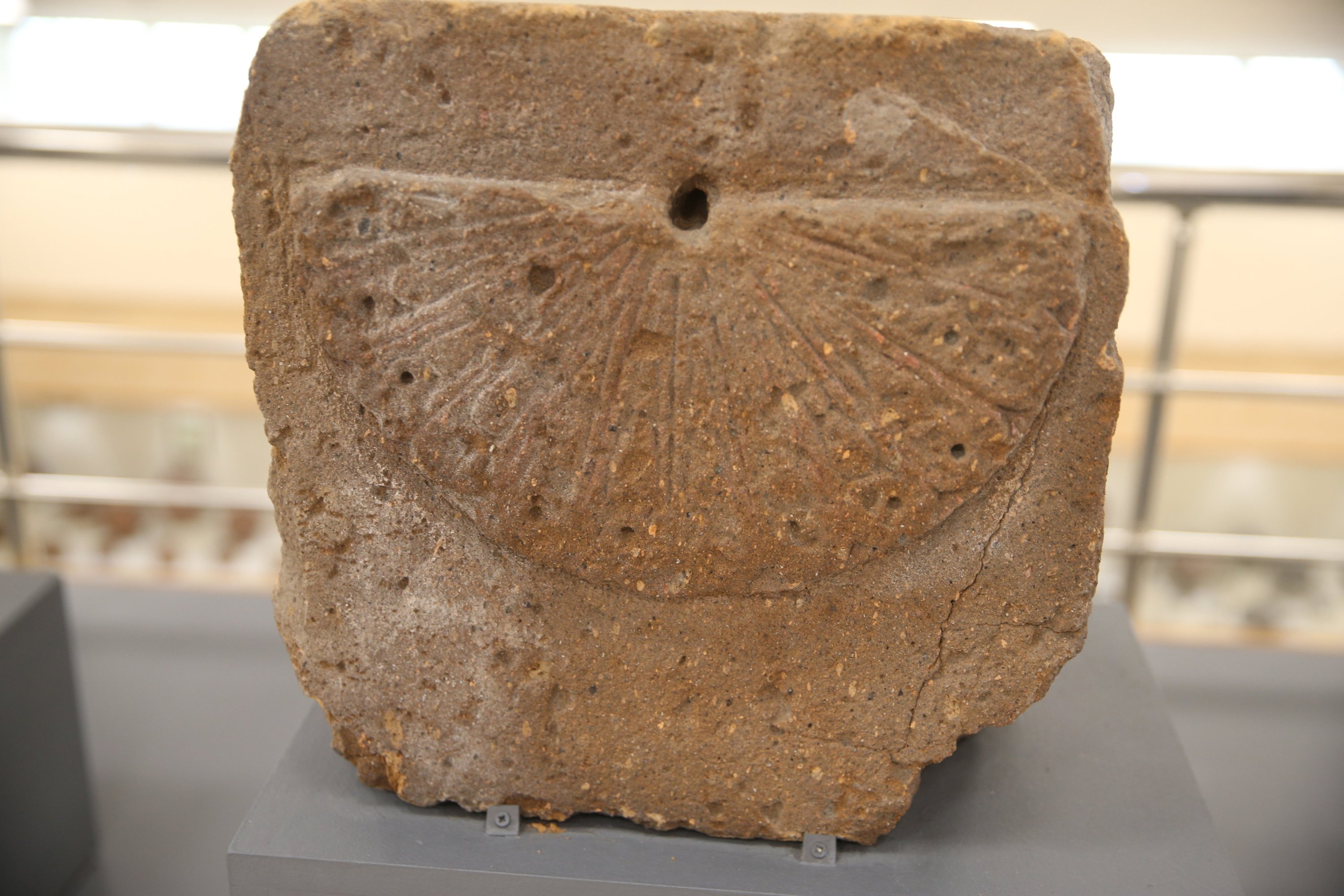
A 1,000-year-old sundial uncovered during excavations at the Ani Ruins, a UNESCO World Heritage Site in Kars, Türkiye, has now been made available for both local and international visitors. Discovered in the bathhouse area of the ancient city, the sundial is currently on display at the local museum.
Ani, which has hosted 23 civilizations throughout its history, holds significant importance not only for its historical structures and cultural treasures but also for its religious landmarks, including mosques, churches and cathedrals. Located at the entrance from the Caucasus into Anatolia, Ani once served as a vital gateway in the region's history.
The ancient city of Ani, covering 85 hectares, is home to numerous archaeological sites, including nearly 1,500 underground structures that provide a glimpse into the city's past and the civilizations that once thrived there. Visitors can explore impressive remains, such as city walls, mosques, cathedrals, palaces, churches, monasteries, baths, bridges and even a partially ruined closed passage.
Ongoing excavations at Ani have led to significant findings over the years. In 2021, during excavations in the bathhouse area, the 1,000-year-old sundial was uncovered. After conservation work was completed, it was recently put on display at the Kars Museum, also known as the Archaeological Museum.
Hakim Aslan, the acting director of the Kars Museum, noted that the sundial was part of the Ministry of Culture and Tourism’s "100+2 Museum Exhibitions Project." This initiative highlights the importance of showcasing Ani's artifacts to both local and international audiences.
Aslan explained that while sundials date back to ancient times, their development peaked during the Roman and Hellenistic periods. However, during the Middle Ages, the design and sophistication of sundials stagnated and, in some cases, even regressed compared to their Hellenistic predecessors.
The sundial found at Ani is significant not only for its age but also for its unique design. It is a semi-circular, 12-segment sundial with a metal stick at the center that casts a shadow to indicate the time of day. This mechanism was quite advanced for its time.
"This sundial is of great importance to us, especially due to its half-circle form and the 12 segments," said Aslan. "The shadow cast by the metal stick in the center shows the time based on the position of the sun. After being uncovered in 2021, it has now been restored and put on display for visitors to appreciate."
The discovery of the sundial provides a fascinating glimpse into the technological and cultural achievements of those who lived in Ani nearly a millennium ago. It also underscores Ani's continuous significance as a site where history, archaeology and tourism intersect, making it an invaluable destination for anyone interested in the ancient civilizations of Anatolia.
With ongoing archaeological efforts, it is likely that more discoveries will continue to shed light on Ani's rich history and the 1,000-year-old sundial stands as one of the most remarkable finds to date.