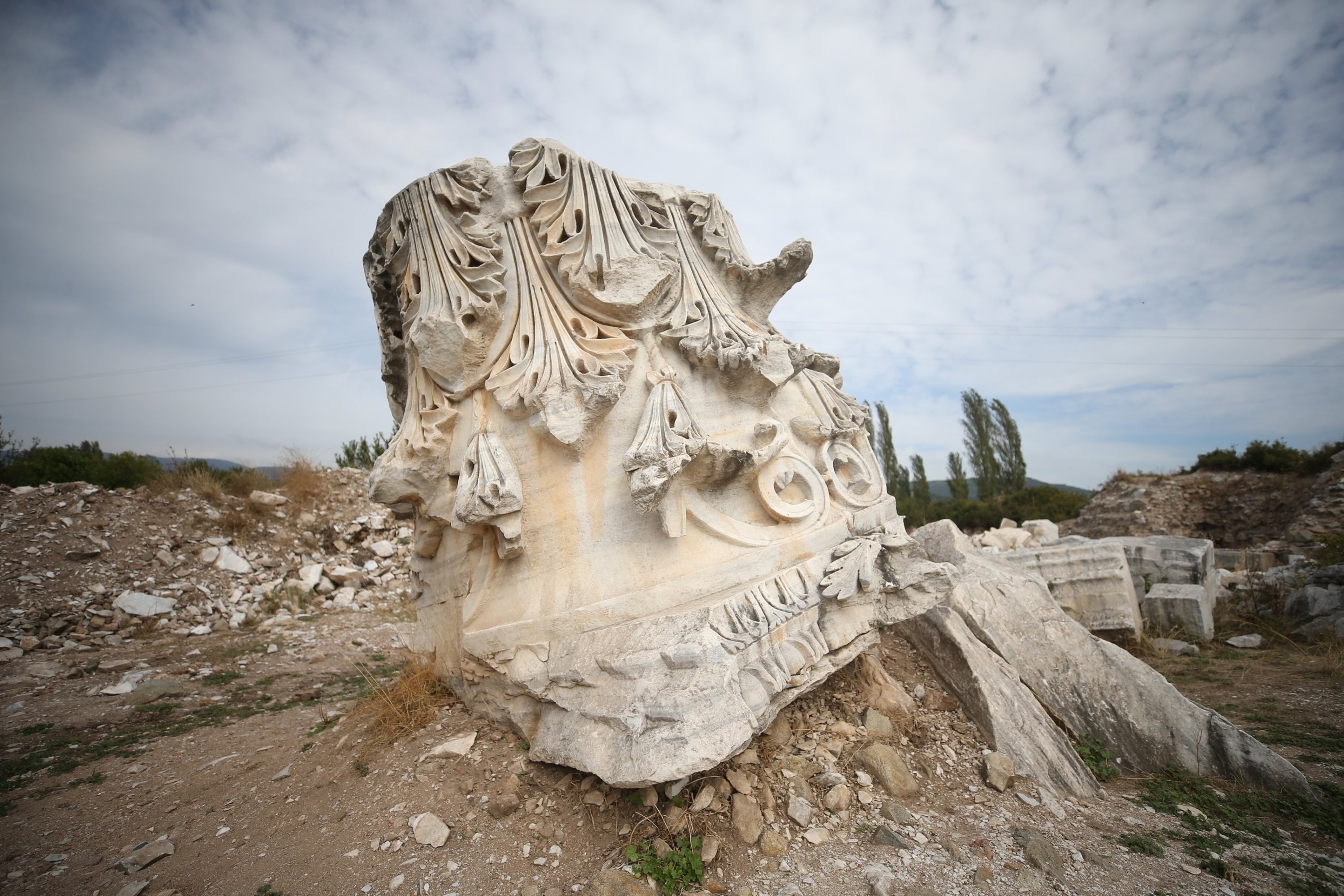
Columns unearthed during ongoing excavations at the Hadrian Temple in the ancient city of Kyzikos, located in the Erdek district of Balıkesir, western Türkiye, are providing new insights into Roman-era art and religious architecture.
The excavations take place at the site where the Kapıdağ Peninsula meets the mainland and continue year-round under the Ministry of Culture and Tourism’s “Heritage for the Future” project.
The site in Kyzikos’ Düzler neighborhood, dating back to the mid-eighth century B.C., is being excavated under the leadership of Ahmet Tercanlıoğlu, a faculty member in the Art History Department at Bandırma Onyedi Eylül University.
Thanks to its strategic location, Kyzikos served for centuries as an important settlement and trade hub. Excavations focus on what is believed to be the largest Corinthian-style temple in Anatolia – the Hadrian Temple – as well as the city’s amphitheater and necropolis.
One of the few ancient cities with three harbors, Kyzikos has seen most of the excavation work concentrated at the Hadrian Temple, which measures approximately 116 by 64 meters. Its columns and frieze decorations stand out for their artistic beauty.
Massive column drums and capitals discovered at the site are shedding light on Roman-era artistry. Experts hope that future restoration efforts will further enhance the site’s cultural and touristic appeal.
Tercanlıoğlu told Anadolu Agency (AA) that Kyzikos was among the major cities of Anatolia. He highlighted the city’s distinctive architectural scale compared with other ancient cities, noting that its buildings include elements from Greek, Hellenistic and Roman periods.
He said the Hadrian Temple, the second-largest Corinthian-style temple in the Roman world, is particularly noteworthy. “Excavations at the Hadrian Temple have been ongoing since the late 1980s,” Tercanlıoğlu said. “The temple dates to the second century A.D. and was a significant religious structure during the Roman period. Its enormous scale, measuring approximately 116 by 64 meters, contributes to the Roman artistic and religious world through both sculptural works and decorative elements.”
The frieze decorations, he added, are especially remarkable. While many Roman temples built during and after the second century A.D. feature frieze motifs, the Kyzikos friezes depict Eastern and Western battles, scenes dedicated to Dionysus, Gigantomachia and other sculptural narratives.
Tercanlıoğlu said that roughly 60% of the Hadrian Temple excavations have been completed. The team has uncovered architectural remnants, sculptures and structural elements that reveal the temple’s design. While the foundation remains intact, much of the upper structure, including columns, lies buried.
“This year, we have uncovered especially important components of the building’s support system,” Tercanlıoğlu said. “Among our most significant finds is a Corinthian-style capital – the largest of its kind in the world. The columns display artistic styles characteristic of the second-century Antonine period. In the coming years, we plan not only to continue excavations but also to begin restorations, which will further support tourism in the region.”