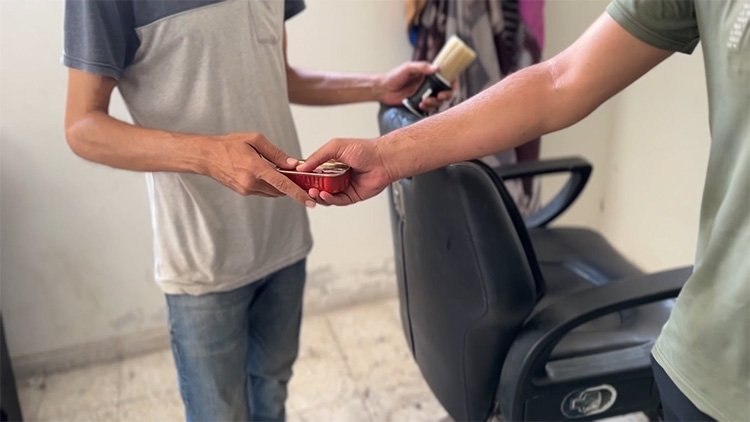
Numan Imad, a Palestinian barber in Gaza, has returned to the age-old practice of barter – an exchange system dating back thousands of years – due to the severe economic collapse caused by Israel's tight blockade.
Despite Israel’s attacks and stringent restrictions that have crippled daily life in Gaza, its residents continue to resist by finding new ways to survive. Basic necessities are increasingly scarce, forcing people to rely on primitive and traditional methods to meet their needs.
Imad, a 30-year veteran barber from the central Gaza city of Deir al-Balah, adopted the barter system to keep his business alive and put food on the table for his family.
A sign in his barber shop reads: “Haircuts exchanged for barter.” Customers bring non-perishable food items, including dried goods and canned foods, as payment for their haircuts.
Before the war, Imad’s business was thriving, but everything changed when the conflict began. He explained the origin of his barter idea: “We used to hear from our ancestors that they would get haircuts in exchange for wheat or barley. I thought we should try it now because our current situation is even harder than theirs.”
Inspired by this, Imad started offering haircuts through barter and announced it on his Facebook page.
Customers showed strong interest in the idea, bringing various goods, including fresh produce like eggplants and tomatoes. Imad accepts everything, emphasizing that it all holds equal value to him and that purchasing such items with money would be very costly.
Imad said he needs to earn at least 300-400 shekels daily to support his family of nine, which barely covers a modest lifestyle, including essential staples like flour, oil and vegetables.
He also uses this method to pay for his daughters’ education and encourages all Gaza merchants to adopt barter as a survival strategy.
Ebu Raid, waiting to get his son's haircut at Imad’s shop, expressed satisfaction with the barter approach.
He learned about it from Imad’s Facebook announcement. “This lightens our burden and benefits him as well, because people are struggling with cash shortages. For example, I brought a food package I received when the border crossings were open. Today, that package is worth 30 shekels in the market, but I don’t have 30 shekels right now.”
He emphasized how this system has made daily life much easier under these difficult conditions.