"Samarkand is the world's most beautiful face toward the sun" – Amin Maalouf.
For centuries, this city, a crossroads of civilizations, captivates visitors with its magnificent architecture, sky-high turquoise domes and the legacy of the Timurid Empire. As a center of science, art and astronomy, Samarkand has influenced the course of Islamic civilization.
Samarkand has been known by various names throughout history. Mentioned as "Marakanda" in ancient sources, the city gained particular importance during Alexander the Great's conquests. Legend has it that Alexander was so impressed by the city's magnificent structures and strategic location that he called it the "Rome of the East."
This analogy demonstrates the central role of Samarkand as a city in the eyes of the world. With its military power, key role on trade routes and cultural richness, Samarkand served as a bridge connecting East and West for centuries.
Samarkand's history was marked by a notable architectural principle: buildings were constructed at a height that would not obscure the sky or obstruct the flight of birds. This approach, in addition to the city's aesthetic appeal, also reflected a lifestyle in harmony with nature.
Traces of justice also existed in social life. For example, a diplomat, a servant and even a cat were considered equal. When a wealthy person built a magnificent house for themselves in the city, they had to consider not only their own comfort but also their surroundings; it would be their responsibility to renovate the neighborhood's sidewalks. This understanding left a legacy of common good and justice, not only in the stones of Samarkand but also in its social fabric.
Elementary school children were taught nature lessons. Nature was considered "mother nature" and was treated with respect. This reverence for trees, water and earth permeated the life philosophy of the people of Samarkand. Protecting nature, passing it on to future generations, and not harming it were integral parts of the social order.
One of the city's must-see spots is the traditional paper workshops. Here, the production process has remained virtually unchanged for centuries. The fibers extracted from mulberry branches are first boiled in cauldrons and then pounded with mallets powered by a watermill. The pulp, filtered through fine sieves, is pressed under heavy stones, then polished and turned into paper.
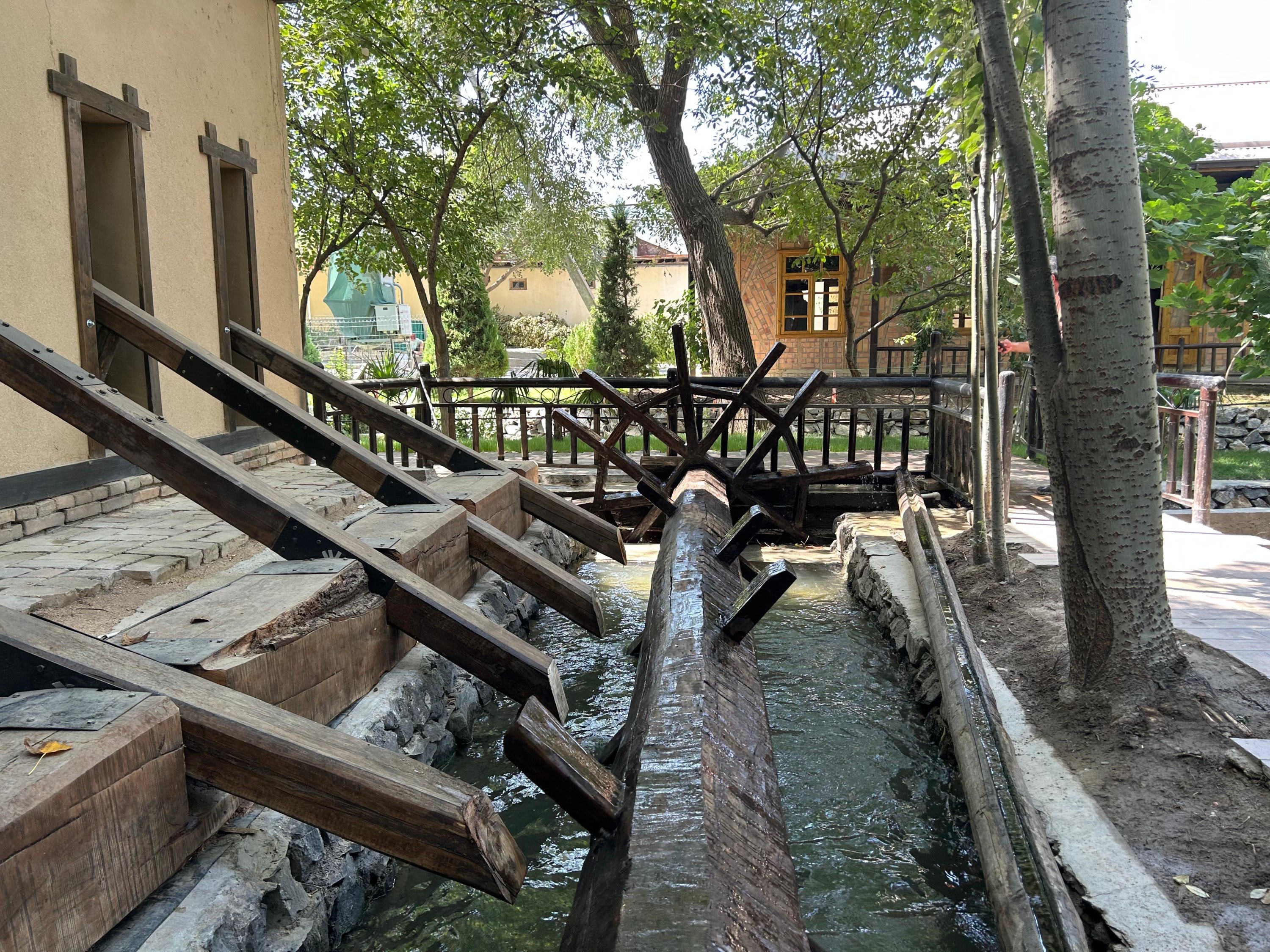
The origins of this technique date back to the eighth-century Battle of Talas. Legend has it that papermaking was brought to Central Asia by Chinese prisoners captured after the war. Samarkand's paper gained fame for its eye-pleasing texture and durable resistance to decay. For centuries, works of science and literature were written on this paper.
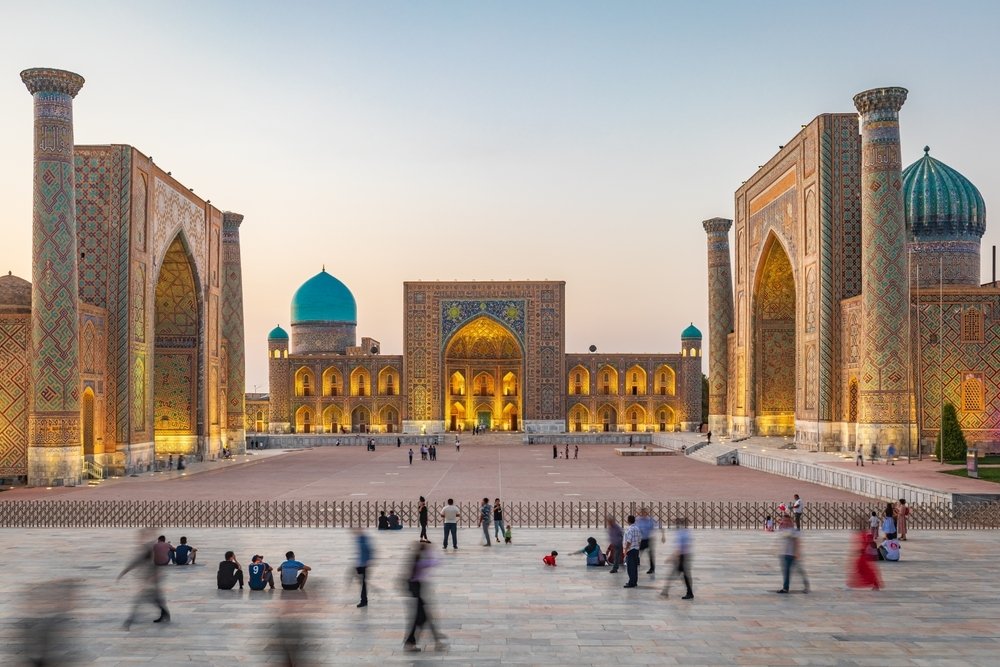
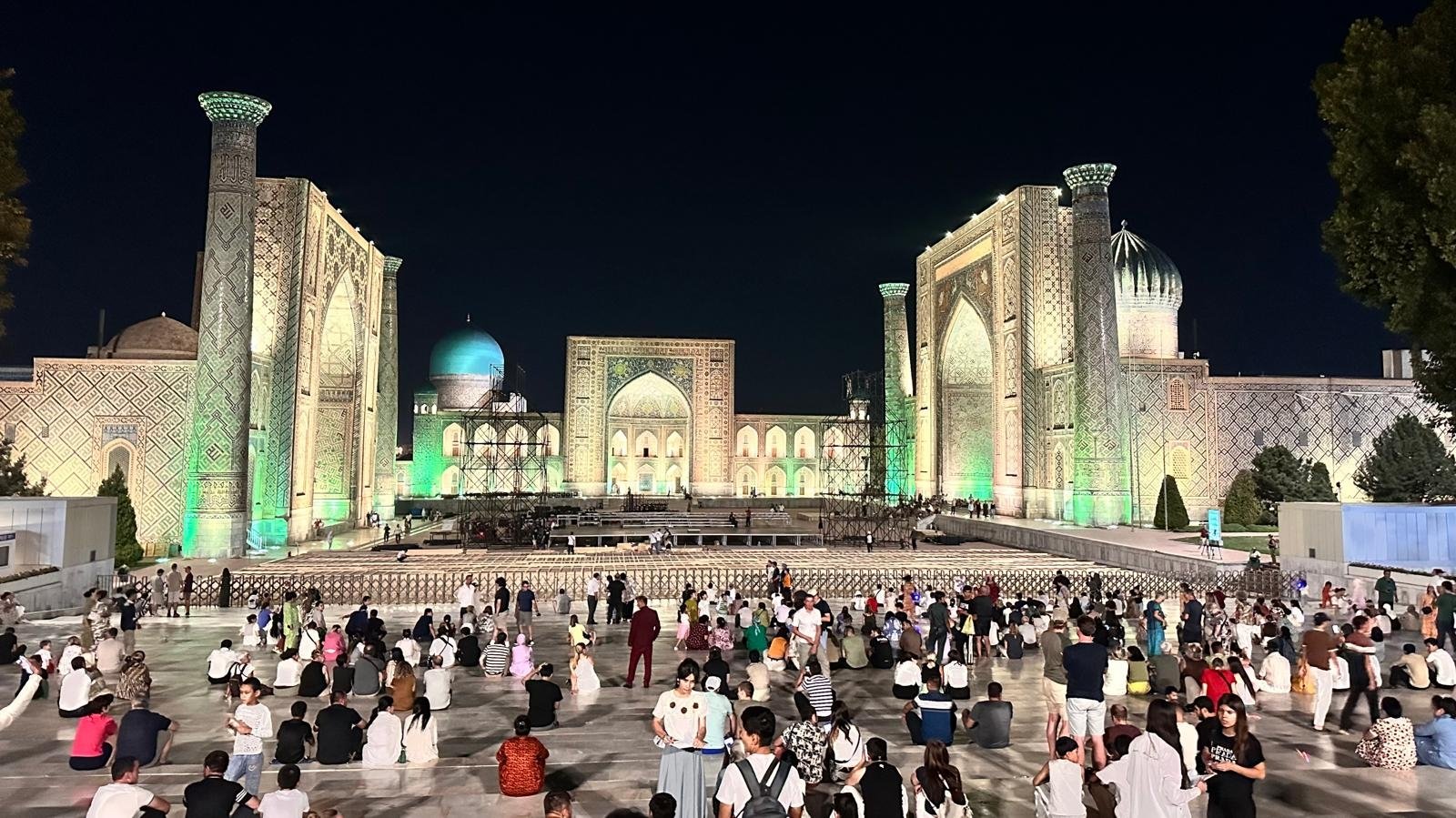
The heart of Samarkand is undoubtedly Registan Square. Surrounded by three magnificent madrasahs, this square served as the center of knowledge and art for centuries in the Islamic world. The blue tiles inlaid on the domes, rising to the heavens, recall the horizon-gazing gazes of scholars of the past. Ulugh Beg, Timur's grandson, commissioned the construction of three madrasahs in the Registan while still in his 20s. This was a center of learning known as the "Oxford" of its time. In response to the politically shaped legacy of his grandfather, Timur, Ulugh Beg turned to the heavens; he discovered numerous stars with the naked eye, and Western astronomers compared their work to his observations for centuries.
These madrassas, which provided educational services for six centuries, were converted into bazaars in 1924, but were restored during the Soviet era for their touristic value. Today, the structure, dazzling with its golden ornamentation in the mosque section, also houses the tomb of Ja'far al-Siddiq. Registan Square, with its splendor, remains a symbol of Samarkand and a powerful symbol of the continuity of knowledge.
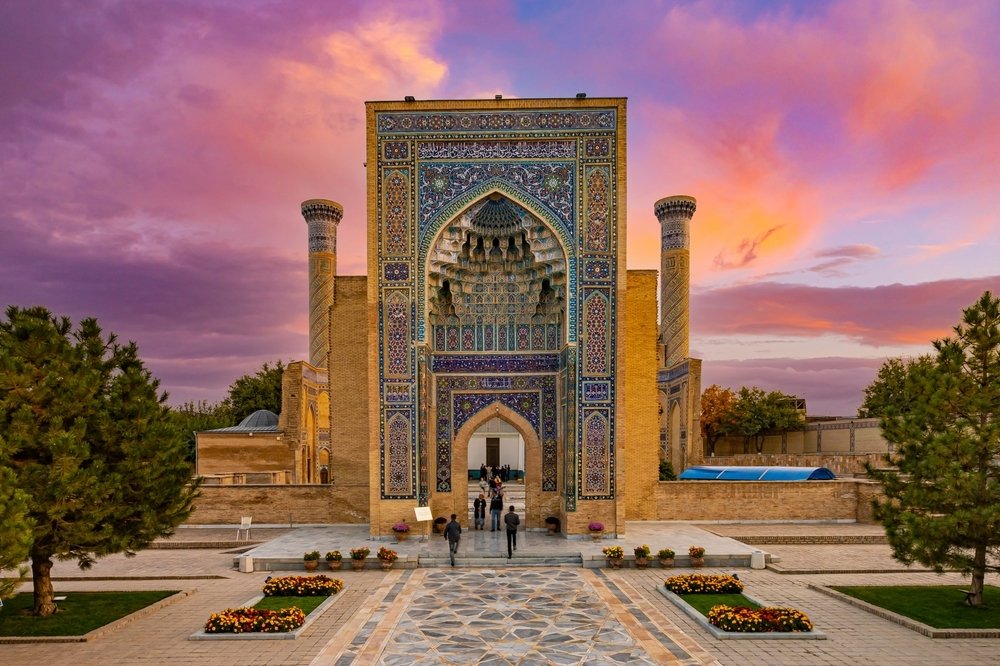
Samarkand was the capital of the great ruler Timur and his legacy is still felt in every corner of the city today. The Gur-i Emir Mausoleum is the final resting place of Timur and his family. The turquoise tiles of its dome and the exquisite decorations of its interior reflect the grandeur of a dynasty, while the silence of the mausoleum reminds us that time bows to no power.
One of the structures that reflects Timur's magnificence is the Bibi Khanum Mosque. Legend has it that Timur commissioned this magnificent temple for his wife Bibi Khanum upon his return from his India campaign. Considered one of the largest mosques of the period with its massive size and tile decorations, the structure is a monument that embodies Timur's might in architectural terms.
Another important structure is the Shah-i Zinde complex. Meaning "Living King," this complex is one of the most impressive mausoleum complexes in Central Asia. Legend has it that Qusam ibn Abbas, the uncle of the Prophet Muhammad, is buried here. Over the centuries, rulers, scholars, and statesmen have added tombs here, transforming the complex into a spiritual center. Today, as one walks through its narrow streets, one finds oneself in a prayer corridor.
Unlike his grandfather, Timur's grandson, Ulugh Beg, was remembered more for his knowledge than his sword. Ascending the throne at a young age, Ulugh Beg transformed Samarkand into a center of science beyond conquest. The Ulugh Beg Observatory, which he commissioned, became not only the most advanced in Central Asia in the 15th century but also a pioneering observatory worldwide.
Observing the sky with the naked eye, Ulugh Beg recorded hundreds of stars. The catalog he compiled, "Zic-i Ulugh Beg," served as a reference source for Western scientists for centuries. Numerous astronomers, from Copernicus to Kepler, compared his calculations with his observations.
Today, the ruins of the observatory can still be seen in Samarkand. Every stone bears the mark of a ruler dedicated to unraveling the secrets of the heavens.
The city's food is as bold as its architecture. One must-try for visitors is the local manti soup. A meat filling wrapped in thinly rolled dough and cooked in hot soup broth, it's both filling and traditional. For those with a sweet tooth, Uzbek baklava stands out with its layered dough and honey- and hazelnut-flavored filling. And the shashlik (shish kebab), a staple of Central Asian cuisine, is found at every turn on the city's streets, featuring meat cooked over embers. The aroma of steaming shashlik stalls draws visitors in.
The city's bazaars offer a vibrant array of dried nuts and tea stalls, complete with whole dried strawberries, macadamia nuts, dried fruit-flavored green teas, and fragrant black grapes.
After the authentic silence of Khiva and the spiritual depth of Bukhara, Samarkand greets us with a captivating magnificence. This city is like a "dome of civilization," where science and art, spirituality and power, meet.
Uzbekistan's geography has fostered the development of the Turkic language, culture and folklore for centuries. Home to Turkestan's most established centers of education, these lands, with their cities stretching from Samarkand to Bukhara, are central not only to Turkic culture but also to Islamic civilization and the shared history of Central Asia. Uzbeks have profoundly contributed to Turkic culture by producing thousands of works to this day.
Uzbekistan, which has been under Russian and Soviet influence for many years in its modern history, faced policies aimed at transforming its identity. However, the people preserved the essence of Turkic culture. After the collapse of the Soviet Union, Uzbeks turned to their roots, seeking not to reclaim what they had lost, but to rekindle their inner identity. Despite economic hardship, they are repairing their historic madrasas, mausoleums and mosques, building new ones and reviving the religious life that had been suppressed for so many years.
After independence, significant momentum was gained in the fields of culture and education. Cooperation with Türkiye is one of the most significant indicators of this. After gaining sovereignty, Uzbekistan sent approximately 2,000 students to Türkiye, establishing a strong bridge in education.
Today, with a population exceeding 34 million and cities such as Tashkent, Samarkand, Bukhara, Ferghana and Andijan, Uzbekistan continues to be the heart of Central Asia, not only with its rich energy resources and strategic geographical location, but also with its historical and cultural depth. This country, which advances toward the future while preserving the legacy of the past, is at the center of both the Turkic world and regional geopolitics.
Samarkand is no longer just a memory of the Silk Road; it is a living page of history in the heart of Central Asia, still alive with knowledge, beauty and spirit. And finally, it reminds us: Here, history is not past, but present.