Daily Sabah logo

Politics
Diplomacy Legislation War On Terror EU Affairs Elections News Analysis
TÜRKİYE
Istanbul Education Investigations Minorities Expat Corner Diaspora
World
Mid-East Europe Americas Asia Pacific Africa Syrian Crisis Islamophobia
Business
Automotive Economy Energy Finance Tourism Tech Defense Transportation News Analysis
Lifestyle
Health Environment Travel Food Fashion Science Religion History Feature Expat Corner
Arts
Cinema Music Events Portrait Reviews Performing Arts
Sports
Football Basketball Motorsports Tennis
Opinion
Columns Op-Ed Reader's Corner Editorial
PHOTO GALLERY
JOBS ABOUT US RSS PRIVACY CONTACT US
© Turkuvaz Haberleşme ve Yayıncılık 2025

Daily Sabah - Latest & Breaking News from Turkey | Istanbul

  • Politics
    • Diplomacy
    • Legislation
    • War On Terror
    • EU Affairs
    • Elections
    • News Analysis
  • TÜRKİYE
    • Istanbul
    • Education
    • Investigations
    • Minorities
    • Expat Corner
    • Diaspora
  • World
    • Mid-East
    • Europe
    • Americas
    • Asia Pacific
    • Africa
    • Syrian Crisis
    • Islamophobia
  • Business
    • Automotive
    • Economy
    • Energy
    • Finance
    • Tourism
    • Tech
    • Defense
    • Transportation
    • News Analysis
  • Lifestyle
    • Health
    • Environment
    • Travel
    • Food
    • Fashion
    • Science
    • Religion
    • History
    • Feature
    • Expat Corner
  • Arts
    • Cinema
    • Music
    • Events
    • Portrait
    • Reviews
    • Performing Arts
  • Sports
    • Football
    • Basketball
    • Motorsports
    • Tennis
  • Gallery
  • Opinion
    • Columns
    • Op-Ed
    • Reader's Corner
    • Editorial
  • TV
  • Opinion
  • Columns
  • Op-Ed
  • Reader's Corner
  • Editorial

'Axis of Türkiye' uncovers a new foreign policy

by Muhittin Ataman

Nov 27, 2024 - 12:05 am GMT+3
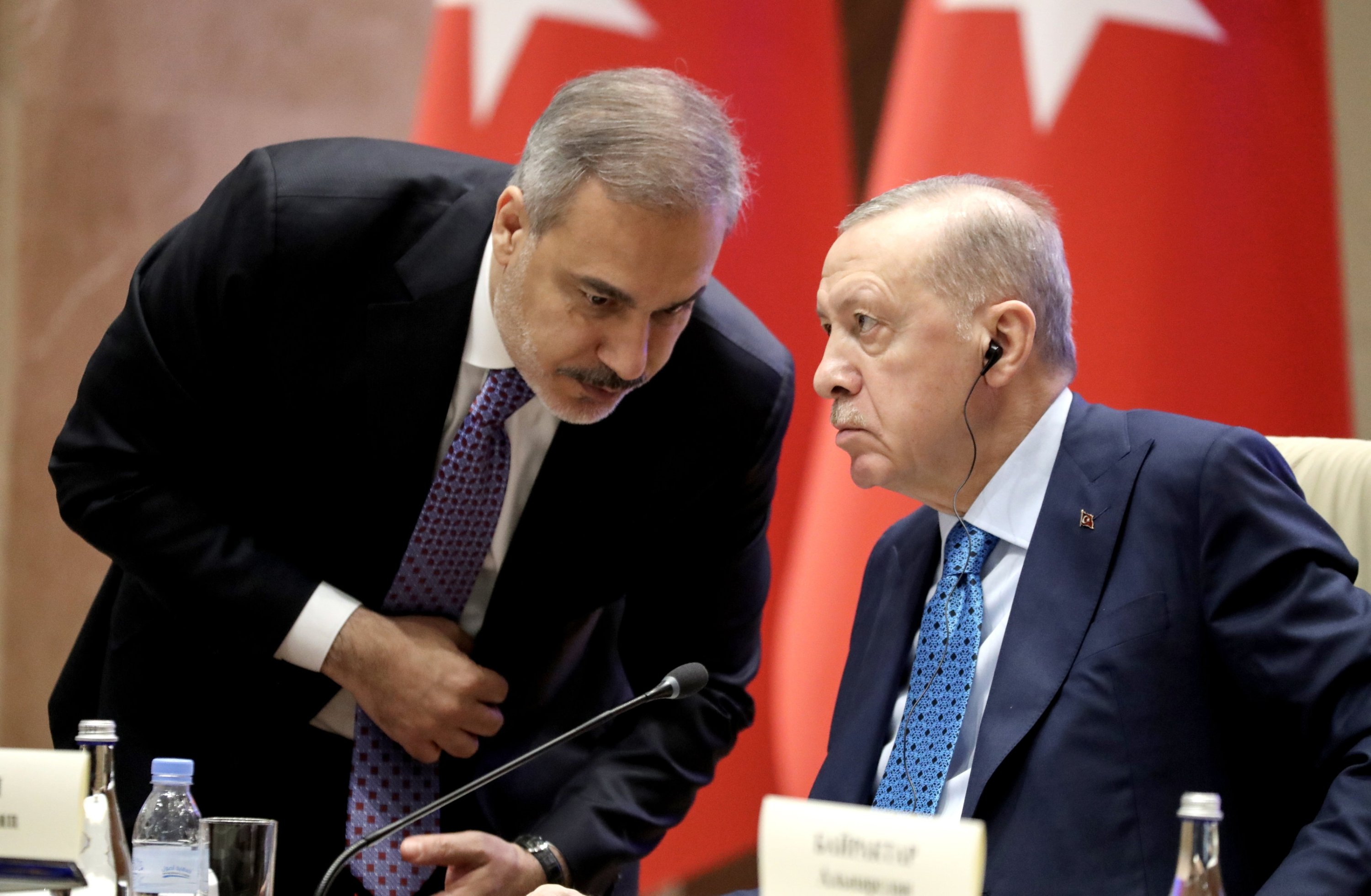
President Recep Tayyip Erdoğan speaks with Foreign Minister Hakan Fidan during a bilateral meeting with the president of Kyrgyzstan, Bishkek, Kyrgyzstan, Nov. 5, 2024. (EPA Photo)
by Muhittin Ataman Nov 27, 2024 12:05 am

President Erdoğan’s attendance at various global summits highlights Türkiye’s diversified foreign policy, strong and independent stance

President Recep Tayyip Erdoğan visited various countries on different continents in the last month to attend the summits of six regional and global international organizations. Erdoğan attended the BRICS summit in Russia, the 11th summit of the Council of Heads of State of the Organization of Turkic States (OTS) in Kyrgyzstan, the European Political Community (ECC) Summit in Hungary, the Extraordinary Joint Summit of the Organisation of Islamic Cooperation (OIC) and the Arab League in Saudi Arabia, the World Leaders Climate Summit of the 29th Conference of the Parties to the United Nations Framework Convention on Climate Change in Azerbaijan and the G-20 leaders’ summit organized under the theme of “Building a Just World and a Sustainable Planet” in Brazil.

All these visits are significant indications of the current Turkish foreign policy orientation, which is based on diversifying its foreign policy and establishing the "Axis of Türkiye." These visits show that there are several important contexts in which Türkiye improves its role in international organizations and its relations with other countries.

Türkiye has been trying to contribute to the resolution of global problems such as climate change, the reformation of the U.N. system and economic disparity. Ankara shows a close interest in solving global problems. For example, Erdoğan has been giving effective speeches at the U.N. General Assembly and emphasizing the keen interest in solving global problems for the last decade. Türkiye has been asking for reforming the U.N. system to be more effective in contributing to international peace and stability. Similarly, Türkiye initiated the zero-waste project that later reached a global scale.

Türkiye has been trying to improve the idea of regionalism. As part of the Axis of Türkiye and the "Century of Türkiye" policies, a recently developed grand strategy by the current Erdoğan government, Türkiye has been trying to improve regional cooperation with different sets of states. There are three main layers of the project, namely its immediate neighbors, the Turkic world and Muslim countries. Türkiye has been trying to increase its cooperation with regional countries in adjacent regions. It wants to increase its level of integration with the Turkic world. Similarly, Türkiye is very careful not to alienate but to underline its common ties with Muslim countries.

Türkiye has benefited from international and multinational platforms in developing its bilateral relations. On the one hand, Erdoğan meets with the leaders of different countries, who also participate in the above-mentioned multinational platforms, to improve Türkiye’s relations with these countries. On the other hand, since the Al-Aqsa Flood on Oct. 7, Erdoğan has used every international platform to mobilize the world's public opinion against the ongoing genocide. Considering almost all Western states justify and most of the non-Western countries remain indifferent to the Israeli atrocities, Türkiye under the leadership of Erdoğan is one of the few countries that try to stop the Israeli aggression toward regional people. During these international platforms, Erdoğan finds the opportunity to show the brutality of Israel to the world's public opinion.

To make a general inference, it becomes obvious that all these visits contribute to Türkiye’s goal of increasing its strategic autonomy, which it initiated almost a decade ago. They have increased Türkiye’s effectiveness in international organizations and multinational platforms, and thus its role in international politics. In other words, by participating in these summits, Erdoğan has been playing a vital role in Türkiye’s increased effectiveness. Also, by participating in these different regional and global platforms, Erdoğan consolidates his country’s diversified foreign policy perspective.


About the author
Muhittin Ataman is a professor in the Department of International Relations at Social Sciences University of Ankara. He is also the Editor-in-Chief of Insight Turkey, published by SETA Foundation.
  • shortlink copied
  • KEYWORDS
    recep tayyip erdoğan axis of türkİye türkiye century turkish foreign policy g20 summit
    The Daily Sabah Newsletter
    Keep up to date with what’s happening in Turkey, it’s region and the world.
    You can unsubscribe at any time. By signing up you are agreeing to our Terms of Use and Privacy Policy. This site is protected by reCAPTCHA and the Google Privacy Policy and Terms of Service apply.
    No Image
    New front in Ethiopian war displaces thousands
    PHOTOGALLERY
    • POLITICS
    • Diplomacy
    • Legislation
    • War On Terror
    • EU Affairs
    • News Analysis
    • TÜRKİYE
    • Istanbul
    • Education
    • Investigations
    • Minorities
    • Diaspora
    • World
    • Mid-East
    • Europe
    • Americas
    • Asia Pacific
    • Africa
    • Syrian Crisis
    • İslamophobia
    • Business
    • Automotive
    • Economy
    • Energy
    • Finance
    • Tourism
    • Tech
    • Defense
    • Transportation
    • News Analysis
    • Lifestyle
    • Health
    • Environment
    • Travel
    • Food
    • Fashion
    • Science
    • Religion
    • History
    • Feature
    • Expat Corner
    • Arts
    • Cinema
    • Music
    • Events
    • Portrait
    • Performing Arts
    • Reviews
    • Sports
    • Football
    • Basketball
    • Motorsports
    • Tennis
    • Opinion
    • Columns
    • Op-Ed
    • Reader's Corner
    • Editorial
    • Photo gallery
    • DS TV
    • Jobs
    • privacy
    • about us
    • contact us
    • RSS
    © Turkuvaz Haberleşme ve Yayıncılık 2021