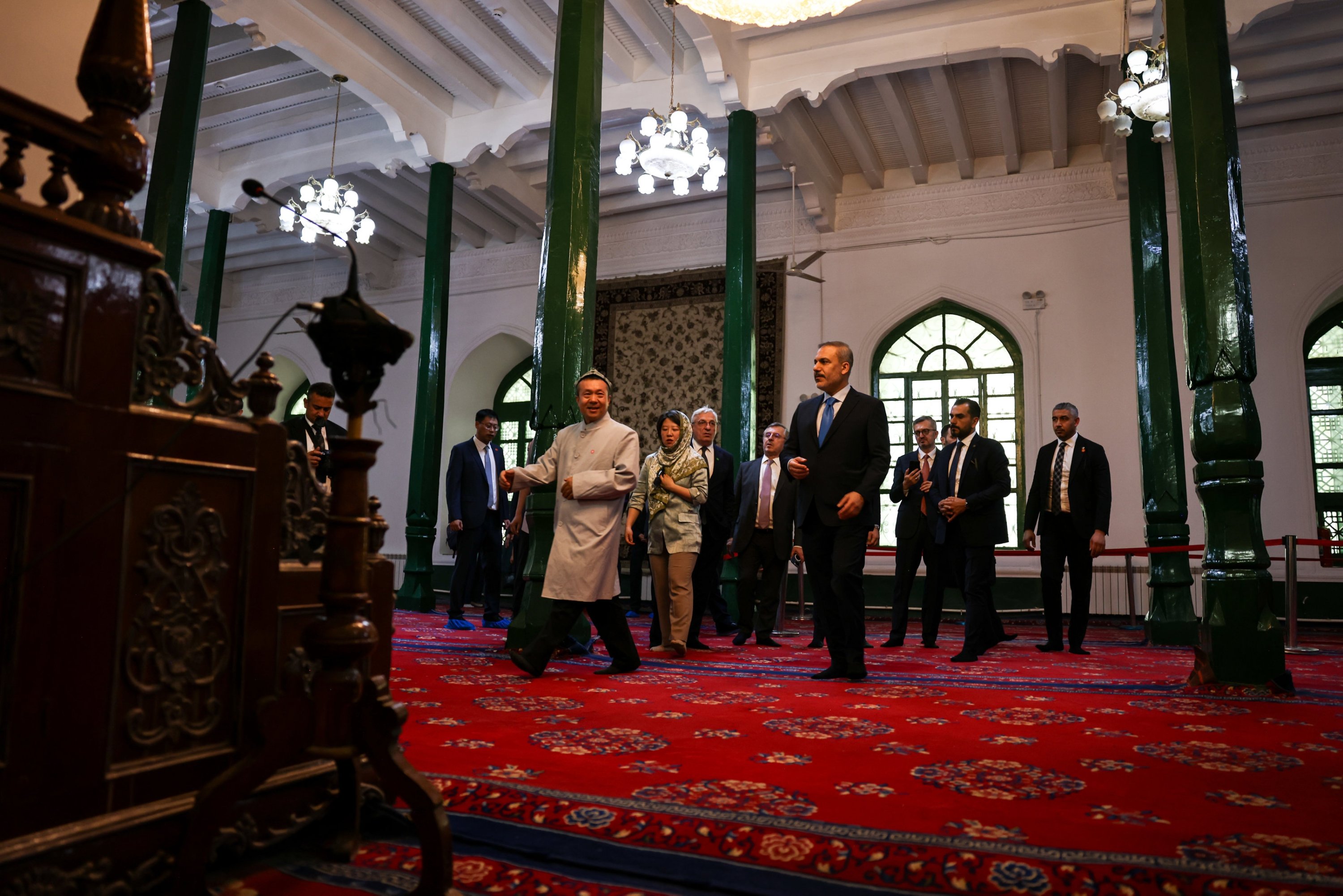
Foreign Minister Hakan Fidan visited China last week. He delivered speeches at significant institutions in Beijing and also visited the Xinjiang Uyghur Autonomous Region of northwestern China. In fact, the region had not received any international visitors for a long time.
There are many regions globally that are under the captivity of different countries. However, due to its cultural depth and historical role, Xinjiang is not a land or country that can be forgotten or abandoned. When the entire Turkish geography was occupied, some Turkish states were annexed by the Soviet Union. Many of these regions declared independence with the collapse of the Soviet Union. The remaining parts were annexed by China. China enforces stricter policies than Russia and keeps Xinjiang under tight control. Hence, sometimes, there are leniency policies for Uyghur Turks in China, and from time to time, assimilation policies are implemented.
Israel has been fighting to destroy Palestinians for 75 years, killing their leaders at every opportunity and imprisoning tens of thousands of Palestinians. However, today, the Palestinian population in the world is almost more than that of Israelis. A nation cannot be eradicated through assimilation or killing.
Recently, I read a hadith (sayings and actions of the Prophet Muhammad) and found it striking: “A hundred years from now, none of the people living in today’s world will remain.” Even though the history of humanity is long and states might have six to seven thousand years of history, none of the people trying to destroy each other today will be around in a hundred years. Such perspective radically reminds us how wars, destructions and great struggles bring about significant disasters for humanity.
The United States, which positions itself as a promoter of democracy worldwide, considers China’s actions anti-democratic. In fact, neither the U.S. nor any Western country really cares about Xinjiang. Their claims of democracy are also not genuine.
While fostering good relations with the Islamic world, China sustains trade partnerships in Africa and the Middle East. There is almost no country that China does not trade with. If China behaves like Israel on the Xinjiang issue, it will inevitably face problems with the anger there in time.
Years ago, during a visit to China, I delivered speeches at universities and conducted meetings with think tanks there upon the request of the Chinese government. The Xinjiang issue was a taboo that no one should address. However, when I started talking, I addressed the topic: A scholar who had previously visited China asked me what to write upon returning. I told him that the Xinjiang issue could be viewed from three perspectives: firstly, from the Chinese perspective; secondly, from the perspective of America and Western states, which denigrate China; and thirdly, that Türkiye could mediate by providing confidence to China while also defending the rights of the Xinjiang people on fairground and being watchful of international issues.
In other words, Türkiye can mediate between China and Xinjiang, and its historical mission and its brotherhood with Uyghur Turks allow it to do so. In a way, Fidan's visit aligns with what I conveyed years ago to my academic friend and expressed to the think tanks during our visit as guests of the Chinese state. Today, I believe that if the Chinese state has enabled Fidan to meet with the Uyghur Turks in Xinjiang, it indicates that they have adopted a framework similar to the vision I proposed years ago.
States usually act with common sense. However, it is occasionally evident that they behave erratically and lose control. Umar ibn al-Khattab, who was a senior companion and father-in-law of the Prophet Muhammad, has a very valuable saying: “It is always better to err on the side of forgiveness than to be wrong in punishment.” Judging by both the information we receive and what remains unreported about events in Xinjiang, it is evident that Uyghur Turks are enduring significant trauma. I hope that this visit and similar efforts will lead to a restoration of sanity and justice in Xinjiang.