In recent weeks, the region has gone through extraordinary and extreme transformations. I've been recently examining the initiative launched by Saudi Arabia against the United Arab Emirates (UAE). The efforts of newly formed, relatively small states that try to imitate Israel and seek a share in global diplomacy were effectively cut short once Saudi Arabia entered the picture.
At the same time, a swift rapprochement among Saudi Arabia, Egypt, Pakistan and Türkiye came to the forefront. This has revealed a pattern showing that the reflexes of institutionalized states tend to develop similar reflexes; eventually, bureaucracy and statecraft inevitably guide them toward the correct path.
In due course, Israel, foremost among them, along with organizations such as the PKK terrorist group and its Syrian wing, YPG, face a situation they are struggling to realize. In fact, we see that they have failed to interpret the transformation in global geopolitics – and Türkiye’s role and objectives within it.
In the U.S., Democrats, neoliberals and circles centered on individualism and civil society had pursued a strategy of political chaos, supporting opposition elements against governments in various countries and, in the long term, encouraging ethnic groups to pursue statehood aspirations.
In contrast, Republicans – and particularly U.S. President Donald Trump – have demonstrated a clear preference for working with strong nation-states. For this reason, Trump treated Türkiye as a legitimate counterpart alongside Egypt and Saudi Arabia, while dismissing both small ethnic entities and terrorist structures outright. In reality, Trump’s principle of working with institutional states has constituted a deep trauma not only for the PKK/YPG but also for Israel.
When the people's revolution took place and a new state emerged in Syria, Türkiye exerted extraordinary efforts to protect Syria’s territorial integrity. Today, we can speak of two major powers in the region, Türkiye and Israel. However, 10 years ago, when the Syrian civil war began, Iran also wielded significant influence.
Iran, much like U.S. Democrats, placed a strategy of chaos at the center of its regional policy. It defined regional instability as a guarantee of its own stability.
Türkiye, in contrast, equated its own stability with that of neighboring countries. It acted on the principle that the stability of Syria, Libya and Iraq directly translates into Türkiye’s stability. Therefore, the U.S.’ policy of engaging with nation-states on the international stage and Türkiye’s efforts to ensure stability in the entire region appear closely aligned.
As the year-end approached and the relevant agreement in Syria was due to expire, the terrorist group PKK/YPG – exaggerating its strength, while underestimating the Syrian state – once again fell into a historic error. In fact, this mistake is not unique: Throughout history, all terrorist groups have consistently overestimated themselves and underestimated the states they confront.
About two weeks ago, I posted a long message on social media, focusing on this very issue. I stated that in any confrontation between a state and a terrorist organization, the decisive factor is never the headcount of the terror group but legitimacy. States represent legitimacy and lawful authority – and in the end, legitimacy prevails.
The U.S. approaches the region with sensitivity. It does not wish to see direct confrontation between Israel and Türkiye. The risk of such a clash would most likely take place on Syrian territory. If Syria is sacrificed to a chaotic environment dominated by terrorist organizations – one in which Türkiye perceives itself as under threat – then the likelihood of two neighboring states being drawn into conflict increases. While this aligns broadly with Trump’s principle of working with nation-states, the U.S. also recognizes that establishing order in Syria would, at the same time, create a buffer between Israel and Türkiye.
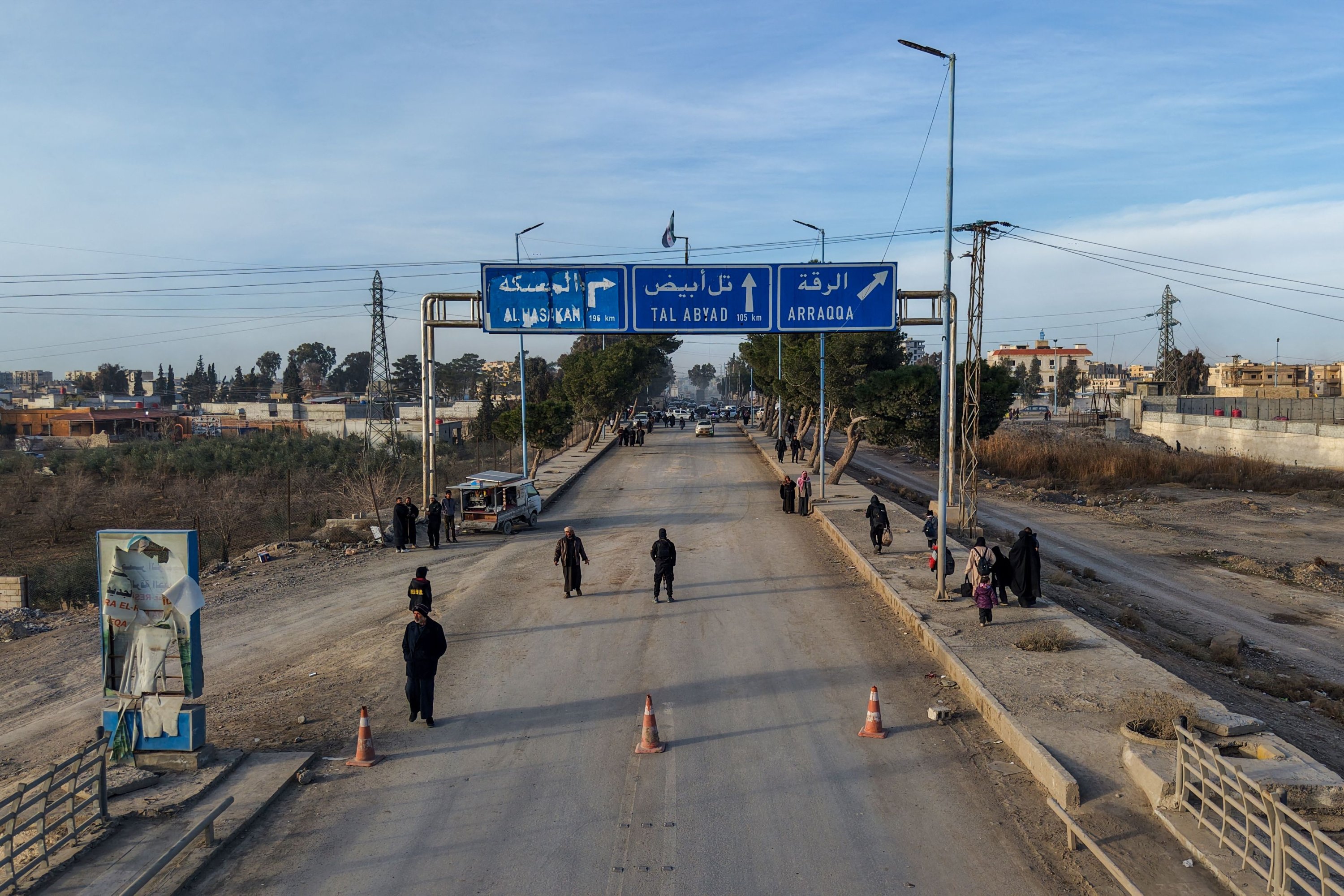
Meanwhile, Syrian President Ahmed al-Sharaa is demonstrating notable leadership capacity. While maintaining relations with the U.S. and the U.K. – at a time when Syrian armed forces were fighting the PKK in Hassakeh, Raqqa and Deir el-Zour, the Syrian president, although later postponed, had also planned a visit to Germany.
Türkiye is a regional power that possesses a state structure capable of exerting global influence in diplomacy and foreign policy. With its trained human capital, strong military, experienced diplomats and intelligence capabilities, Türkiye has directly managed this process alongside the Syrian government.
Those who chose to put their trust in Israel and the U.S. – rather than remain loyal to the lands where they were born, lived, ate and drank, namely Türkiye, Syria and Iraq – by making thousands of misguided choices have once again found themselves on the wrong side of history. This has once more revealed how those claiming to lead the Kurds have, in fact, acted against Kurdish interests, undermining their peace, prosperity and well-being.
In a recent statement, Masoud Barzani, the former president of the Kurdistan Regional Government (KRG), said that the PKK must leave the Kurds in Syria alone; Kurds should live within a legitimate state, and they do not need the PKK to do so. Drawing on his experience and political heritage, Barzani has come to recognize this reality with clarity. One can only hope that other Kurdish leaders will take note and draw the necessary lessons as well.
Today, the Syrian state has rapidly expanded its zone of legitimacy, while the space occupied by terrorist organizations has narrowed dramatically. Taken together, these developments – and even the tone of recent statements – can be interpreted, in one sense, as the PKK’s de facto death warrant.