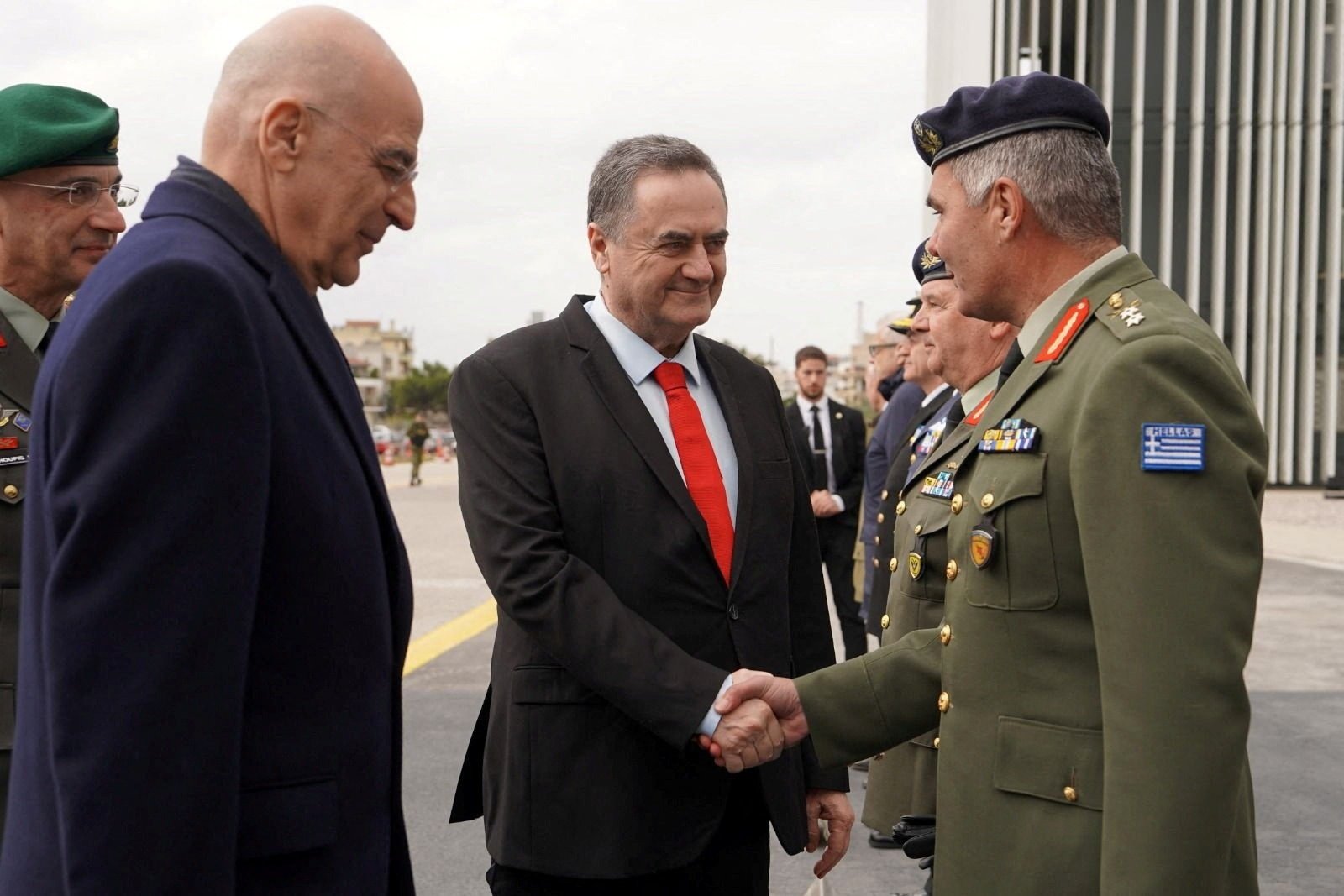
On the last day of August, two tables were set at the same time. In Istanbul, the first high-level meeting was being held under the framework of the Mecca Joint Defence Agreement, signed by Türkiye, Saudi Arabia and Pakistan on Aug. 7. On the same day in Tel Aviv, Israeli Ministry of Defense Director-General Amir Baram and his Greek counterpart, Maj. Gen. Ioannis Bouras, signed the “Achilles Shield” contract.
Athens put the price tag at 3.035 billion euros ($3.51 billion). It is the largest defense export deal in Israeli history, reportedly surpassing even Germany. But one item in the package is particularly critical: the national command-and-control system to be built by Rafael. David’s Sling, Spyder, Barak MX and Elta radars are set to integrate Greece’s entire airspace into a single Israeli-designed architecture within 35 months.
In other words, Greece is not merely buying weapons from Israel. It is outsourcing the nervous system of its air sovereignty. Athens may have secured a 25% domestic production share and provisions for access to source code, but these do not alter the fundamental reality.
Nor is this a sudden decision. In 2021, Elbit took over the international flight training center in Kalamata for approximately two decades. In December 2025, the Greek Parliament approved the acquisition of 36 PULS rocket launchers, and a $750 million contract was signed in April 2026.
Calling Achilles Shield the culmination of this process would not be an exaggeration. And this is not merely my assessment. Parts of the Greek press have described the agreement as a “national trap.” Militaire warned that “our freedom now depends on Israel.” Syriza has demanded that the government explain whether the agreement genuinely safeguards Greece’s strategic autonomy. Former Finance Minister Yanis Varoufakis summed it up in a single phrase: “Shameful.”
The government’s response, however, reveals the political logic behind the agreement. Health Minister Adonis Georgiadis told Parliament that the alliance with Israel guarantees “the freedom of the Greek state.” He dismissed pro-Palestinian protests at Greek ports as “clownery” and openly identified Türkiye as a threat. This is where the Turkish-Greek dimension deserves closer scrutiny.
Türkiye and Greece certainly have serious disagreements. The Aegean, the Eastern Mediterranean and the island of Cyprus remain contentious issues. But disagreement is not the same as permanent enmity, and the existence of unresolved disputes does not automatically make Türkiye an existential threat to Greece.
The more important question is whether Athens has allowed the perception of Türkiye as a permanent threat to become the organizing principle of its entire security policy. That distinction matters. A country that sees every defense partnership as a necessary response to an ever-present enemy can gradually find itself locked into a cycle of threat perception and military dependency. Each new acquisition reinforces the original narrative; the original narrative, in turn, justifies the next acquisition. This is the deeper significance of Achilles Shield.
Türkiye is presented as part of the rationale for a system whose technological architecture will increasingly connect Greece to Israel. The partnership may enhance Greece’s military capabilities, but Israel is not bound to Greece by a mutual-defense commitment that obliges it to fight Greece’s wars. Military cooperation and strategic guarantees are not the same thing.
At the same time, Türkiye has pursued a markedly different strategy. Over the past two decades, it has invested heavily in developing a domestic defense industry designed to reduce reliance on external suppliers.
Greece has chosen another model: strengthening its deterrent capabilities through increasingly deep technological and strategic partnerships with outside powers. Neither approach is without costs. But the contrast raises an unavoidable question for Athens: does buying more advanced systems necessarily translate into greater strategic autonomy?
The picture becomes even clearer when we extend the map to the Greek Cypriot administration. The Greek Cypriot administration had already received the Barak MX system, and now the same platform is becoming the core of Greece’s new shield. Add to this the approximately 3,800 properties acquired by Israeli citizens in the Greek Cypriot south between 2021 and 2025. Their geographical concentration is also worth noting: 1,406 purchases in Larnaca, 1,291 in Paphos and 1,154 in Limassol, clustered around ports, bases and coastal areas.
The broader trend is therefore difficult to ignore. External actors are acquiring an increasingly prominent role in the Eastern Mediterranean security architecture, while the fundamental relationship between Türkiye and Greece remains defined largely through military suspicion. But dependency does not necessarily produce deterrence. At times, it produces constraints.
Nor is there any guarantee that Israel would fight Greece’s wars. There is no mutual-defense clause here comparable to the one contained in the Mecca Agreement. What Greece gains is significant military capability; what it may gradually surrender is the ability to exercise that capability entirely on its own strategic terms.
Perhaps that is the real Achilles’ heel. Not the weapons Greece is buying, but the possibility that the search for security could gradually narrow its room for independent action.
Athens has every right to strengthen its defenses and pursue international partnerships. But Türkiye and Greece also have a choice: to treat every disagreement as evidence of an inevitable conflict, or to recognize that rivalry need not permanently define their relationship. No imported defense system can resolve the political problems that ultimately lie behind a regional security dilemma.
The distance between the two shores of the Aegean is shorter than the distance between Athens and Tel Aviv. For both Türkiye and Greece, a durable security order will ultimately depend on how they manage their relationship with each other.