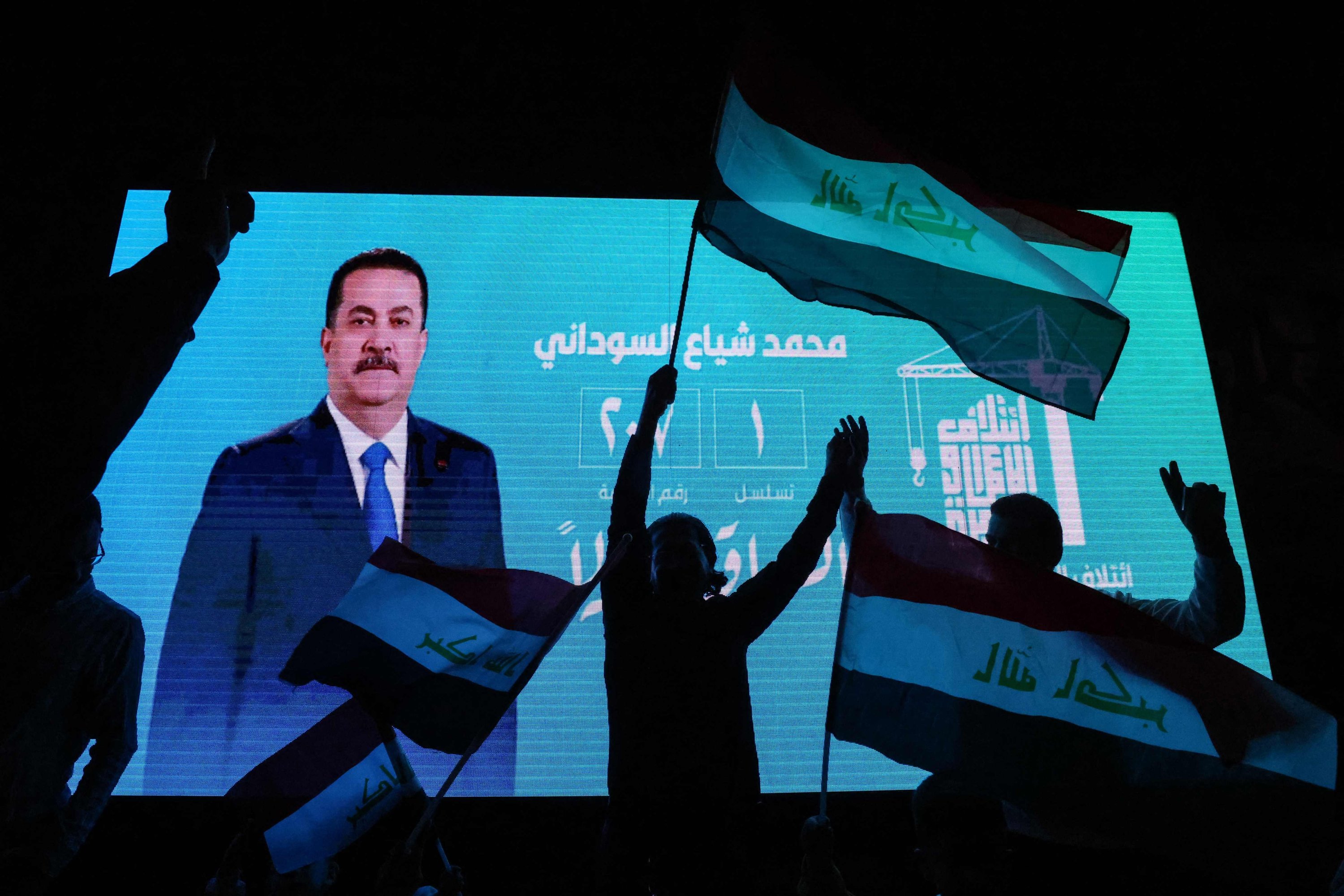
On Nov. 11, the Iraqi people voted in their sixth parliamentary elections since the fall of Saddam Hussein’s regime in 2003. The election environment was quite positive and hopeful. More than 100 political parties and 7,744 candidates competed in the elections to enter the 329-seat Iraqi Parliament. Taking the election results into consideration, this mess in politics will gradually decrease. More than 40 candidates received only one vote in the elections. Small political parties have largely failed. Therefore, the number of political parties may decline in the future.
No single party won the majority of the seats in the elections. The Iraqi Independent High Electoral Commission announced that the Reconstruction and Development coalition led by Prime Minister Muhammad S. Al Sudani, which secured 46 seats in the parliament, came first. The Progress (Taqaddum) Party, led by Parliament Speaker Muhammad al-Halbousi, came second and won 36 seats. According to the results, no party or political coalition won a decisive victory. The formation of a large coalition is needed. The Iraqi people, who come from different ethnic and sectarian backgrounds, avoided the consolidation of power by one party. However, Shiite political parties, who represents the country’s demographic majority, won the most seats in the parliament.
According to the official data, the election turnout was a record high 56%. The results call for the formation of a broad coalition government led by a Shiite party. The incumbent Al Sudani, the strongest candidate, is expected to serve for a second term.
Considering the results of the election, the following inferences can be made. First of all, the Iraqi people adopted a pro-stability stance in the elections, prioritizing prosperity and development over ideology or ethnic or sectarian identity. They expect politicians to maintain political and economic stability and to carry out necessary reforms. This demonstrated a transformation in the political culture of Iraqi society.
Although the Sairun Coalition, led by Muqtada al-Sadr, which had a clear lead in the 2021 elections with 73 seats, boycotted the election and did not participate, the election turnout was a record high. On the other hand, their votes were distributed among different parties, not just one.
The elections show the transformation of social and political life in Iraq. A significant indicator of social and political transformation in the country is the increased participation in the elections. The 56% election turnout, exceeding expectations, shows a 13% increase compared to the previous elections. Furthermore, this high rate contributed to the increased legitimacy of politics.
Calls from religious figures to boycott the elections did not resonate strongly with society. Al-Sadr directly called for a boycott. The boycott call, especially among the younger generation, had little impact. The overwhelming majority of ballot box observers were young men and women in their 20s. This also demonstrates that the political sociology of the country is changing.
Not only the role of religious institutions, but also the role of other traditional institutions, such as tribes, has diminished. “Service politics” began to come to the fore.
The only anomaly is the role of armed groups. Candidates with close ties to armed groups, including tribal candidates, won the elections. Many voters voted for those who could provide jobs, streamline operations, offer grants or build roads.
The election results show that the Iraqi identity is getting stronger. Moreover, the voters have distanced themselves from Iran and do not want to be affected by the Iranian state’s problems, but not too much. A few months ago, Iraq narrowly escaped being involved in the war between Iran and Israel. Now, they have achieved a balance between their bonds with Iran and their political independence and national interests.
We also see that political actors who received the most votes and consolidated their positions are actors who distanced themselves from Iran. The three parties that received the most votes in the elections are the Reconstruction and Development coalition led by Al Sudani, the Kurdistan Democrat Party (KDP) led by Masoud Barzani, and the Progress (Taqaddum) Party led by Muhammad Halbusi (Sunni).
Elections allow Sunni Arabs to participate in the country’s governance. The Sunni bloc consolidated its position, and the bloc emerged from the election much stronger. The otherization of a large segment of the Iraqi society naturally would become a source of political tension. Results allow the Sunni Arabs to remain as part of the state. Parliament Speaker Halbusi became the most powerful Sunni politician after Tariq Hashemi.
Another outcome is in Kurdish politics in Iraq, where the KDP emerged stronger in the elections and especially consolidated its position in the autonomous region. The KDP received twice as many votes as its archrival, the Patriotic Union of Kurdistan (PUK).
In conclusion, in spite of many deficiencies of the Iraqi political system, the most recent elections demonstrated that the future of Iraq is promising. According to the 2005 Constitution of Iraq, a political system based on ethno-sectarian identity was formed. The presidency has gone to the Kurds, the speaker of parliament to the Sunni Arabs and the prime ministership to the Shiites. State institutions are also allocated according to the same formula. The president is elected with a two-thirds majority in parliament. Then, the president appoints a prime minister-designate from the Shiite party with the most seats in the parliament
In spite of these institutional challenges, the country recently achieved relative stability. The Shiite coalition builds a comprehensive political coalition with the main Sunni Arab and Kurdish parties to form a government. Iraqi political parties are able to achieve a balance among different domestic political actors as well as external actors such as Iran and the United States. A weakened Iran and a disengaged United States facilitate the maintenance of Iraq’s political stability and democratization process.