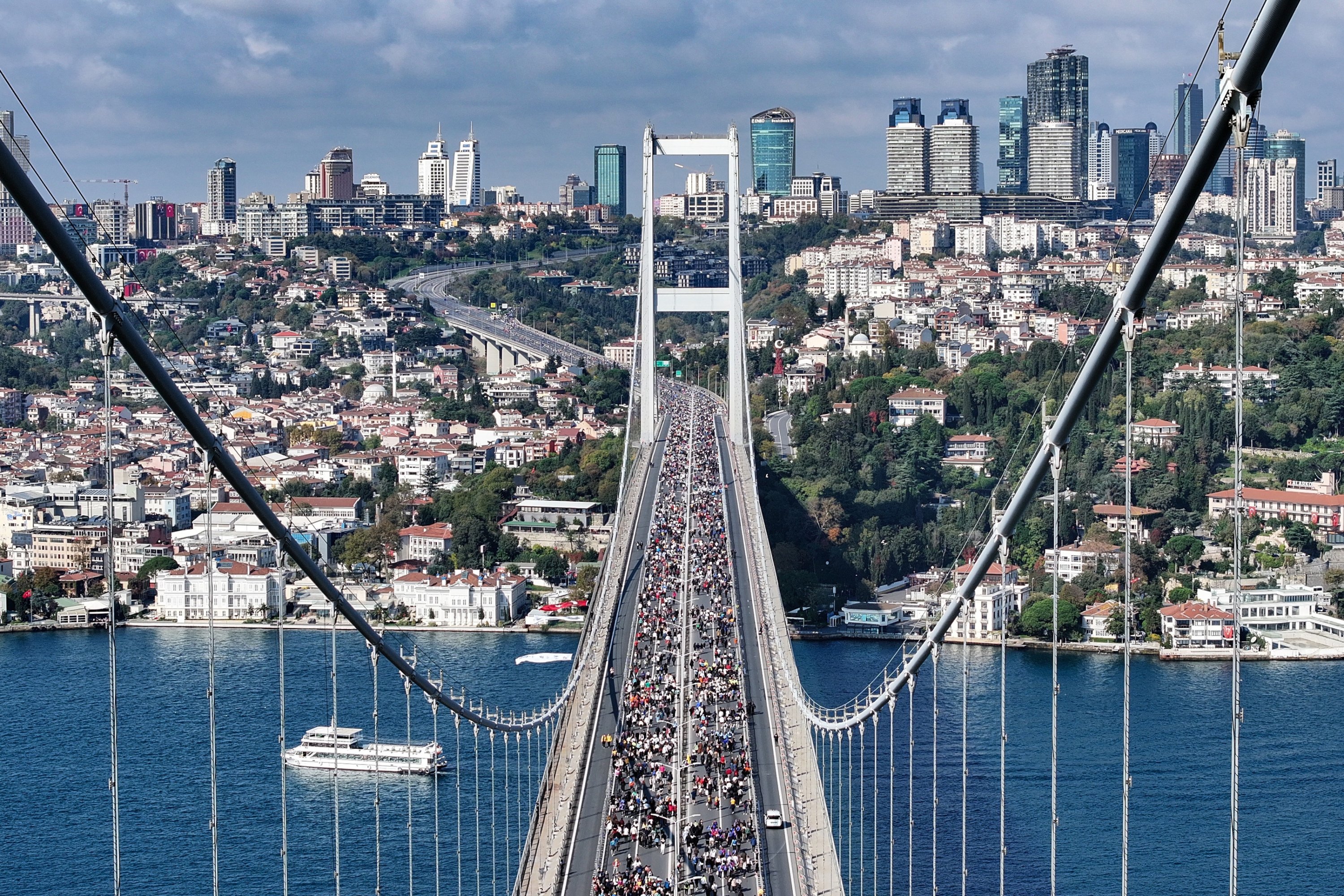
A week ago, early on Sunday morning, I stood on the deck of a ferry crossing the Bosporus, shoulder to shoulder with hundreds of runners. Around me, I heard Turkish, English, German, Arabic, Polish and languages I could not identify. Everyone was wearing a bib, everyone was nervous, and everyone was heading to the same start line on the Asian side.
I had signed up for the 15.5-kilometer race at the Istanbul Marathon, the longest distance I had ever attempted. It was my first Istanbul Marathon. I finished at what I can only describe as a 40-year-old dad pace. But I finished, and I have the medal to prove it. I came home tired and happy, but also with a list of things I could not stop thinking about. Some were wonderful, some were frustrating and one was frankly ugly.
No other major race in the world can offer what Istanbul offers. You start in Asia and finish in Europe, and in between you run across a bridge that, on every other day of the year, belongs to cars. The city's geography does the marketing on its own. Crossing that bridge on foot, with the water below and the city opening up on both shores, is a feeling I will not forget.
That ferry ride was the highlight of my morning. Hundreds of strangers from literally everywhere crossed the Bosporus together at dawn, chatting about pace, shoes and nerves. It felt less like a commute to a start line and more like a small festival on water. Organizers should treat it as a signature moment of the race, because that is exactly what it is.
The event also shows how much Türkiye's running culture has grown. The race is now nearly half a century old, but for most of that time it was a niche affair for a few dedicated athletes. Today it draws families, corporate teams, running clubs and first-timers like me. That is a public health story as much as a sports story, and it deserves recognition.
The same ferry that gave me the best moment of the day also produced the worst. The crossing took longer than planned, and many of us arrived too late for the bag drop deadline. Imagine preparing for months, waking before dawn and then spending your last half-hour before the start worrying about where to leave your bag. Nobody on that boat was at fault, yet we were the ones who paid for the delay.
Once on land, the start area made things worse. The course entrance, bag drop and toilets were all crammed into the same small space. Thousands of runners were trying to do three different things in one spot at the same time. The result was a slow-moving crush of people, with runners queuing for the toilets blocking those trying to reach the corrals.
The frustrating part is how easily this could be fixed. People came to run 15.5 or 42 kilometers. Nobody would have complained if the toilets, the bag drop and the entry were each 100 meters apart. A simple one-way flow (toilets first, then bags, then the corrals) is standard practice at major marathons. Likewise, if the boats are part of the plan, the bag drop deadline should be tied to the boat schedule, or bags should be collected at the piers before boarding.
Then there were the plastic bottles. Thousands of them were handed out at water stations, half-full and tossed onto the road within seconds. By the time the last runners passed, parts of the route looked like the morning after a festival. For a race whose entire appeal rests on the beauty of the city, this is a painful image.
There has to be a better way, and other races have already found one. Many major marathons now use cups instead of sealed bottles, which cuts waste and lets runners take only what they need. Some have experimented with refill stations, compostable cups and even edible seaweed water pods, which the London Marathon tried in 2019. Clearly marked drop zones just after each station, with volunteers collecting waste, would also keep the road clean.
None of this is expensive. It requires planning and a decision that the environment is part of the race experience, not an afterthought.
The timing makes this even harder to overlook. Türkiye is hosting COP31, putting the country at the center of the global climate conversation. A marathon running through its largest city was the perfect chance to show that commitment on the street. A road littered with plastic bottles sends exactly the opposite message.
I am not writing all this to complain. I write it because the Istanbul Marathon has something money cannot buy: a course that crosses two continents through one of the most beautiful cities on earth. Berlin, London and New York have built their reputations on flawless organization. Istanbul already has the stage. What it needs now is attention to the small things. A world-class setting deserves world-class details.
Separate the start-area facilities. Align the bag drop with the boats. Rethink the plastic. These are modest fixes, and they would turn a great race into an unforgettable one.
There is now a fridge magnet in my kitchen that reads "Intercontinental Runner." I intend to earn it again next year. I just hope the toilets will be 100 meters away.