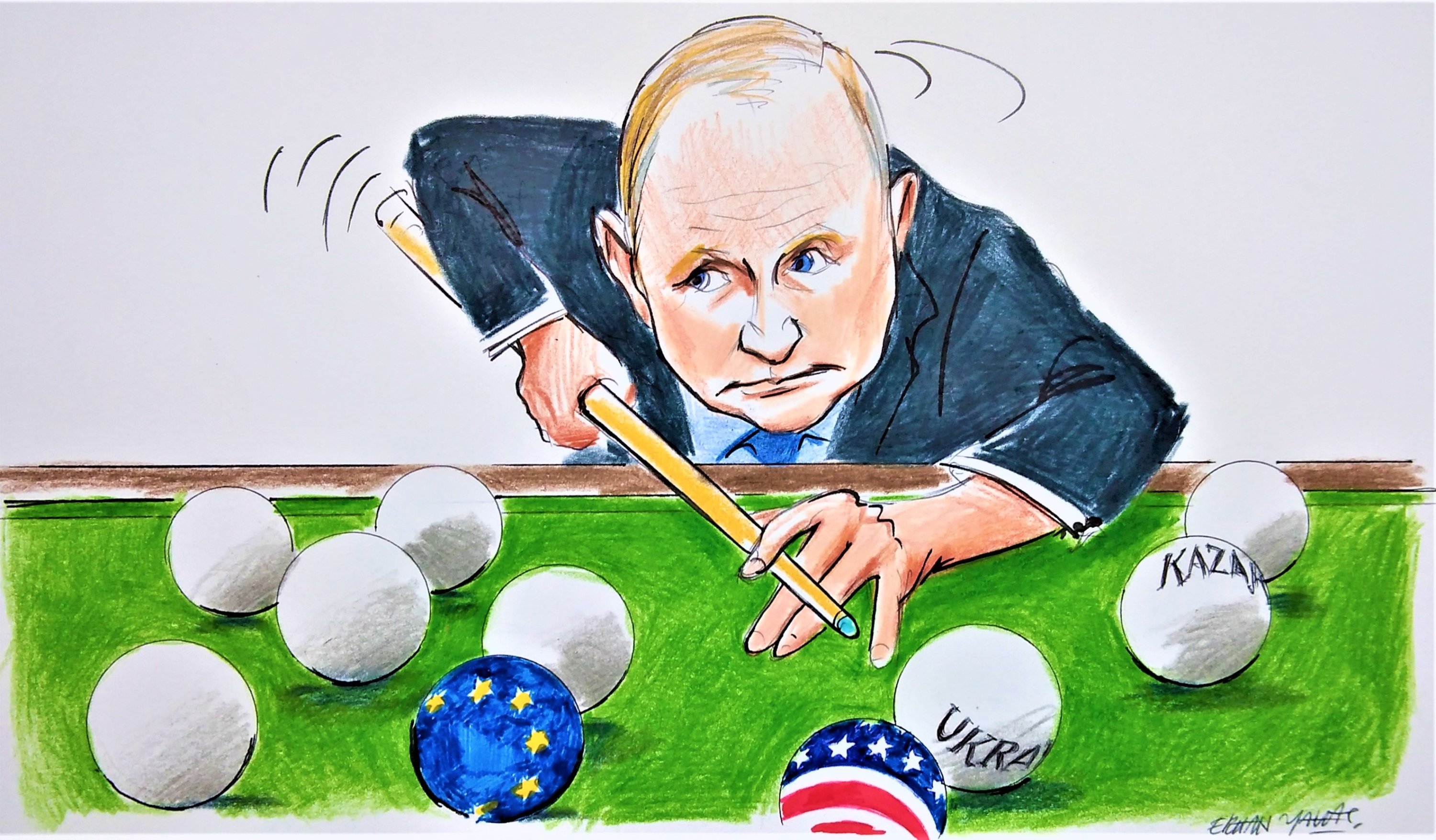
The protests in Kazakhstan took place on the 13th anniversary of the Soviet Union’s disintegration. Whether or not that was a coincidence remains unknown. Yet the Collective Security Treaty Organization’s (CSTO) quick response to Kazakh President Kassym-Jomart Tokayev’s request for help was no coincidence at all.
Having seen the West break its promises about NATO’s expansion, which were made as the Cold War ended, and having witnessed the "color revolutions" in 2000-2005, Moscow made preparations to involve itself in the future of countries in what it sees as its sphere of influence. The organization was founded in 1994, yet Russia’s reaction against NATO’s expansion and its policy of intervention in crisis areas, including the Middle East, coincided with Russian President Vladimir Putin’s strong leadership. Indeed, the Kremlin demonstrated that it would not allow the West to control Georgia (2008) and Ukraine (2014). The Ukraine crisis remains a source of friction between Russia, and the United States and Europe. The Russians have expressed their demands and official talks kicked off earlier this week in Geneva. It remains unclear, of course, whether those proceedings will yield any results.
Speaking at the CSTO’s videoconference last week, Tokayev said his country had survived a “coup attempt.” Putin, in turn, warned that the CSTO would not “allow color revolutions in the region.” To be clear, the CSTO’s rapid deployment of troops to Kazakhstan, having turned down similar requests from Kyrgyzstan in 2010 and Armenia in 2020, reflected the firm commitment that Putin referenced. Both the Russian and Kazakh presidents, however, were careful to underline that the peacekeeping forces would remain in Kazakhstan “for a limited period of time.”
That point was obviously related to the war of words between Washington and Moscow over the duration of foreign troop presence. Unhappy with Russia’s growing influence over Kazakhstan, U.S. Secretary of State Antony Blinken recently warned, "One lesson of recent history is that once Russians are in your house, it's sometimes very difficult to get them to leave.” The Russian Foreign Ministry delivered a strong response: “When Americans are in your house, it can be difficult to stay alive and not be robbed or raped. Indians of the North American continent, Koreans, Vietnamese, Iraqis, Panamanians, Yugoslavs, Libyans, Syrians and many other unfortunate people who are unlucky enough to see these uninvited guests in their ‘home’ will have much to say about this.”
In all fairness, contemporary global history is full of devastation and tragedy that local communities have experienced due to American and Soviet or Russian interventions. It would suffice to take a quick look at Afghanistan alone. Whereas Putin made a commitment not to allow “revolutions” in the region, it goes without saying that the actual battle in his confrontation with the West will take place in Ukraine.
Putin intends to use the Ukraine crisis to strike a “grand bargain” with the U.S. and Europe. That Washington’s actual rival will be China in the medium and long term is not lost on anyone. Hence the Russian leader’s demand for concessions from the West to turn that situation into a strategic advantage in the future. Russia, which played an active role in Syria and Libya, wants NATO to take a step back in order to strengthen its influence over the former Soviet republics and Eastern Europe. That’s why Moscow opts for escalation right now. The United States and Europe, in contrast, find themselves between a rock and a hard place. They do not dare threaten the Russians with anything, except economic sanctions, in case Ukraine is occupied. Putin has already accepted that. The West’s withdrawal from Eastern Europe, however, would mean more Russian influence over the continent.
Is there “a third way between war and reconciliation”? That is unclear, but we will wait and see what happens over the next weeks and months.