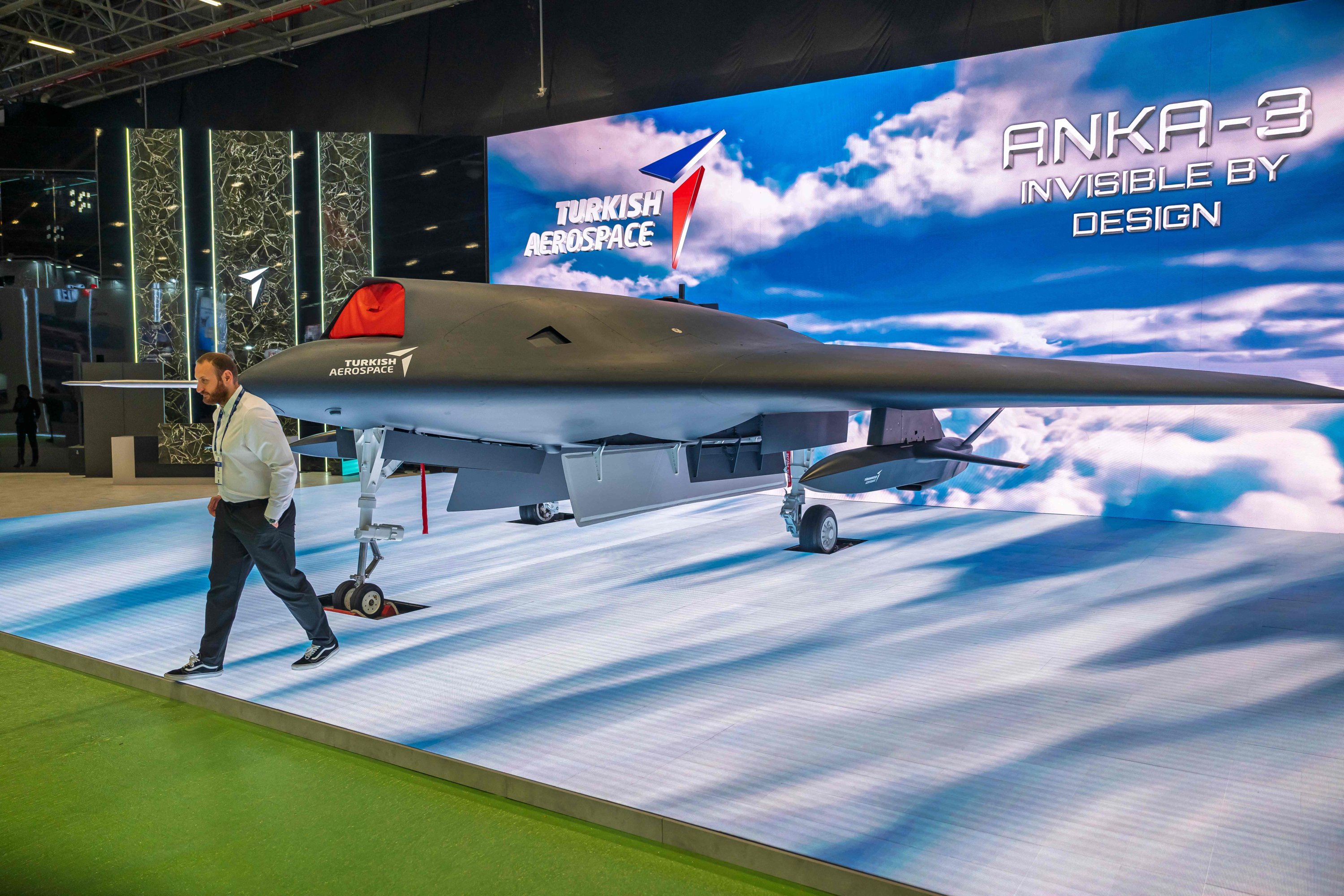
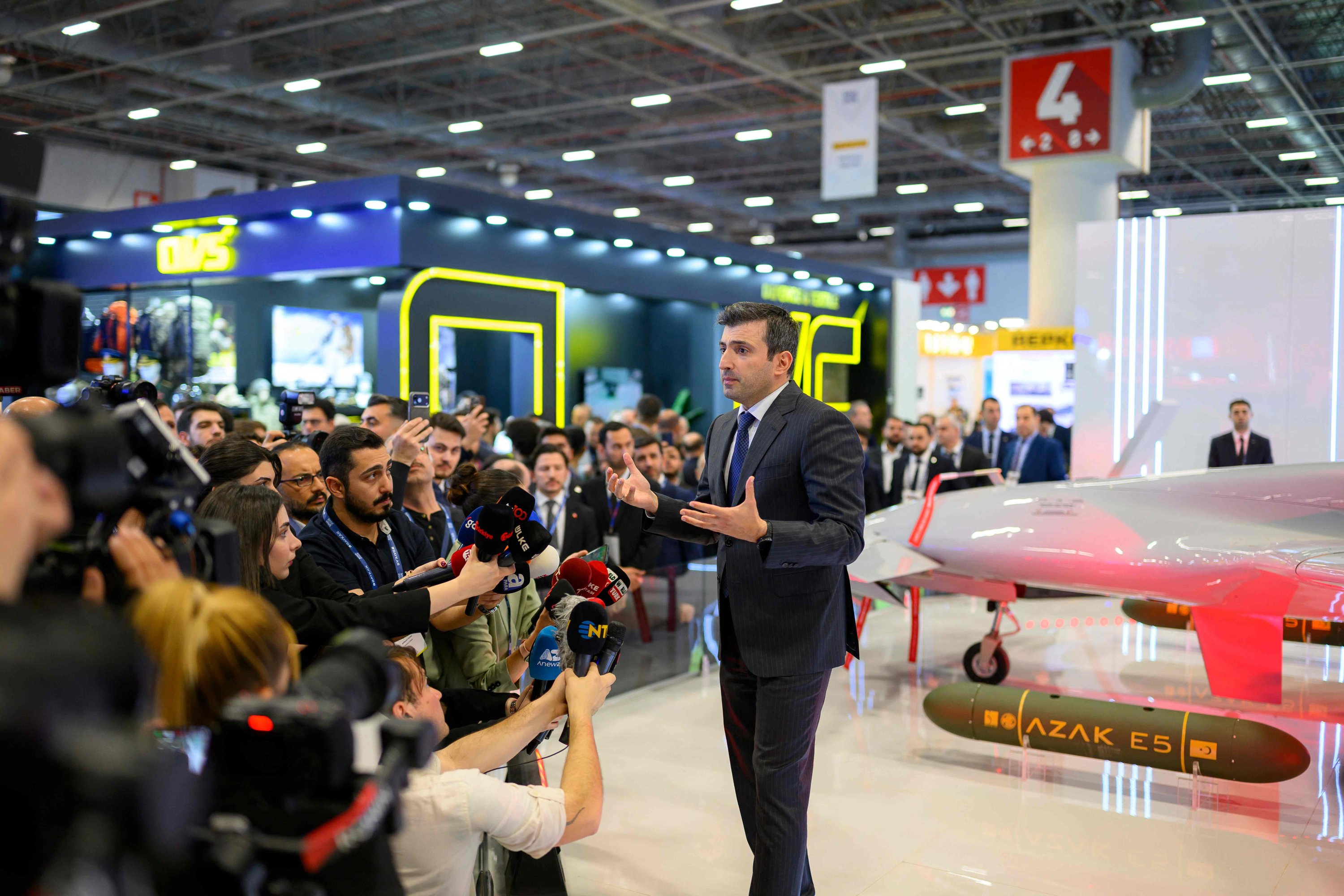
At the SAHA 2026 expo, an International Defense and Aerospace Exhibition held in Istanbul this week, Selçuk Bayraktar delivered remarks that defied easy categorization. The man who built the drones that reshaped contemporary warfare did not speak primarily about weapons systems, export figures, or strategic deterrence. He spoke about smartphones. The greatest threat we face, he argued, is not a conventional military adversary massing on a border. It is the device in our pocket: a platform whose algorithms are designed not to inform or connect but to exploit neurological vulnerabilities, to maximize engagement through fear, anger, and addiction, and to embed users inside what he called a spider web of digital dependence.
Technology companies, he warned, have evolved from providers of services into something closer to a techno-feudalist structure, governing behavior, shaping political perception, and extracting data at a scale no territorial empire could have imagined. He called for a Technological Solidarity Alliance among friendly, allied, and developing nations, built on decentralized, federated, open-source architectures as an alternative to the concentrated cloud monopolies that currently mediate the world’s data flows.
On the same day, at NEXT TRT 2026, Burhanettin Duran, head of Türkiye's Communications Directorate, posed a question that echoed Bayraktar’s diagnosis from a different vantage point. Who will govern us in the future, he asked, if algorithms already shape how we form opinions, make decisions, and understand the world? Duran warned against becoming, in his words, semi-mechanized individuals whose minds are being controlled, swept by currents and algorithms from side to side, without knowing where we are going. He called on countries like Türkiye, states that appear middle-sized but carry a message for the world, to step forward in the domain of technological supremacy, not merely to speak but to act.
Taken together, these two speeches constitute something more than public intellectual commentary. They represent a coherent Turkish diagnosis of the defining civilizational contest of this era. One is speaking about the geopolitics of technology. The other is speaking about its anthropology. Bayraktar is calibrating military-technological posture against a superior competitor. Duran is fighting the war that runs beneath it: information, cognition and the contest for human agency. Both are right, and their convergence on the same day points to the emergence of a distinctly Turkish philosophy of technology.
The era of a universal technology order, governed by American platforms, liberal norms and the assumption that open digital infrastructure would distribute freedom and prosperity equally across nations, is over. What has replaced it is a fragmented, competitive and increasingly weaponized landscape in which states are pursuing sovereign digital architectures with the same urgency they once reserved for nuclear programs.
The United States treats technology export control as a primary instrument of geopolitical competition, restricting access to advanced semiconductors and AI chips across a growing list of countries and companies. China has built an entirely parallel digital ecosystem and is pursuing semiconductor independence through programs worth hundreds of billions of dollars. The European Union has responded with the AI Act, the Digital Markets Act and the Digital Services Act, attempting to assert regulatory sovereignty over platforms whose servers sit in California but whose reach extends into every European household.
None of these actors is pursuing a universal vision. Each is pursuing a civilizational one. The international technology order has been departmentalized: fragmented into competing national and bloc architectures, each encoding its own values, governance norms, and its own vision of the relationship between technology, power and the human person.
Bayraktar’s Technological Solidarity Alliance is a proposal to give this fragmentation a third direction, one defined not by American platform dominance or Chinese state-directed technological nationalism, but by decentralized sovereignty and shared human dignity.

Türkiye's technological trajectory must be understood at the level of the ecosystem, not the platform. The drone narrative, however accurate, captures only one dimension of a defense-industrial transformation that is reshaping the country's entire technological DNA.
In 2025, Türkiye’s defense and aerospace exports surpassed $10 billion for the first time in history, a 48% year-on-year increase from the $7.1 billion recorded in 2024. New contracts reached a record $17.8 billion, growing by 78% in a single year. Five Turkish defense companies now appear in the Defense News Top 100 global rankings: Aselsan at 43rd, Turkish Aerospace Industries (TAI) at 47th, Roketsan at 71st, ASFAT at 78th and MKE at 80th.
According to the Stockholm International Peace Research Institute (SIPRI), Türkiye has secured the 10th position among the world’s largest defense industries. The sector directly employs approximately 100,000 people, with targets of 158,000 by 2028 and sector-wide exports of $11 billion. Total R&D spending in Turkish defense reached $3.3 billion in 2025 alone, exceeding the total R&D budgets of several European states combined.
The breadth of this ecosystem is what distinguishes the current moment from earlier phases of Turkish defense development.
Aselsan, with annual revenues of $3.47 billion, has signed new contracts worth $2.07 billion with 58 countries, including a $410 million electronic warfare system sale to Poland, the first such sale to a NATO member state. The Steel Dome air defense architecture, integrating the Siper long-range, Hisar mid-range and Sungur short-range platforms into a single networked system, represents a qualitative leap in integrated air defense design.
Roketsan entered serial production in 2025 on both the Akata anti-ship missile and the Tayfun strategic ballistic missile and its products are now active in more than 40 countries.
ASFAT delivered Pakistan’s PNS Khaibar corvette under the MILGEM program and began sea trials on a Romania-bound vessel, opening the European naval export market.
Indonesia alone signed contracts in 2025 for 60 Bayraktar TB2 drones, nine Akıncı unmanned aerial vehicles (UCAVs) with a joint drone factory agreement, two Istif-class frigates, and a reported $6 billion order for 48 Kaan fifth-generation fighters. Türkiye’s Hürjet advanced trainer secured a 2.6 billion euro ($3.06 billion) contract to supply Spain’s NATO pilot training center. This is not a single-platform export story. It is a systemic defense ecosystem establishing itself as a credible alternative in global arms markets.
The Iran-Israel war has added a new and urgent dimension to this assessment. The conflict has simultaneously recapitalized conventional military posture, demonstrating that mass, firepower and territorial defense remain irreducible elements of state power, and accelerated the strategic significance of post-conventional capabilities in ways that will shape the future of warfare.
The artificial intelligence (AI) powered loitering munition systems Bayraktar unveiled at SAHA 2026, the K2, the Mızrak and the Sivrisinek, built around GPS-independent visual positioning, swarm attack doctrine and force multiplication through autonomous coordination, are not incremental refinements. They represent the next paradigm of battlefield technology. The lesson the U.S.-Israel war on Iran is teaching in real time is that the state that commands both conventional mass and post-conventional autonomy will define the military-technological horizon of the coming decade. Türkiye is positioning its defense industry to operate on both registers simultaneously.
The honest strategic assessment of Türkiye’s technological position must confront a structural tension that the country’s own most perceptive voices are beginning to name. The defense industrial transformation is real, rapid and increasingly systemic. But it remains concentrated in a domain whose logic is defined by state procurement, strategic necessity and national security imperatives. The broader civilian technology ecosystem has not undergone a comparable transformation. Türkiye has not produced a globally competitive AI research institution, a major civilian technology platform with international reach, or a semiconductor design capability of strategic significance. The brain drain of technically trained graduates to Western universities and companies continues. The venture capital ecosystem, while growing, lacks the depth to sustain the kind of platform development that Bayraktar’s solidarity alliance vision implies.
This gap matters strategically, not just economically. A middle power that develops exceptional military-technological capacity without transforming its civilian technology ecosystem risks building a defense industry that serves state security but does not generate the broader spillovers, the entrepreneurial culture, the civilian AI applications and the sovereign digital infrastructure that constitute genuine technological sovereignty.
Türkiye’s defense industry has been the primary driver and the largest recipient of the country’s research and development (R&D) investment. The question Duran’s challenge implies, even if he did not state it in precisely these terms, is whether the institutional logic, the investment culture, the human capital formation and the philosophical orientation that have produced Kaan and Steel Dome can now be deliberately extended into civilian AI, sovereign cloud, semiconductor design and digital platform development. The military-to-civilian technology transfer is not automatic. It requires a policy decision, a capital allocation and an institutional architecture that Türkiye has not yet fully built.
Türkiye’s contribution to the global technology debate is most original at the level of philosophy and most incomplete at the level of civilian institutional capacity.
Bayraktar’s warning that humanity is heading toward a dark age in which humans themselves are rapidly becoming mechanized, dominated by what he called a soulless rationalism, is not a technical observation. It is a civilizational claim, one that positions Türkiye as a voice for a different kind of technological modernity: not anti-digital, but insistently human-centered, built around ethics, justice and dignity rather than efficiency, scale and engagement maximization.
Duran’s insistence that human consciousness, free will and values must be preserved in the age of AI makes the same argument from a communications and governance perspective. Together they sketch a Turkish philosophy of technology that is coherent, timely, and genuinely distinct from both Silicon Valley's techno-optimism and Beijing's techno-authoritarianism.
The Global South is watching the U.S.-China technological bifurcation with unease, finding neither model adequate to its own conditions and values. Türkiye, combining NATO interoperability with non-Western civilizational claims, military technological credibility with moral-philosophical critique, is better positioned than almost any other middle power to offer a third framework. But a philosophy without an ecosystem is an aspiration, not a strategy.
Bayraktar called on allied and developing nations to share technologies and pool resources to reduce dependence on global monopolies. Duran called on Türkiye to step forward in technological supremacy, not merely to speak but to act. Both imperatives point in the same direction: from the defense industrial base that Türkiye has built over the past decade toward the civilian technological ecosystem that, if Türkiye chooses to build it with comparable deliberateness, could make its philosophy of technology something the world actually uses, not merely something the world admires.