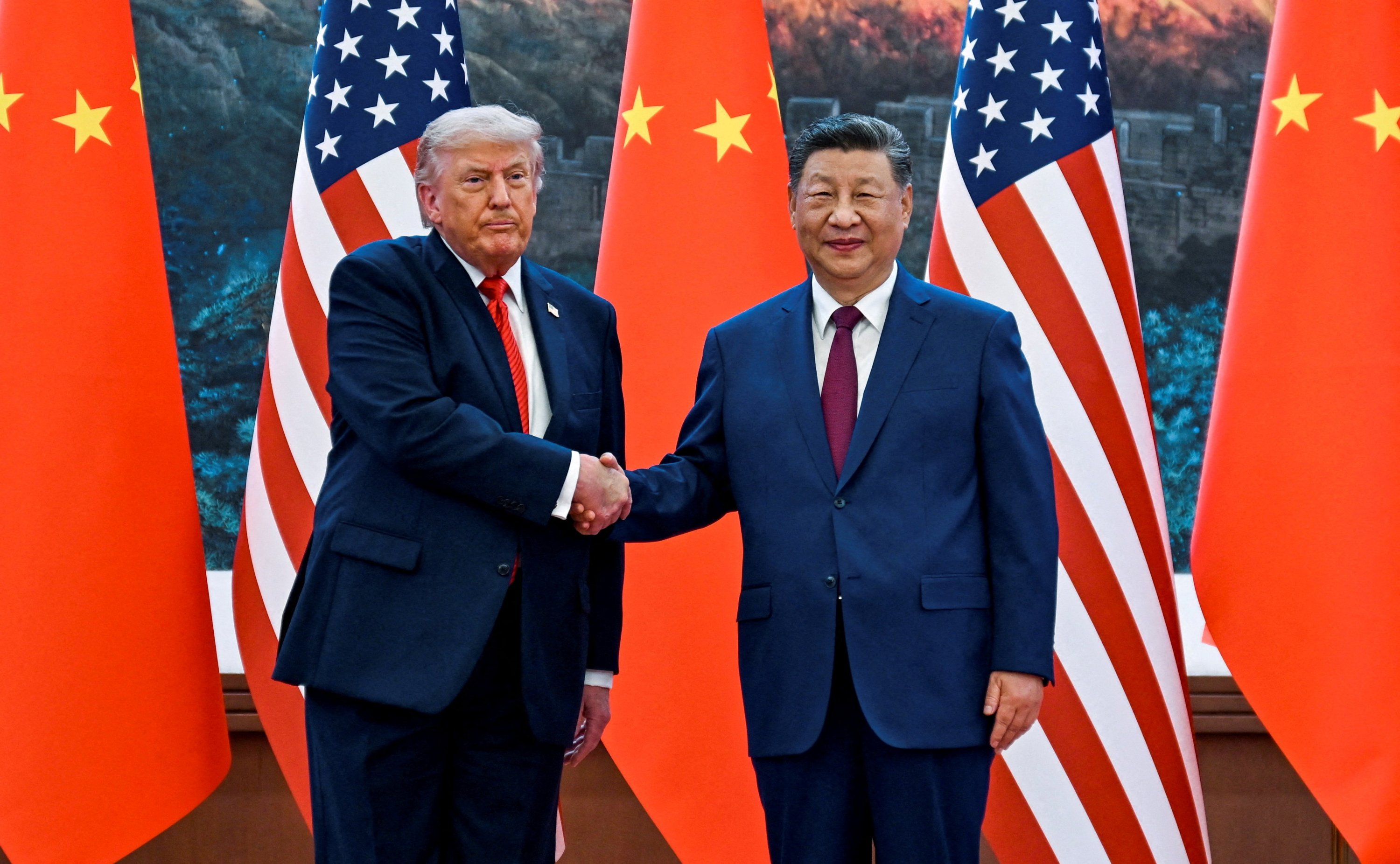
U.S. President Donald Trump visited China for a three-day official trip, marking the first visit by a U.S. president in nearly nine years. His previous visit to Beijing was in 2018. The visit was important since the two countries have decided to reestablish bilateral diplomatic relations.
During his stay, Trump met with Chinese President Xi Jinping twice to discuss different bilateral issues and global political developments, including trade imbalances, new technologies, the Taiwan issue, the U.S.-Israel-Iran war and global security concerns.
Normally, leaders of two countries that compete for global economic and political influence would be expected to meet more frequently. However, as soon as Trump assumed office for his second term, he began to pursue unilateral policies. First, he implemented an economic nationalist approach toward China and other countries, significantly increasing tariff barriers against China. Although China responded accordingly, it behaved more rationally. In bilateral relations, a pattern emerged of a panicking United States and a patient China.
However, the measures taken by the U.S. were largely counterproductive. There are many reasons for this. First of all, China is the largest trade partner of the U.S. There is a high degree of interdependence between the two countries. At a time when the U.S. is bogged down in the Middle East, the Trump administration is expected to soften its stance towards China. It appears that the U.S., at least under current circumstances, wants to pursue a different policy than it perceived before. The U.S. government today does not want to alienate Beijing.
According to the official records, bilateral trade between the U.S. and China dramatically dropped in 2025, the first year of Trump’s second term. As a result of the unilateral steps taken by the U.S. and the Chinese reactions, bilateral trade volume between the two countries decreased dramatically. While U.S. goods trade with China was $658 billion in 2024, it dropped to $414 billion in 2025. Similarly, the U.S. goods trade deficit with China dropped to $202 billion in 2025, a 31.6% decrease ($93.4 billion) over 2024. There are many positive and negative implications of this decrease in trade volume.
We know that economic relations are at the heart of Trump’s policy. During his second term, reciprocal tariffs, technology restrictions and redesigning of production chains at the global level damaged Washington-Beijing bilateral economic relations. Both sides have leveled accusations at each other. The U.S. called for a more balanced bilateral trade, while China urged the easing of sanctions and technology restrictions. Clearly, these economic problems are difficult to resolve, yet both sides must manage the relationship due to their high level of interdependence.
One of the main issues at the negotiation table was technological competition between the two states. It is reported that many sensitive economic issues, such as artificial intelligence (AI) technologies, chip manufacturing, semiconductors, cybersecurity, communication infrastructure and rare elements were discussed during the summit meeting. Washington considers developments in all these sectors as a risk to its national security. The two countries will increase their struggle for global technological leadership.
It seems that the U.S. has to accept the Chinese reality, both in technological development and in economic sectors. Independent Chinese technology platforms will remain outside of American control. In other words, for now, China is the only country in the world that can compete with the U.S. There is a mutually exclusive technological divide between the two countries.
Many observers correctly claim that many recent U.S. policy moves, such as the military intervention in Venezuela and the war in the Middle East, directly target the global Chinese interests. The U.S. aims to contain China’s influence by targeting its key economic and political partners, seeking to block China’s global expansion and penalize countries maintaining strong ties with it.
One of the main subjects discussed during the Trump-Xi meeting was the future of the Asia-Pacific region and specifically the Taiwan issue, the most important security crisis between the two states. China has recently increased its military activities around Taiwan and the South China Sea, which it perceives as part of the Chinese territory. On the other hand, the U.S. continues to provide security guarantees to Taiwan and contribute to its defense capabilities. However, neither side wants to take the risk of direct conflict over Taiwan.
The second main global issue discussed during the summit meeting was the ongoing Iran-U.S. conflict in the Middle East. As a matter of fact, the conflict in the Middle East was one of the main reasons for the visit. When Iran closed the Strait of Hormuz, the global energy market began to fluctuate, and trade routes came under threat. Relying heavily on energy imports, China prioritizes Middle East stability, as regional conflicts pose direct risks to its economy.
The closure of Hormuz and the insecurity of global trade routes damaged the Chinese economy severely. Furthermore, the U.S. knows that China is one of Iran's largest trade partners. As long as China wants to maintain its close relations with Iran, it will become even more difficult for the U.S. to bring Iran to its knees.
Sino-American relations are complex, involving both economic cooperation and strategic competition, which makes them difficult to manage. Consequently, the U.S. administration seeks limited cooperation with China to help stabilize the world market, without provoking direct confrontation. Overall, although China will remain a rival state and neither side is likely to change its core priorities, both are determined to reduce the risk of direct conflict and, at a minimum, keep communication channels open.