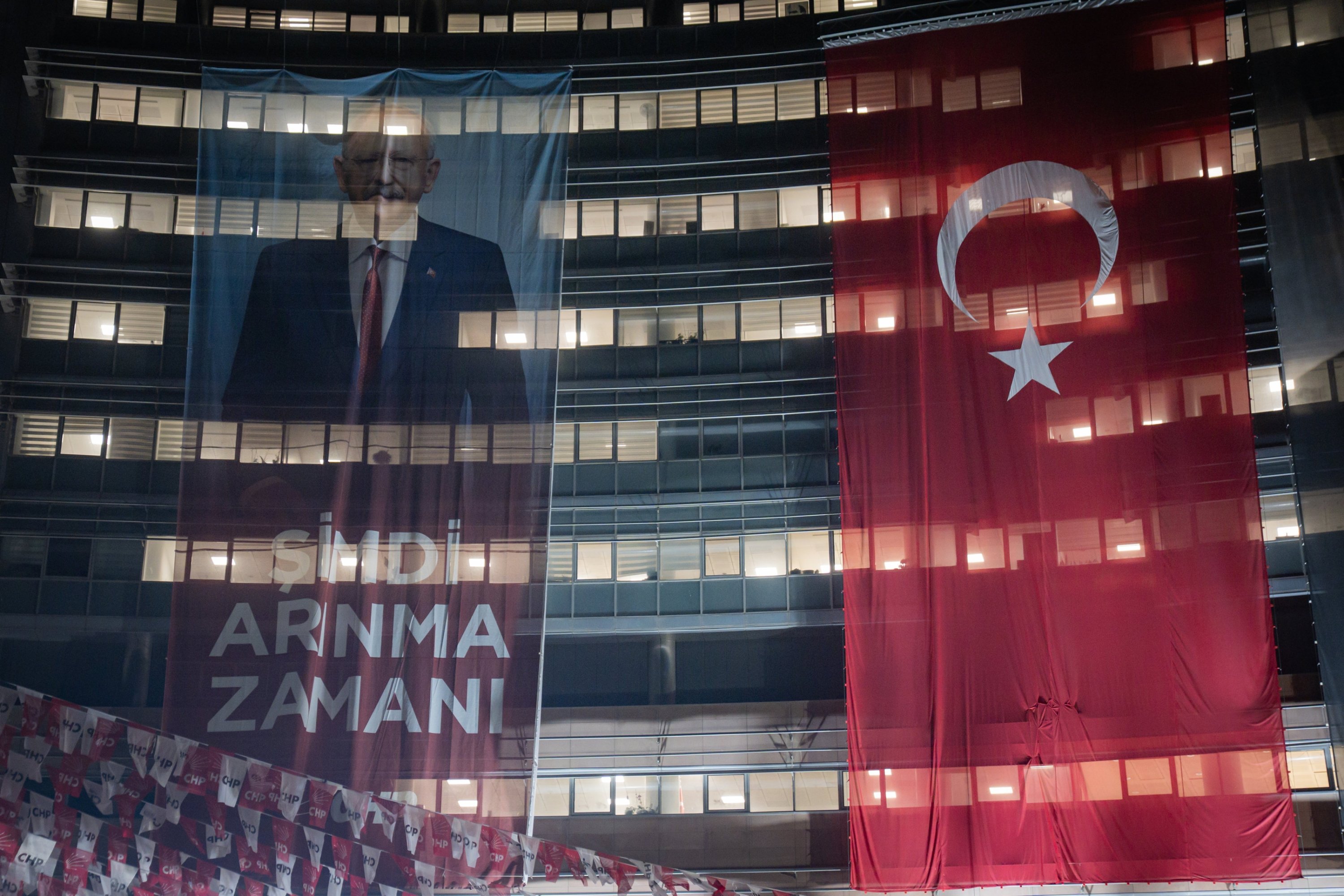
Following the decision of the Ankara Regional Court of Justice, Kemal Kılıçdaroğlu returned to leading the CHP. Özgür Özel and his supporters resisted the leadership change, but they were escorted out of the party headquarters by police forces.
Kılıçdaroğlu announced that he would return to the party headquarters on the fourth day of Eid al-Adha, May 30 and would deliver a very important speech there. Following this, Özel decided to hold a meeting at the CHP’s Ankara Provincial Headquarters on the same day and at the same time. The original invitation was for holiday celebrations, but the gatherings and speeches turned into political rallies, contrary to the spirit of the holiday.
Both sides drew their swords and made their first moves. On the one hand, Kılıçdaroğlu accused his opponents, namely Özel and former Istanbul Mayor Ekrem Imamoğlu, of being members of the Gülenist Terror Group (FETÖ) and having close ties to foreign circles. Özel, on the other hand, stated that the issue was not an internal struggle within the CHP, but rather an extension of the conflict between the ruling party and the opposition, and accused Kılıçdaroğlu of acting in a pro-Erdoğan manner.
Therefore, as of today, the division within the CHP is very clear, and the likelihood of the parties reaching an agreement is very low. Kılıçdaroğlu’s side will continue to accuse Imamoğlu and his team of corruption, immorality, and illegal connections. Imamoğlu’s side will continue to accuse Kılıçdaroğlu of being a traitor, a trustee and a puppet of the ruling party. The conflict between the parties will deepen even further in the coming weeks. The accusations the parties make against each other could likely send them back to the courtroom.
Kılıçdaroğlu will change his leadership style during his second term. His first and most important action will be to purify the party. He will have to carry out a comprehensive cleansing and purge, which is crucial. It is expected that Kılıçdaoğlu will not only remove members of Imamoğlu’s team, but also those within his own team who have been involved in corruption.
It seems that Kılıçdaroğlu will be a more effective and involved leader than before. During the first term of the presidency, he did not hesitate to promote certain names, including Ekrem Imamoğlu, Mansur Yavaş and Özel, within his party. He will not allow the formation of influence groups. That is, from now on, he will pay more attention to the loyalty of the names in his team. He will not delegate his authority to anyone else. On the contrary, he will try to consolidate his leadership within the party. Eventually, the CHP will become a more centralized party.
Özel and Imamoğlu’s faction will want to take the party from Kılıçdaroğlu. Securing the CHP name and party identity is extremely important because its brand value is very high. Furthermore, historical experience shows that those who leave the CHP have a very low chance of success. Turkish political history is full of unsuccessful political parties that broke away from the CHP.
If Imamoğlu’s group fails in their attempts to regain control of the CHP, they will either take over an existing political party or form a new one. It seems that Imamoğlu side will form a populist political party with no ideology and no political perspective. For them, this is the only way to get votes from different segments of Turkish society. Only by establishing such a political party can they compete with the ruling Justice and Development Party (AK Party).
According to some observers, Imamoğlu wants to form a new political party to become the Turkish version of Emmanuel Macron, who came to power by forming a new political party that received votes from both mainstream right and left. In other words, he will ask Özel to form a party that embraces different segments of society, both conservatives and secularists.
However, most observers claim that imitating Macron of France is very difficult. Because the conditions in Türkiye and France are quite different. For instance, there is no gap in the political atmosphere in Türkiye. The charismatic leadership of Recep Tayyip Erdoğan still dominates the political setting. It is very difficult to mobilize a large portion of society against such a strong leader, who is considered one of the most capable leaders in the world. Furthermore, throughout the Republican history, only two political parties, the Democratic Party and AK Party, that originated from another party and then came to power. It seems that if the CHP remains under Kılıçdaroğlu's control, Imamoğlu's side will face a real and serious political challenge.
Given that they are a group accused of immorality and corruption, and many of their officials have been imprisoned, Imamoğlu’s team will have a very difficult task. It will not be easy for them to influence and persuade dissatisfied voters. More importantly, a large portion of the Turkish public views the group’s leader, Ekrem Imamoğlu, as worn-out, tainted and untrustworthy.
In conclusion, I would like to draw some conclusions about the future of the CHP. First of all, neither side of the party has a charismatic person with a clean record who offers hope. There is no leadership vacuum that needs to be filled in Türkiye. In other words, there is still no alternative to the charismatic and effective leadership of Recep Tayyip Erdoğan. This will continue to be the biggest shortcoming of the CHP.
Another challenge of the CHP will be about its political tradition. The failures the CHP has experienced against President Erdoğan and the AK Party since 2002 have led to the abandonment of its traditional rhetoric, namely center-leftism, secularism and Westernism. The party was filled with pragmatic, opportunistic, and populist individuals. Eventually, CHP’s center of gravity has shifted. The CHP now represents nothing more than hostility and opposition to Erdoğan.
Furthermore, both sides will have to develop strategies to attract the support of other political parties in the opposition. The current political system in Türkiye necessitates a bipolar structure for winning presidential elections. Therefore, any party seeking to overthrow the Erdoğan government needs the support of other political parties in the opposition. The CHP, with both its factions, risks losing its leadership position in the opposition. This makes its future questionable and undermines public trust in the party.
Given the ongoing terror-free project and the rapprochement and dialogue between AK Party and Nationalist Movement Party (MHP)'s the People’s Alliance, and the Democracy Party (DEM), one of the most effective de facto members of the CHP-led Nation Alliance may act differently. Because the political climate has changed, the parties at the Table of Six (Altılı Masa), the CHP, the Good Party (İYİ Parti), the Future Party (Gelecek Partisi), Democracy and Progress Party (DEVA), the Felicity Party (Saadet Partisi) and Democrat Party (DP), may not want to act together with the CHP this time. At least two political parties, the Felicity Party and the Good Party, have changed their leaders. It is not clear whether the new leaders of these two political parties will act together with the CHP or not.
Following the marginalization of the previous CHP presidential candidates, the accusations of treason against Kılıçdaroğlu are eroding trust in the CHP. The CHP stubbornly refuses to engage in self-criticism. According to the CHP, anyone who opposes them and anyone who criticizes them is wrong and bad. The CHP continues its habit of always looking for the fault in others instead of itself.
Since the general elections of 2002 that brought the AK Party to power, the CHP represents the Kemalist tradition. It is the second largest party in the country and the main opposition party since then. Erdoğan’s consecutive electoral successes have disrupted the CHP’s settings and political rhetoric. As a result of electoral failures, the CHP has been plagued by internal power struggles and has lagged behind the Erdoğan leadership and the AK Party governments. It seems that the divisions within the CHP will continue for some time.