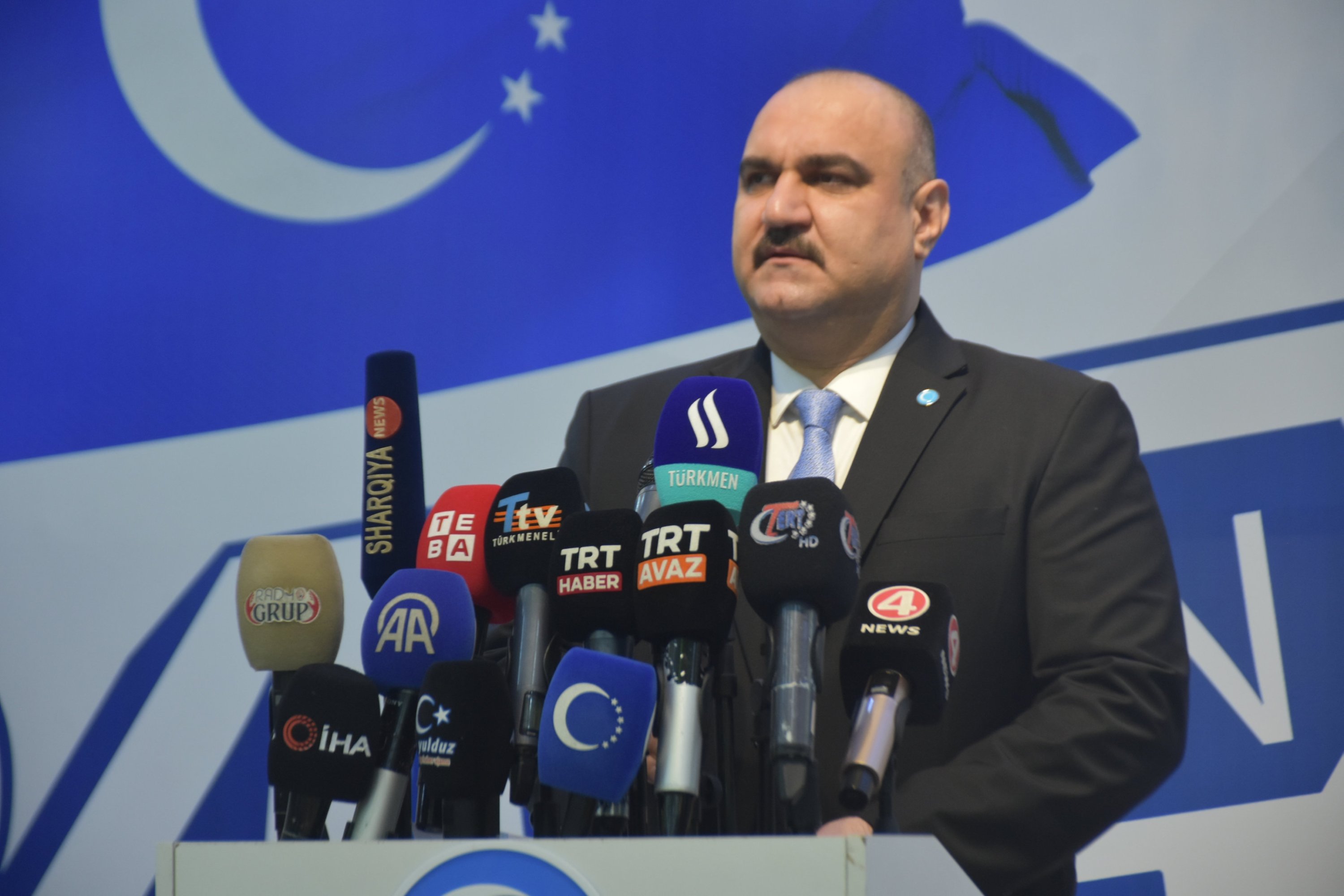
A short while ago, in a Kirkuk Provincial Council session, Governor Rebwar Taha, who is close to the Patriotic Union of Kurdistan (PUK), resigned. The council accepted Taha’s resignation and elected Mohammed Samaan Agha, leader of the Iraqi Turkmen Front (ITF), as the new governor. Thus, the governorship of Kirkuk returned to the Turkmen after nearly a century. This development, met with great enthusiasm among the Turkmen, significantly affects not only Iraq but all actors in the region.
Kirkuk is one of the most sensitive geopolitical fault lines not only in Iraq but in the entire Middle East. Decades of disputes over oil, identity and land ownership have condemned the city to a state of endless “transience.” From a historical demographic perspective, the 1957 census remains the most critical reference point for Kirkuk, as it is the last reliable source indicating that Turkmen constituted a slight majority in the city center. In this context, the election of Mohammed Samaan Agha, leader of the ITF, as governor on April 16, 2026, is viewed by Turkmen circles as “the end of a century-long hiatus.”
However, this change should not be interpreted solely as an ethnic victory. The removal of the question regarding ethnic affiliation in the 2024 national census highlights this. The decision aimed to avoid escalating tensions. It demonstrates how fragile the city’s demographic fabric is. Mohammed Samaan Agha’s emphasis on “living together and serving” upon assuming office is strong evidence. It shows that the Turkmen community frames this issue not as ethnic reckoning but as a quest for administrative stability.
Although Ağa’s appointment was perceived as a surprise by the public, it is actually the result of a painful process that has been ongoing since the Dec. 18, 2023, local elections. The agreement reached on Aug. 10, 2024, at the Rashid Hotel in Baghdad, which launched Rebwar Taha’s governorship, actually envisaged a “rotation” model from the very beginning.
The change we are witnessing today reflects that day’s power-sharing formula, though delayed. One key transition in geopolitical analyses that must be clarified is the duration of the rotation: some sources mention a seven-month term, others a one-year timeline. This ambiguity suggests that the mechanism of "power shifting hands" could give rise to new crises in the future.
This change in Kirkuk is more than a local administrative procedure. Strong leaks from geopolitical circles claim a direct link between Nizar Amedi’s election as president of Iraq on April 11, 2026, and the gubernatorial change on April 16. The PUK officially denies this connection. Still, a “give-and-take” process in which high-level federal positions are traded for local administrative posts remains central to regional and international analyses.
The Kirkuk governorship is no longer simply a symbolic representation of identity. It is now a direct management hub for the “Energy and Revenue File.” Comprehensive agreements in 2025 and 2026 between Baghdad and the oil giant BP, along with the Kirkuk-Ceyhan pipeline returning to full capacity, have shifted the dynamics of competition for the governorship.
The issue has shifted from the question of “Who does Kirkuk belong to?” to “Who will manage Kirkuk’s energy resources and external connections?” Economic data indicate that this new reality imposes a pragmatism that can push ethnic identity debates into the background.
The change in governance in Kirkuk has deepened the rift. The two main factions of Kurdish politics are impacted. The process has created a new front line between the PUK, led by Bafel Talabani, and the Kurdistan Democratic Party (KDP), led by Masoud Barzani.
The PUK uses influence from former governor Rebwar Taha as leverage. This helps them remain a “mediating actor” in federal negotiations in Baghdad. Meanwhile, the KDP, under Masoud Barzani, has chosen to boycott. Barzani characterizes the process as “suspicious deals” and the manipulation of Kurdish will. He rejects the PUK’s sole authority to represent the Kurds.
Ankara’s policy toward Kirkuk has changed recently. It moved from an emotional approach based only on Turkmen representation to an institutional partnership with the Iraqi state. Foreign Minister Hakan Fidan’s diplomatic engagements in 2025 demonstrate this shift. Ankara now sees Kirkuk as a “stability file” for security agreements and energy flows.
In an environment where U.S. and Iran-linked networks in the region prioritize “stability,” Türkiye’s approach is built on a delicate balance aimed at protecting Turkmen rights while avoiding jeopardizing its strategic and economic partnership with Baghdad.
Mohammed Samaan Agha’s pledge to be “everyone’s governor” is a key test for Kirkuk. Still, it must not be forgotten: even this change happens under the shadow of Article 140 of the 2005 Constitution, which remains unresolved, and the city’s disputed status.
The change of governor in Kirkuk is historic. Yet, real stability will only come if this change leads to a service-oriented system where rules matter more than individuals. It must not create social tension. The real question is: Will Kirkuk be governed by a set of rules or shaped by negotiations of each era?
The last word belongs to the Turkmen. They must focus on securing a legal status within the Iraqi Constitution. Positions like the governorship are important but temporary. Legal status is a permanent guarantee.