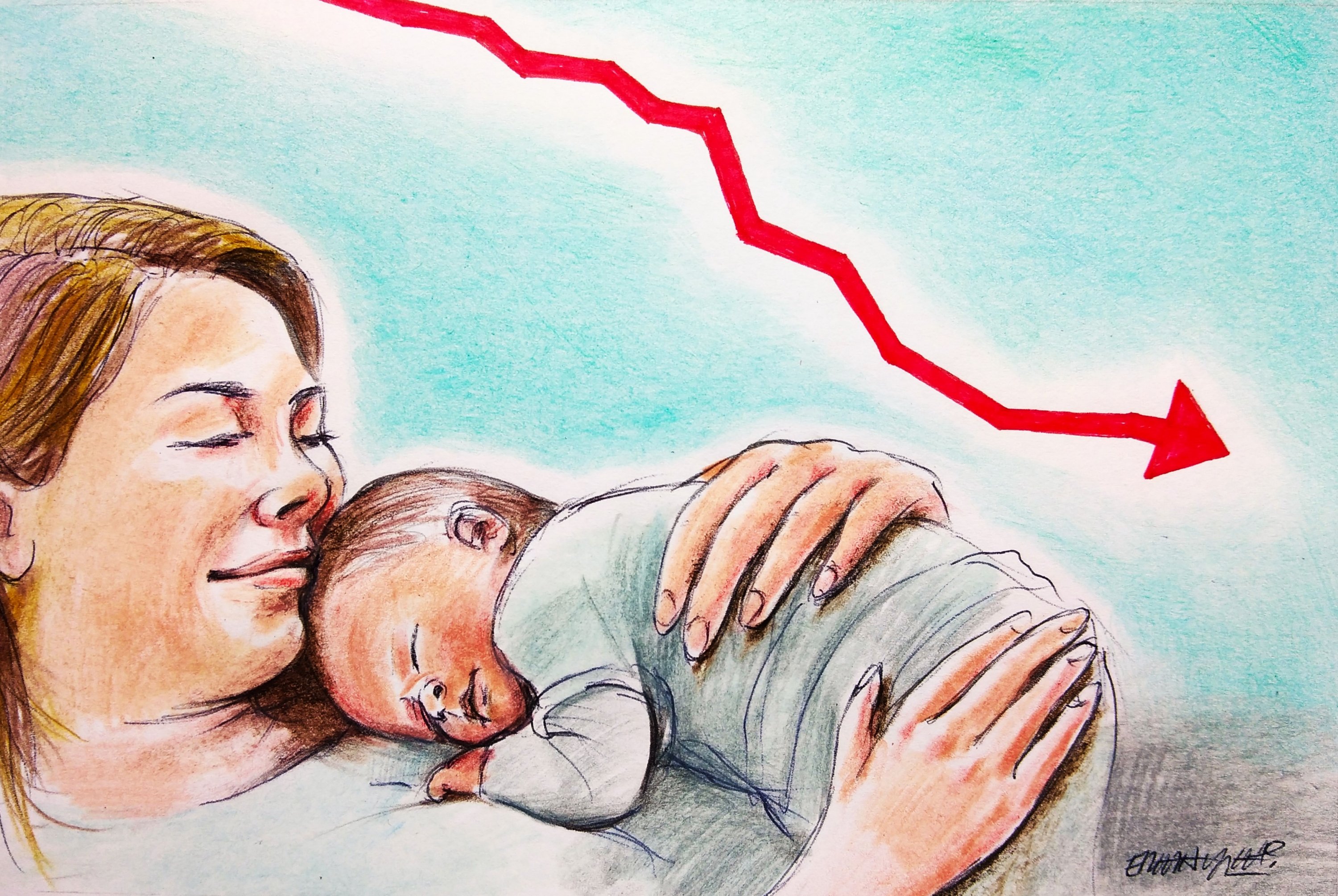
Population size and demographic composition are strategic variables shaping a country's long-term trajectory as profoundly as economic performance or foreign policy. Demography influences a nation's productive capacity, social security balance, family-society structure and state resilience. For many years, Türkiye has benefited from a young and dynamic population, but the country now stands at the crossroads as its population structure is changing decisively.
Declining fertility rates, a growing elderly share and shifts in family structures are likely to become defining issues of the coming decades. Against this backdrop, President Recep Tayyip Erdoğan's designation of 2026-2035 as the "Decade of Family and Population" should be understood as an expression of long-term strategic foresight.
Türkiye's total fertility rate has been on a sustained downward trajectory for years. Its fall below the replacement threshold signals a structural transformation rather than a temporary fluctuation. Simultaneously, the elderly share of the population is rising rapidly. The proportion of citizens aged 65 and above climbed from 5.7% in 2000 to 11.1% in 2025, and projections indicate that this trend will continue.
What is particularly noteworthy is not aging itself but the pace at which it is occurring. While many countries experienced similar transitions over the course of half a century, Türkiye is confronting a comparable demographic shift within a far shorter timeframe, placing greater pressure on economic adjustment mechanisms and institutional adaptation capacity.
This rapid, compressed transformation may be conceptualized as “demographic exhaustion”: the risk of becoming an aging society before sufficient prosperity has been achieved, institutional systems are fully prepared and the necessary social infrastructure has been consolidated. The core challenge is therefore a shrinking working-age population, mounting pressure on pension systems, rising demand for care services, increasing numbers of elderly people living alone and shifting intergenerational balances.
These developments signal that Türkiye must move beyond conventional population debates. Demography is no longer a purely social concern. It has become a matter of political economy, development strategy and national capacity.
Discussions of growth, investment and production typically focus on capital, technology and finance. Yet the essential driver of all these factors remains human capital. A contracting working-age population implies downward pressure on productive capacity, intensifying demands for productivity gains and new vulnerabilities in labor markets.
In aging societies, pension burdens rise, healthcare expenditures increase and the ratio of active workers to dependents deteriorates, necessitating reforms across both the public and private sectors.
Aging also reshapes physical and social infrastructure requirements: more hospitals, care centers, accessible urban environments, long-term health care systems and expanded social support mechanisms are all needed. Because the priorities of younger societies differ fundamentally from those of older ones, demographic transformation reconfigures public policy agendas across housing, transportation, employment incentives and local governance planning.
Regional disparities within Türkiye must also be taken into account. Some provinces may age gradually, while others face rapid aging or outright population decline, differences that require differentiated approaches to internal migration management, service delivery and regional development.
A further dimension concerns changing lifestyles. Household sizes are shrinking, the average age at marriage is rising, single-person living arrangements are becoming more common and everyday contact between generations is diminishing. The result is greater social isolation, weaker communal ties and thinner networks of solidarity. Yet the family remains one of society's most powerful resilience mechanisms in times of crisis. Therefore, its weakening reduces the broader capacity of society to endure adversity.
Türkiye's population challenge is thus not simply a question of how many citizens it will have in future decades. It is a question of what kind of economy it will sustain, what kind of social order it will preserve, and what type of state capacity it will be able to build.
In certain policy domains, decisions made today yield visible effects not tomorrow but decades hence. Population policy must therefore be approached through long-term statecraft. In this regard, the designation of 2026-2035 as the "Decade of Family and Population" represents a timely and significant step. It signals that family and population issues are being treated as strategic priorities.
On the other hand, in contemporary societies, the family is often perceived as merely a private or cultural institution. However, it is the nucleus of the care economy, the foundation of intergenerational solidarity, the primary setting for child-rearing and the first locus of belonging. During economic crises, natural disasters, pandemics, wars and social disruptions, families typically become the primary units of mutual support. Strengthening the family is therefore not only a cultural preference but a rational strategy for building societal resilience.
At the same time, reducing family and population policy to the issue of fertility decline alone would be insufficient. Marriage decisions, housing costs, women's employment, care services, urban living conditions, working hours and expectations about the future all shape demographic behavior. The appropriate response must therefore move beyond numerical targets and situate population policy within a holistic, family-centered life ecosystem.
The policy framework reveals that demographic transformation is a multi-layered process encompassing cultural, digital and cognitive dimensions. Addressing cultural trends, addictive behaviors and harmful media content that negatively affect family and population structures within a comprehensive policy framework.
Another important dimension of the framework is its emphasis on institutional capacity and data production. Regular monitoring of changes in family and population structures, strengthening strategic data generation, encouraging academic research and ensuring centralized coordination all aim to enhance continuity and measurability in this field.
The framework also seeks to address rural depopulation, encourage reverse migration from urban to rural areas and promote the transformation of urban spaces through a family- and child-centered perspective. This is particularly important in terms of addressing internal demographic imbalances and incorporating a regional dimension into national population policy.
Finally, it envisages the strengthening of Türkiye’s leadership role in family and population issues through international cooperation and diplomacy with like-minded countries. This is especially significant given that declining fertility and population aging are not unique to Türkiye. Cooperation in these areas, through the sharing of best practices, joint research platforms and the exchange of experience, can provide important gains for Türkiye.
The directive provides a solid foundation for addressing demographic challenges, but complementary measures will be crucial.
At this stage, the localization of population policies emerges as a key priority. Türkiye’s demographic structure is not homogeneous, while some regions maintain a high concentration of young population, others experience rapid aging and population decline. Therefore, moving beyond national policies toward regionally differentiated strategies is essential. The inclusion of local governments, universities and other institutions in data-driven cooperation will enhance policy effectiveness.
Moreover, the relationship between family policy and economic policy must be strengthened and made more direct. Decisions regarding marriage and childbearing today are shaped by both cultural preferences and economic feasibility. Factors such as housing prices, rental pressures, income stability and job security directly influence individuals’ decisions to form families.
Additionally, the tension between modern working and family life remains a critical factor shaping demographic trends. In particular, the balance between women’s participation in the workforce and childbearing decisions is a critical issue in many countries. Although extending maternity leave to 24 weeks is an important step, expanding flexible working arrangements, institutionalizing care services, and strengthening childcare infrastructure remain crucial.
In conclusion, Türkiye stands at a critical crossroad where demographic exhaustion has not yet reached an irreversible stage. However, delayed intervention would significantly increase future costs. The policy framework introduced under the “Decade of Family and Population” provides a comprehensive and institutional response at this juncture. However, its effectiveness will depend on its integration with broader domains such as economic policy, labor markets, local governments, urbanization, and social structure. Ultimately, the issue is less about demographic scale and more about the societal model and state capacity that Türkiye seeks to develop over the coming decades.