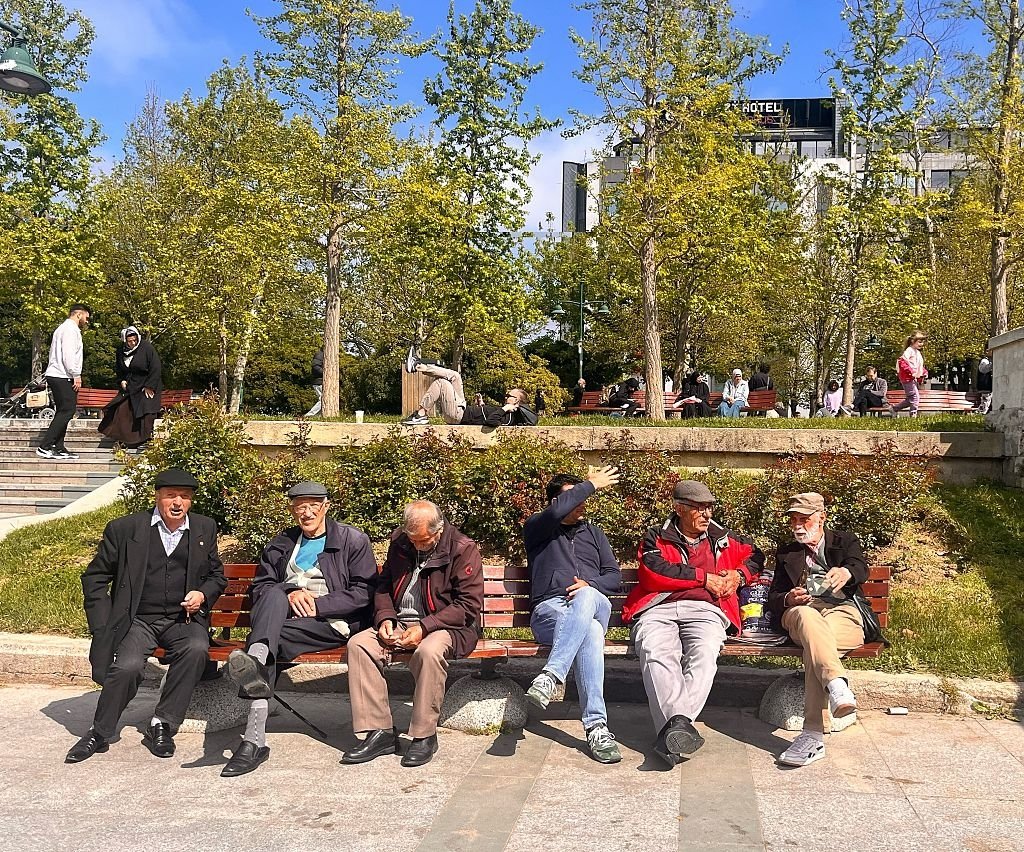
Despite being a country that has boasted its “young population” advantage for decades, Türkiye is witnessing one of the most critical demographic turning points in the history of the republic today. As of 2025, the fertility rate has regressed to 1.48, falling well below the replacement level of 2.1; meanwhile, the share of the elderly in the total population has reached double digits for the first time and exceeded the world average, rising to 11.1%. These data confirm that demographic aging is no longer a distant future scenario for Türkiye, but an “existential” reality shaking every field from the social security system to the labor market.
The issue is not merely a numerical decline. Modernization processes, rapid urbanization and digitalization are transforming the traditional family structure, leading to an increase in single-person households, the delaying of marriage and the weakening of intergenerational bonds. Due to the rise in divorce rates, the share of single-person households reaching 20% of all households, Gen Z's perception of family and the impact of the economic crisis on childbearing behaviour, the fertility rate has been steadily declining for the last 15 years. Türkiye presents the portrait of a society facing the risk of “premature aging,” meaning it is acquiring an aged population structure while at a lower level of prosperity compared to developed economies.
In the face of this picture, the political will’s decision to elevate the issue to the level of “national survival” and declare the 2026-2035 period as the “Decade of Family and Population” is a strategic step. The Presidential Circular dated May 1, 2026, issued for this purpose, aims to gather fragmented population policies under a holistic vision. The goal of “preserving the active and dynamic population structure,” which lies at the heart of the strategy, serves as a defence shield intended to alleviate the economic burdens brought about by demographic aging.
Similarly, the Vision and Action Plan prepared by the Ministry of Family and Social Services details the measures to be taken to strengthen the population. In this context, the strategy document puts forward a multi-stakeholder action plan in core areas such as encouraging marriages, expanding family-oriented social services, and protecting family values against the risks of digitalization. It is evident that the government is attempting to turn the fight against the aging crisis into a state policy.
When the latest circular and vision document are examined, the Turkish state’s mode of intervention in demographic transformation is structured in three stages. The first stage consists of “protective factors,” involving the promotion of elements that keep the family together. The second stage aims at identifying families at risk of dissolution or weakening under the scope of “risk-orientedness.” In the final stage, specific interventions for damaged family structures are planned through “specialized services.”
The announced vision and action plan are built upon a paradigm that is both pro-natalist and protectionist. However, the success of these measures depends not just on ideological fortification but on the extent to which they align with economic realities. In other words, the aging problem in Türkiye’s lap now requires the implementation of feasible and effective measures tailored to the socio-economic structure rather than repeating the old rhetorical discourse. We are in a time for action rather than words. Likewise, instead of palliative, secondary measures that circumvent the problem, it is necessary to move toward genuine policy steps that produce impact.
The current policy of a 150,000 TL loan with a two-year grace period provided to newlyweds by the circular constitutes a concrete financial tool toward encouraging marriage. However, from a modern economic perspective, it is clear that a one-time borrowing opportunity will have a limited impact on the “delaying of the marriage age,” which is a structural issue. The primary factor influencing the marriage decisions of young people is a sustainable income. In the cost-of-living crisis Türkiye is currently experiencing, this aid appears quite symbolic and almost perfunctory. At this point, the promise in the action plan to “design social housing projects according to household size” has the potential to create a much more lasting impact than a loan, for housing costs are the greatest demographic obstacle facing the urban population today.
One of the strongest aspects of the Vision Document is the statement that the effects of remote, flexible and hybrid working models on parenting will be analysed. The only way to break the inverse correlation between women's labor force participation and fertility is to share the child care burden through public and professional mechanisms. In this context, expanding nurseries and daycares for parents with children aged 0-72 months is a strategic necessity. However, the extent to which these services will be “accessible” and “qualified” is directly related to how much the state will subsidize this area. Child care and elderly care have long surpassed being a capacity problem that can be left solely to the private sector or solved by offloading it onto municipalities.
Expressions frequently emphasized in the Vision Document, such as “de-gendering trends” and a “digital family shield against harmful content,” show that the state reads the demographic crisis also as a cultural crisis. However, the “regulatory and sanctioning” approach proposed against the atomizing effect of digitalization may not be sufficient on its own. Protecting intergenerational bonds solely through external content control, without strengthening the internal dynamics of the family, is a defense line difficult to maintain in modern societies. Here, updating “Family Education Programs” and positioning digital literacy as a “parenting skill” is a more functional path. Instead of the classic paternalist approach, there is a critical gap for academic research and policy strategies that understand the needs of young people, especially Gen Z.
The heaviest bill for demographic aging is charged to the social security system. The phrases “sustainable social security systems for elderly welfare” and “family-centred care models” in the circular open the door to a chronic need for “care insurance” brought about by the aging crisis. The state’s orientation toward a model that encourages “care at home” instead of institutional nursing homes is a choice that is both culturally appropriate and cost-effective. However, to prevent this situation from resulting in the care burden falling solely on the shoulders of women in the family, legal regulations such as “premium support for housewives” must be implemented rapidly. Facing the reality that Turkish society is undergoing a sociological transformation and that informal welfare mechanisms no longer function, and establishing institutional care systems immediately, is the policy Türkiye needs.
The state’s declaration of the years between 2026 and 2035 as the “Decade of Family and Population” and the preparation of action plans are imperative steps for Türkiye to cope with the burning effects of the aging crisis. Through the “Presidential Circular No. 2026/4” and the published vision document, the aim is to preserve a dynamic population structure against a declining fertility rate and demographic transformation.
However, this policy strategy must go beyond being a document of good intentions for Türkiye. Demographic aging is not merely a “number-counting” issue to be solved by simply having more children. It is the redesigning of the society’s contract with social security, working life, spatial planning and family structure.
Although the proposed vision tries to protect the family by defining it as a “fortress,” for this fortress to remain standing, the economic security of young people, the family-friendly transformation of urban spaces, and the reconciliation of modern working life with parenting roles are required. Türkiye’s overcoming of the demographic crisis will only be possible by blending this “administrative will” with the “structural reforms” and “sustainable financing models” voiced by academic circles and experts like yourself. Türkiye has 10 years left to meet the devastating effects of the aging crisis. Finally, establishing a long-term elderly care insurance system is the most important step that must be taken immediately.