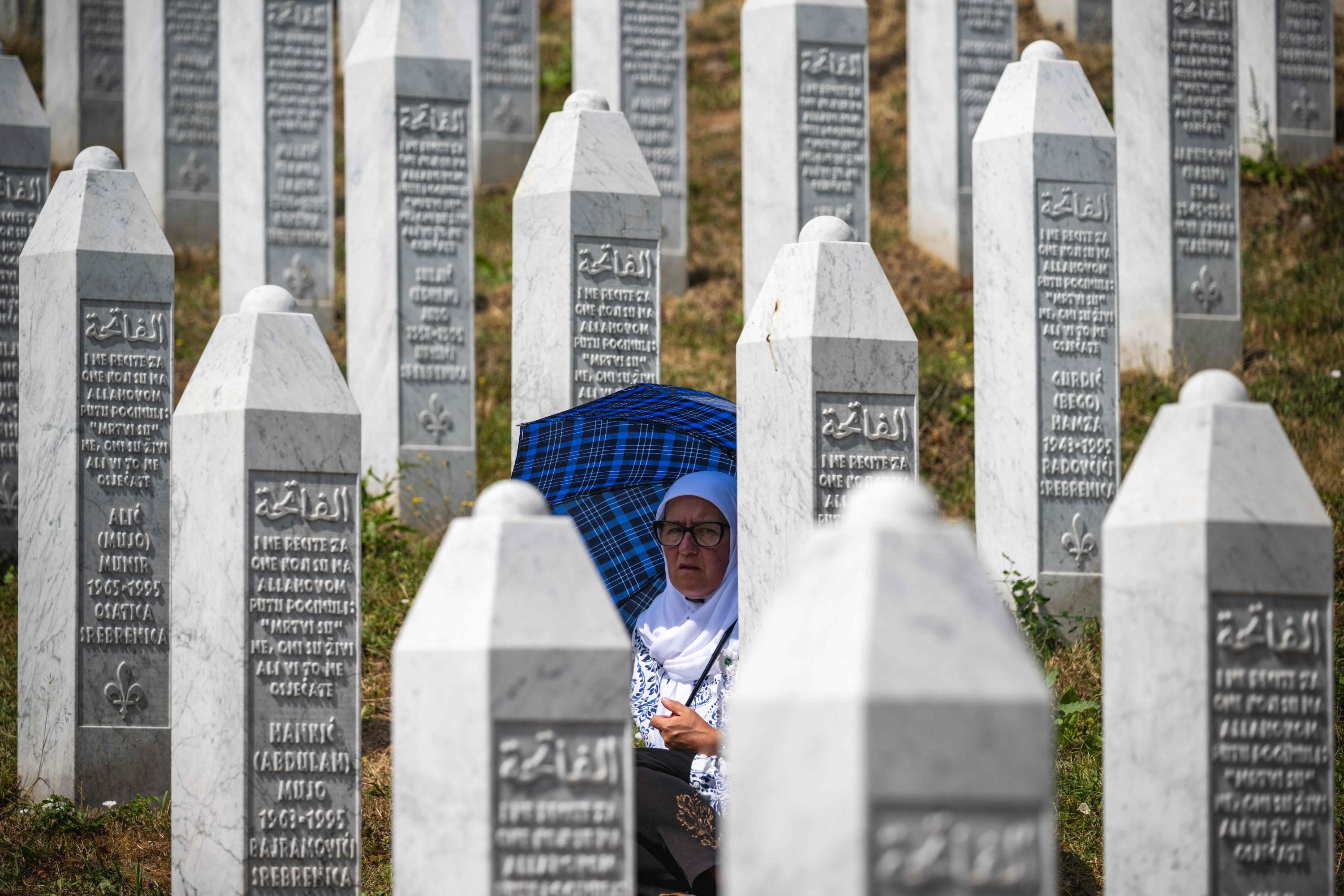
On July 11, 1995, during the final years of the Bosnian War, Serb forces entered the eastern Bosnian town of Srebrenica, which had been declared a “safe area” by the United Nations. The town, under the protection of Dutch U.N. peacekeepers, was indifferent as Serb forces advanced.
Following the entry into the town, over 8,000 Bosnian men and boys were systematically separated from women and children and executed over several days in what was later classified by international courts as genocide. Many of those killed had attempted to flee through forested terrain toward Bosnian government-controlled territory. Others had taken shelter in the U.N. base at Potocari, a former battery factory, which was subsequently handed over to Serb forces.
As Bosnian civilians desperately sought protection, many turned to the Dutch U.N. battalion stationed at Potocari. Women and children were allowed to remain, but the men and boys were separated and handed over to the Serb forces, who promised to “process” them. What followed was a systematic massacre. U.N. peacekeepers were under orders as they stood aside and watched the massacre. Requests for military intervention and air support were delayed or denied. The failure to prevent the massacre became one of the most serious breakdowns in U.N. peacekeeping history.
Following the executions, victims were buried in mass graves throughout the surrounding region. In the years since the war, international forensic teams have worked to locate, exhume and identify the remains. As of 2025, more than 1,000 victims remain missing, with annual excavations continuing in search of unmarked graves.
The remains of those identified are buried at the Potocari Memorial Cemetery, established near the former U.N. base. The site has become a center of commemoration and forensic documentation. Each year, additional victims are laid to rest, as DNA analysis allows for ongoing identifications.
The International Criminal Tribunal for the former Yugoslavia (ICTY) and other legal bodies have confirmed that the killings at Srebrenica constituted genocide under international law. Several military and political leaders from the Republika Srpska entity were convicted and sentenced for crimes against humanity and war crimes.
Despite legal recognition, disputes over historical memory persist. In parts of Bosnia-Herzegovina, particularly in areas with Serb political leadership, the classification of the event as genocide is rejected or contested. Some memorials and cemeteries have faced vandalism or public denial, complicating post-conflict reconciliation.
As of the 30th anniversary in 2025, Srebrenica remains a symbol of the failure of international protection mechanisms, as well as a site of ongoing humanitarian and forensic efforts. The legacy of the massacre continues to shape regional politics, international law and debates about the role of peacekeeping in conflict zones.
Turkish statesman and former member of parliament Süleyman Gündüz provided insight during an exclusive interview. One of the first Turkish civilians to travel to Bosnia during the war, he attended the first anniversary commemoration in Potocari. There, he encountered a woman tenderly caressing the grass on a grave as if she were brushing the fringe of a child’s forehead. When he approached her, she said: “They tore my 11-year-old son from my arms. As they dragged him away, he looked at me and shouted, ‘Mother, they use small bullets for children, right?’”
The haunting innocence of that final question underscores the brutality inflicted not only on bodies but on memory itself. It remains one of the most painful personal recollections Gündüz carries from his years of witnessing the war and walking alongside Bosnia’s leaders and civilians during their struggle for survival.
Süleyman Gündüz traces the root back to the unraveling of the Yugoslav federation following the death of Yugoslav President Josip Broz Tito in 1980. After Tito’s death, a rotating collective presidency governed the multi-ethnic state, but growing Serb nationalism, particularly under former Serbian president Slobodan Milosevic, soon disrupted this fragile balance.
In 1989, Milosevic declared the end of the collective leadership system, signaling a shift toward Serb hegemony by revoking the autonomy of Kosovo and Vojvodina. As the Soviet Union collapsed and communism declined, Yugoslavia’s constituent republics began asserting independence, starting with Slovenia and Croatia. When Bosnia and Herzegovina held a referendum in early 1992, spurred by international pressure, and declared independence, it became a flashpoint due to its diverse ethnic and religious makeup.
Gündüz emphasized that the multi-cultural character of Bosnia – where Muslims, Croats, and Serbs had long coexisted – clashed with the rising tide of ethnic nationalism, ultimately triggering the brutal war and setting the stage for the Srebrenica genocide.
Reflecting on the 30th anniversary of the Srebrenica genocide, Gündüz drew parallels with the current situation in Gaza. “What happened in Srebrenica is not just a tragedy confined to Bosnia,” he said. “We are seeing echoes of the same silence, the same global indifference today in Gaza. Children are no longer killed with small bullets. They are being massacred with large-scale bombs, weapons of mass destruction.”
In his view, the moral failure that allowed Srebrenica to happen lives on in the world’s tepid responses to present-day atrocities. “The shadow of genocide stretches across time and space,” he said. “Just as Srebrenica haunts our conscience, so too will the silence around Gaza.”
Gündüz, who formed a close friendship with Bosnian President Alija Izetbegovic during the war, emphasized that Bosnia is not merely a geographic location. “Bosnia is an idea,” he said. “It is the idea that people of different faiths and ethnicities, Muslims, Christians, Jews, can live together in justice, freedom and dignity.” He echoed Izetbegovic’s famous words: “Bosnia is not just a piece of land. It is a vision and an ideal.”
As the international community gathered once again in Srebrenica to mourn, remember, and recommit to “Never Again,” voices like Süleyman Gündüz’s serve as a powerful reminder that memory without action is hollow. The anniversary is not only about mourning the past, but also confronting the present and shaping the future.
“Bosnians paid a sacred price for the hope that different peoples can live together,” he said. “That hope is under siege again, in Gaza, and in every place where justice is denied and memory is erased. To honor the dead of Srebrenica, we must defend the living everywhere.”