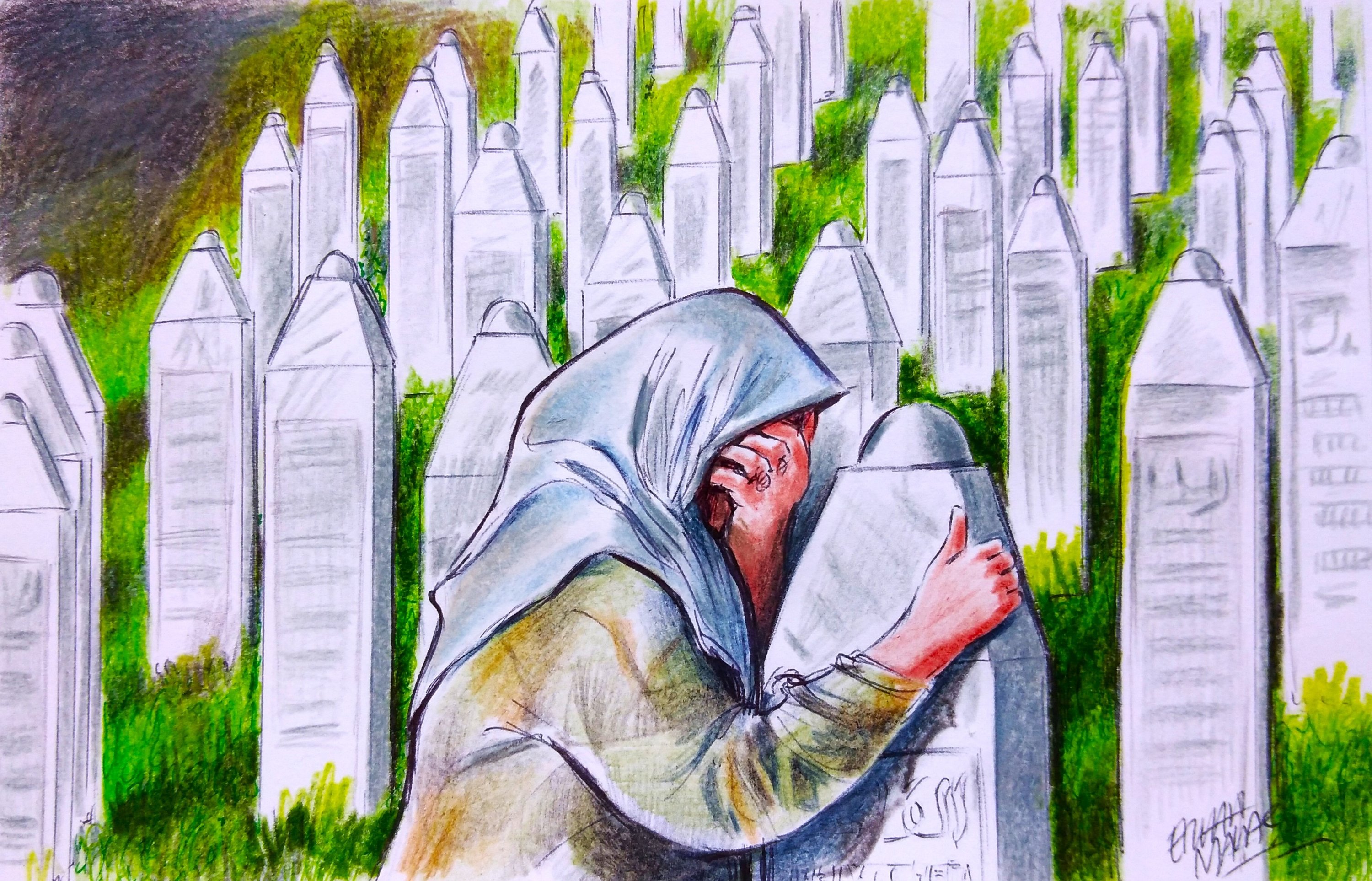
On the surface of the terrain, unburied remains of a teenager, Hariz Mujic, were found during an exhumation carried out near the small town of Zvornik, 27 years after he disappeared during the Srebrenica genocide in the summer of 1995.
Hariz was 19 years old when he was butchered by the Bosnian Serb Army. The genocide took place at the end of the aggression against Bosnia-Herzegovina shortly after it was internationally recognized as an independent state following the collapse of Yugoslavia in the 1990s.
The eastern part of the country, where it is close to the border with Serbia, has seen some of the bloodiest, most cruel killings during the war.
The former Serbian president, Slobodan Milosevic, the Bosnian Serb leadership led by Radovan Karadzic and commander Ratko Mladic, all of them later convicted for genocide, war crimes and crimes against humanity by the international courts, had an idea of creating “Greater Serbia” that included Bosnia. That meant ethnically cleansing the territory of the majority of the local population, Bosnian Muslims or Bosniaks, and having only Serbs, Orthodox Christians, stay there or settle in their homes instead.
Hariz was born in Srebrenica in 1976. The genocidal plan meant he spent the last months of his life trying to escape to a safe area, while Serb forces were advancing and gaining more territory. Based on witnesses and their testimonies who survived, he most probably didn’t have food or water and decided, like many other men and boys, to try to escape through the woods to the area held by the Bosnian Army. He never arrived there.
Found in a location far away from where he was seen last, Hariz’s bones were lying in a plastic bag in one of the identification centers in Bosnia-Herzegovina. Hariz was identified through DNA analysis by his family despite his body being incomplete. It took longer to find him than how long he actually lived.
I was sent once to the exhumation center near Sarajevo to do a story about the identification process. It was just a couple of weeks before the anniversary of the Srebrenica genocide when the newly identified remains were laid to rest in a collective burial.
My cameraman and I were waiting since early morning for one family to arrive. The workers in the center said they have already done DNA testing but want to come and see the remains before the burial. They told us we can come inside if they allow. Around noon, one older man arrived. He was carrying a cane and could barely walk. It was hot, and he was sweating. The center was empty, yet filled with body remains wrapped in white plastic bags. It was quiet, clean and none of the staff spoke much. When that man arrived, he said “Salam” – softly, hesitantly. We replied. He took off his cap. “I came to identify my son,” he said. I asked him if it bothered him that we were there. He said it didn’t, but he hadn’t even noticed us, really. I told him it was important for us that the whole world knows what happened to us Muslims here in Bosnia-Herzegovina.
He said that was why he allowed us to come in. The old man stood beside a large table and stared at the floor. The staff brought him a large white plastic bag. I remember turning to the cameraman and quietly saying, “That’s enough. Don’t film anymore. This is more than enough.” We began to head for the exit. But just then, a staff member opened the bag. It was nearly empty, just one small, darkened bone inside. Everyone froze. The elderly man let out a heartbreaking scream and dropped to his knees. The composure he had carried until that moment disappeared. He wept openly, crying out, “My son!”
For that man, decades of waiting had come down to a single bone.
I remember spotting a name that same day, Hariz Mujic, on one of the lists of missing persons.
“He was only 19,” I said quietly. “Any sign of him?”
“No, not yet,” the worker responded.
This year, Hariz Mujic is one of the youngest victims to be buried in the Potocari Memorial Center close to Srebrenica. At least 8,372 people, mostly men and boys, and around 600 female babies, women and girls as well, have already been identified and buried there so far. But the process is not finished, and many are still missing.
Unlike the killings and genocide that happened in just a couple of days that summer, the identification of the genocide victims is a long and complicated process. The extent of the brutal killings and the way the genocide was carried out was known to the world many years after the Dayton Peace Agreement was signed and brokered by the Clinton administration. It was seen as a success for the former American president as he was reelected again soon after the accord was signed.
Bosniaks didn’t have many reasons to celebrate.
It stopped the killings, but the peace deal divided the country into two entities and one district. Today, Srebrenica is run by Bosnian Serbs, and not many Bosniaks have returned home.
I remember meeting one woman who returned to Srebrenica two years after Dayton and found a Bosnian Serb who killed her family sitting on her terrace. She moved into the basement of her own house and had to live alongside him and his family until they finally left one day. She doesn’t have any family members who survived.
However, many of those who comitted war crimes still walk freely around the same villages where they carried out genocide, rape and the worst crimes against humanity. New mass graves are yet to be discovered, but those among them who have information about where they are usually don’t want to share it. Three decades later, this is Bosnia-Herzegovina’s reality.
Genocide and crimes against humanity in Srebrenica happened while the enclave was designated as a U.N. safe zone guarded by the Dutch battalion. Kofi Annan, the former U.N. secretary-general, on the 10th anniversary of the genocide, said, “The tragedy of Srebrenica will forever haunt the history of the United Nations.
"Only by acknowledging the failures of the past can we begin to face the future with honesty and dignity.”
Not much dignity is left in Gaza today. Just like Bosniaks, Palestinians were forcibly moved from their homes, if they were lucky to survive the bombings, to a small pocket of the land. Just like them, weeks before the genocide, Bosniaks from surrounding villages were rushed to the town of Srebrenica looking for a refuge. There was not enough space for all of them in Srebrenica, no food or water. Just like in Gaza, no aid was allowed in, and starvation was used as a weapon of war. Just like Donald Trump today, the U.S., led by the Bill Clinton administration, was promising a cease-fire and was warned by the humanitarian organizations about the genocidal acts. Journalists were warning of a dire humanitarian situation, and children were dying of hunger and diseases. Srebrenica was, just like Gaza is today, a recognition that the international community had failed in its core mission: to protect civilians, prevent genocide.
U.N. Secretary-General Antonio Guteress described Gaza as “campo di sterminio” (“field of extermination”). He urged Israel to restore humanitarian aid and abide by international law. He also called for an independent investigation into the killings of aid workers found in a mass grave in Rafah. Where Annan reflected on the past failure, Guterres is speaking out in real time. But still, the genocide continues. And yet, both situations expose a painful truth: When the international system lacks the will or consensus to act, the U.N.’s moral voice is not enough to stop mass suffering. Just like Bosniaks 30 years ago, the people of Gaza, too, are surrounded by blue flags and empty promises.
Just in the last couple of days, Israeli Defense Minister Israel Katz has reportedly revealed a proposal to transfer 600,000 Palestinians into a secured “humanitarian city” built on the ruins of Rafah. Entry to the city would be controlled by Israelis, and exit would be largely prohibited. This would be a part of Israel’s vision, backed by the U.S., to replace Hamas and take control over what is left of the population of Gaza.
Israeli Prime Minister Benjamin Netanyahu says he was working closely with the U.S. to identify countries that would be willing to accept displaced Palestinians. The U.S. President says we can expect “something good” to happen in the coming days and says he is speaking to the surrounding countries about the relocation.
All these moves mirror ethnic cleansing and, like Bosniaks, are forcing surviving Palestinians to choose between death and leaving their homes.
These unfolding plans, of enforced displacement, coerced relocation and demographic engineering, are being legitimized not through international consensus but by decisions made in Washington and Tel Aviv. Just like in Dayton, where the borders of Bosnia-Herzegovina were drawn not to ensure justice, but to cement a fragile peace that came at the cost of truth and dignity for survivors, today’s emerging “solution” for Palestinians is being constructed far away from the ruins of Gaza. What is being negotiated is not peace, but permanence. A new reality is being written, just as it was for Bosniaks in 1995. And once again, the world is expected to accept it as inevitable. We are being told to tolerate a future in which genocide can be rebranded as geopolitics. We are witnessing the normalization of apartheid, occupation and displacement under the banner of stability. International justice is not just failing; it is on trial. If the crimes committed in Srebrenica took years to be fully acknowledged and prosecuted, what message does it send today when similar crimes are being livestreamed from Gaza and met with impunity?
When leaders issue statements of “deep concern” but continue to fund the very weapons that devastate civilian populations? The International Criminal Court (ICC) has issued arrest warrants for Russian and Sudanese leaders, but it hesitates when it comes to those protected by powerful allies. If we accept that international law applies only to the weak and that powerful nations and their allies are exempt, then the entire post-World War II legal order collapses into moral theater. Thirty years ago, justice came late, if at all, for the victims of Srebrenica.
Today, justice is being preemptively buried in the rubble of Gaza. If we are not brave enough to call this what it is, ethnic cleansing, collective punishment, genocide, then history will not forgive our silence. Because Palestinians, like Bosniaks, are not just dying. They are being erased. And once again, the world watches. But this time, not on the evening news, but on their phones while drinking coffee.