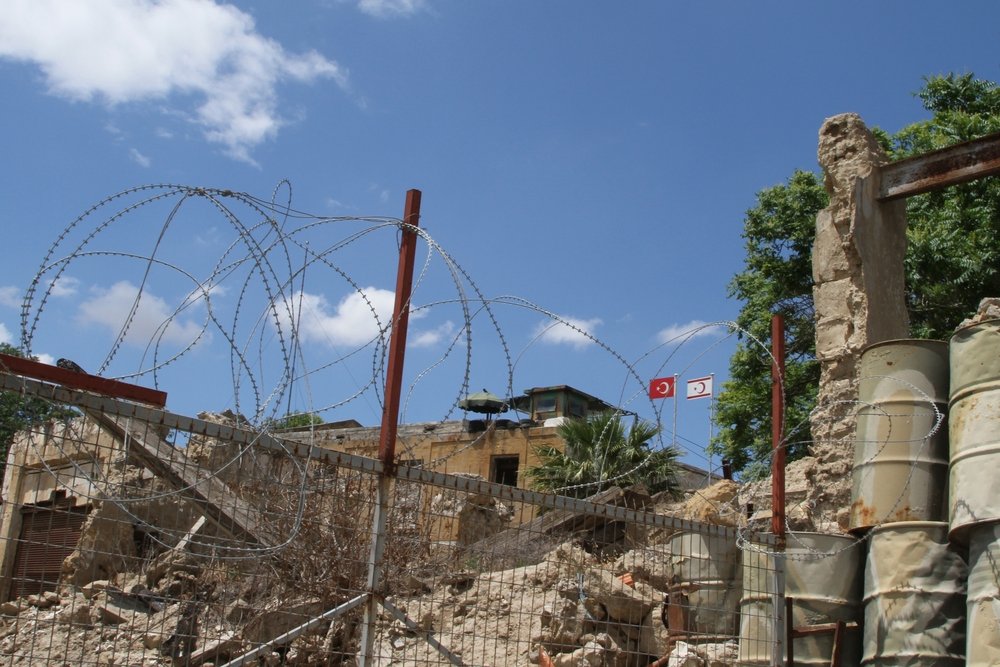
Every decade or so, the United Nations rediscovers Cyprus. A new envoy arrives, a new acronym is coined, and a new round of "constructive ambiguity" is presented to two communities that have disagreed for half a century about what reunification even means. The latest iteration, reportedly drafted by the secretary-general's personal envoy, Maria Angela Holguin, and circulating among diplomats ahead of an "enlarged" five-plus-one meeting expected this summer, is being sold as something new: a "looser" federation, flexible enough that Greek Cypriots can call it a federation and Turkish Cypriots a confederation, so nobody has to admit what they actually signed. That, in itself, is the first warning sign. A settlement whose authors cannot agree on what to name it is a postponement with better branding.
According to multiple reports out of Lefkoşa (Nicosia), Ankara and Athens this June, the Holguin blueprint envisions two constituent states joined by a central government stripped down to five or six ministries – foreign affairs, defense, internal affairs, finance and European affairs – run by a rotating presidential council with top posts allocated by community rather than by vote. Security guarantees under the 1960 treaty system would be replaced by a NATO-based arrangement, with Turkish, Greek, British, French and American forces on the island.
At the heart of the deal sits a transaction dressed up as generosity: Turkish Cypriots would surrender the strategic Turkish-owned districts of Maraş (Varosha), Güzelyurt (Morphou) and parts of the Mesarya plain – also, if past plans are any guide, almost certainly parts of Karpaz as well – in exchange for lifting restrictions that should never have existed: direct trade, flights and contacts, the so-called "three Ds.“
The NATO formula deserves a harder look, because for most of the flags on that list, it changes nothing on the ground. France and the U.S. already operate in the Greek Cypriot administration through bilateral arrangements; South Nicosia pursued on its own initiative, part of a steady militarization of the south that has had nothing to do with any U.N. process. Wrapping that reality into a NATO label is an internationally sanctioned name for what the south was already doing. Türkiye, Greece and the United Kingdom are the only powers with an actual claim to a role: All three are 1960 treaty guarantors and NATO members in their own right, and Türkiye and Greece in particular are bound to the island through their population and violence of half a century ago in a way no other state is. Adding more flags dresses up unilateral militarization as multilateral peacekeeping, and it comes at an odd moment to sideline Türkiye: NATO leaders gathered at the Ankara summit were widely expected to formalize Türkiye's growing weight in Eastern Mediterranean security.
The three Ds, meanwhile, are presented as a trade between equals when they are nothing of the sort. They are not a gift Brussels is offering in 2026, but a promise the European Council made in April 2004, days after Greek Cypriots rejected the Annan Plan and Turkish Cypriots approved it. In the years that followed, the EU's own enlargement commissioner, Olli Rehn, has repeatedly called ending the isolation of the north a "moral obligation." Two decades later, that obligation remains unmet, and the new plan repackages it as a concession earned through territorial loss, rather than an overdue correction for discrimination against EU citizens with the wrong identity card. Asking Turkish Cypriots to hand over land for rights they were already promised is leverage dressed as compromise.
It is worth remembering what else the Annan Plan contained: provisions, contingent on approval on both sides, that would have set the new state on a path toward sovereignty and recognition. Because the Greek Cypriot referendum failed, none of it was implemented. Turkish Cypriots delivered their side of the bargain and got nothing for it, while the Greek Cypriot administration entered the EU regardless. That history is why current Turkish Republic of Northern Cyprus (TRNC) President Tufan Erhürman has made political equality, a firm timeline, the preservation of past convergences and binding guarantees against renewed isolation his explicit preconditions for any new round of talks.
Anyone who has followed this file for more than one news cycle will recognize the shape of what is happening. In 2004, the Annan Plan collapsed on the Greek Cypriot side, which had already secured EU membership regardless of the referendum outcome, removing any incentive to compromise once the prize was banked.
In July 2017, Crans-Montana collapsed in the early hours of the morning over the same questions now being recycled: guarantees, troop presence, territory and political equality. The official account points to an impasse over Türkiye's guarantor status and troop withdrawal. But former Turkish Cypriot leader Mehmet Ali Talat has since alleged that Israeli Prime Minister Benjamin Netanyahu personally urged then-President Nicos Anastasiades to walk away from the table – an allegation Anastasiades has denied responsibility for without directly engaging with it. Whatever the precise trigger, the pattern is unmistakable: As Cyprus has grown entangled in Eastern Mediterranean energy and security politics since the 2010s, outside actors with no stake in reunification have had every incentive to keep the island divided and predictable.
Now comes attempt three, under a secretary-general with months left in office and an acute interest in a legacy before his term expires on Dec. 31, 2026, and the race to succeed him concludes. Holguin herself already tried and failed once before, during a first stint as envoy from January to July 2024 that produced no framework. Her credentials are real. She is a former Colombian foreign minister who helped negotiate the Havana peace accords ending a decades-long civil conflict. But Colombia's war was a domestic insurgency resolved through demobilization and transitional justice. Cyprus is a dispute over sovereign status, two legal orders and a foreign-backed security guarantee, and it has consistently punished diplomats who import frameworks built for different conflicts.
Strip away the diplomatic language, and the Holguin plan proposes a confessional power-sharing system: ministries and the presidency allocated by community of birth rather than vote or competence. That is the architecture that has kept Lebanon in recurring institutional paralysis for half a century, where a presidency reserved for one community and a premiership for another have produced years-long vacancies whenever the two sides disagree, rather than a functioning government.
Guaranteed communal seats do not eliminate the incentive to deadlock. Contrarily, they institutionalize it, since every disagreement becomes a test of communal standing rather than a normal dispute resolved by majority or compromise. Bosnia-Herzegovina offers the closer warning: Dayton's rotating tripartite presidency, allocated by ethnicity in nearly the same structure now proposed for Cyprus, has spent 30 years entrenching the nationalist vetoes it was meant to dissolve, and in 2025 its Serb member was removed from office for defying the state amid open threats of secession. Cyprus would be wiser to study why that model keeps failing in Beirut and Sarajevo than to import a softer version of it.
There is also a basic cartographic question that the public reporting hasn't answered. Güzelyurt (Morphou) sits in the northwest of the TRNC; the Karpaz peninsula juts out toward the far northeast, a long, sparsely populated finger of land making up more than a quarter of the country's area. No version of the plan specifies which "parts" of the Mesarya plain would change hands, which matters enormously: depending on where the new line is drawn, the territory left to Turkish Cypriots could remain a coherent coastal corridor from Kyrenia through Famagusta to Karpaz, or end up narrower and harder to govern, with outlying areas more exposed. Before 1974, Turkish Cypriots lived scattered across dozens of isolated enclaves, dependent on outside intervention to avoid being cut off entirely. A serious settlement proposal would rule that risk out explicitly, with maps, rather than leave the question open as every previous round of talks did.
Any honest accounting of regional risk has to reckon with how entangled the Greek Cypriot administration has become with Israel specifically. Property purchases by Israeli buyers, once a source of friction in the TRNC, shifted decisively south after the north tightened its foreign-ownership rules in late 2023. Reports this spring documented an Israeli entrepreneur's purchase of roughly 70% of the homes in the depopulated village of Trozena, part of a wider wave that General Secretary of the Progressive Party of Working People (AKEL) Stefanos Stefanou says has brought close to 4,000 Israeli-linked purchases since 2021, concentrated near ports, resorts and sites close to Cypriot military installations. Haaretz and official statements have shown that Mossad uses Cyprus for safe house operations. And when Israel and Iran went to open war in June 2025, the island's practical role became impossible to miss: thousands of Israelis fled by yacht to Larnaca and Limassol, with southern Cyprus' Chabad network alone processing more than 12,000 people in 10 days.
To be clear: None of this means Israel belongs anywhere near the negotiating table. It does not, and should not. It means the Greek Cypriot administration has, on its own initiative, let itself become a logistical and intelligence rear base for a country at active war with its neighbors. A new constitutional order that says nothing about reining in that role is not protecting Cyprus' neutrality. On the contrary, it is formalizing the end of it, risking dragging a reunified island into conflicts that are not its own, while once again placing Turkish Cypriots in danger for decisions and policies over which they had neither responsibility nor control.
The status quo is not acceptable, but the cure on offer is the wrong one. A two-state outcome – sovereign equality between two states, each with full control over its own foreign relations, security and resources, linked through EU association rather than forced into a single shared government – would not satisfy the U.N. resolutions built around the federal model since 1977, and it would face real resistance in South Nicosia and Athens. But it would not require Greek Cypriots and Turkish Cypriots to pretend an agreement says two different things, and it would not require the Lebanese-Bosnian-style communal carve-up described above.
Erhürman has a genuine mandate and a genuine opening. But Holguin's blueprint will not give him a framework specific enough to survive its own implementation. The next round of talks will be remembered either as the moment Cyprus finally said what it meant, or as Crans-Montana's sequel: closer to a deal than ever, and no deal at all.