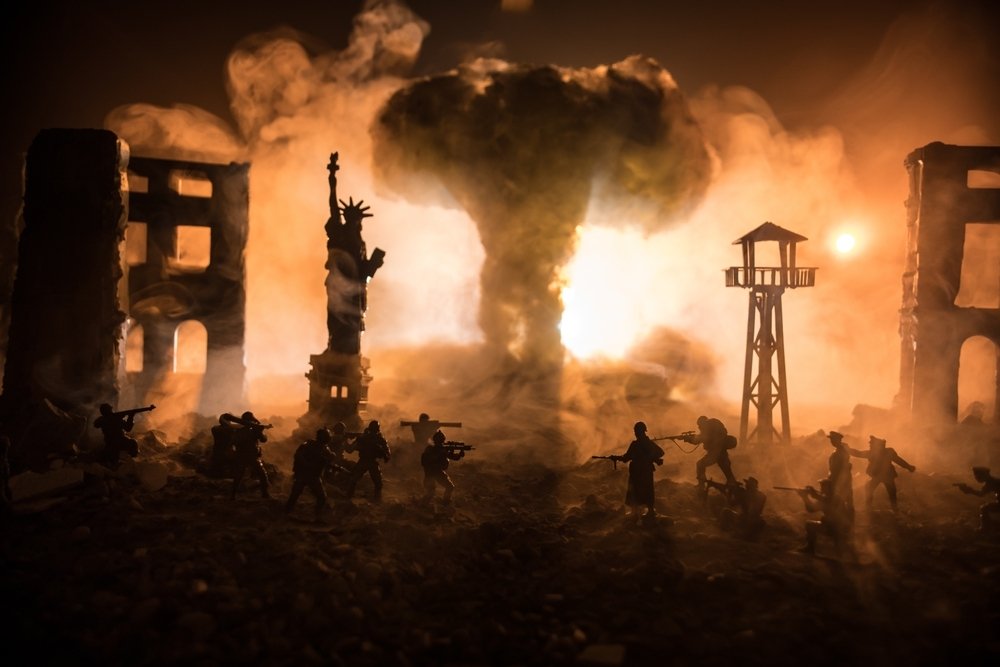
As of Feb. 5, 2026, the last pillar of the international security architecture has fallen. The New START treaty, the last legally binding agreement limiting strategic nuclear arsenals between Washington and Moscow, has expired without a successor. Framing this moment simply as the beginning of a new arms race misunderstands the nature of the danger ahead. New START was never just an arms-control mechanism. It served as a form of crisis management. What has been lost is not only a numerical cap on warheads, but the strategic certainty required when crises erupt. Legally, the treaty cannot be extended again. However, the real problem is systemic, not legal. This ending does not indicate that the world will suddenly wake up to larger nuclear arsenals tomorrow. It means strategically waking up with far less knowledge about what tomorrow holds.
The treaty had been in a state of systemic failure for some time. Inspections suspended during the pandemic and followed by a crisis deepened by the war in Ukraine had already rendered its technical mechanisms largely ineffective. While the United States accused Russia of noncompliance for denying access to inspections, it also announced in June that it halted the flow of information to Russia as a countermeasure.
Russia, on the other hand, announced that it would continue sharing data on Intercontinental Ballistic Missile (ICBM) and Submarine-Launched Ballistic Missile (SLBM) tests despite suspending the treaty. Yet, in an environment where both sides were effectively looking at each other half-blind, with on-site inspections halted, such fragments of data had already reduced New START to something barely worth taking seriously. What is happening today is not a sudden rupture but the formal recognition of a reality that had long been in place.
And what has changed is that nuclear strategy has become increasingly performative. Nuclear weapons and the language surrounding them now function less as elements of a defense doctrine and more as displays of power performed in public view. Russia’s increasingly frequent nuclear saber-rattling has brought nuclear weapons back into the center of public discourse.
However, Moscow offered to comply with the treaty’s limits on an informal basis for another year. This was not a gesture of goodwill, but rather a concession to Ukraine. The response from Trump’s side, framed as “a better deal or no deal,” reflected Washington's clear understanding of the weaknesses of New START. The result is performative rather than a stronger deterrence. Rather than a classic arms race, the emerging norm is one of crisis instability.
Another reason the treaty could not be renewed is technological. The text signed in 2011 is increasingly detached from today’s realities of warfare. Nuclear-capable hypersonic missiles, nightmares for air defense systems, remain outside New START’s scope. The U.S. National Defense Strategy makes clear that Washington now sees itself facing a modern and increasingly diversified nuclear threat.
More importantly, the landscape is no longer bipolar. Actors such as China and North Korea continue to expand their nuclear arsenals without the constraints of any agreement. The U.S. describes the growing threat from North Korea and Russia’s ongoing modernization as risks that now extend directly into the Western Hemisphere. In an age of rising powers and uncertainty, updating an agreement limited to just two states had become unrealistic.
In this new equation, Europe emerges as the most exposed actor. The continent is caught between two nuclear powers engaged in increasingly unconstrained competition. At a time when debates over the future of the U.S. nuclear umbrella are already underway, the absence of New START is setting off alarm bells in European capitals.
If Washington and Moscow refuse to limit their nuclear arsenals, European countries will be forced to limit their dependence on Washington. This situation will necessitate a debate on Europe’s creating its own nuclear umbrella (through France and the United Kingdom). In a period when the international rules-based order is unraveling, and war is raging on the continent, Europe needs to secure its own nuclear guarantee.
The collapse of New START may resemble past diplomatic crises, but timing changes everything. Weakened European democracies, a war on the continent, and an age defined by uncertainty have made this vacuum far more dangerous. The real danger is not the number of missiles, but the loss of information. The disappearance of verified data will push both sides toward assuming the worst about each other’s capabilities. In this new era, where nuclear transparency gives way to speculation and risk reduction is replaced by performative threats, the narrative of nuclear war is likely to remain a permanent feature of public life.