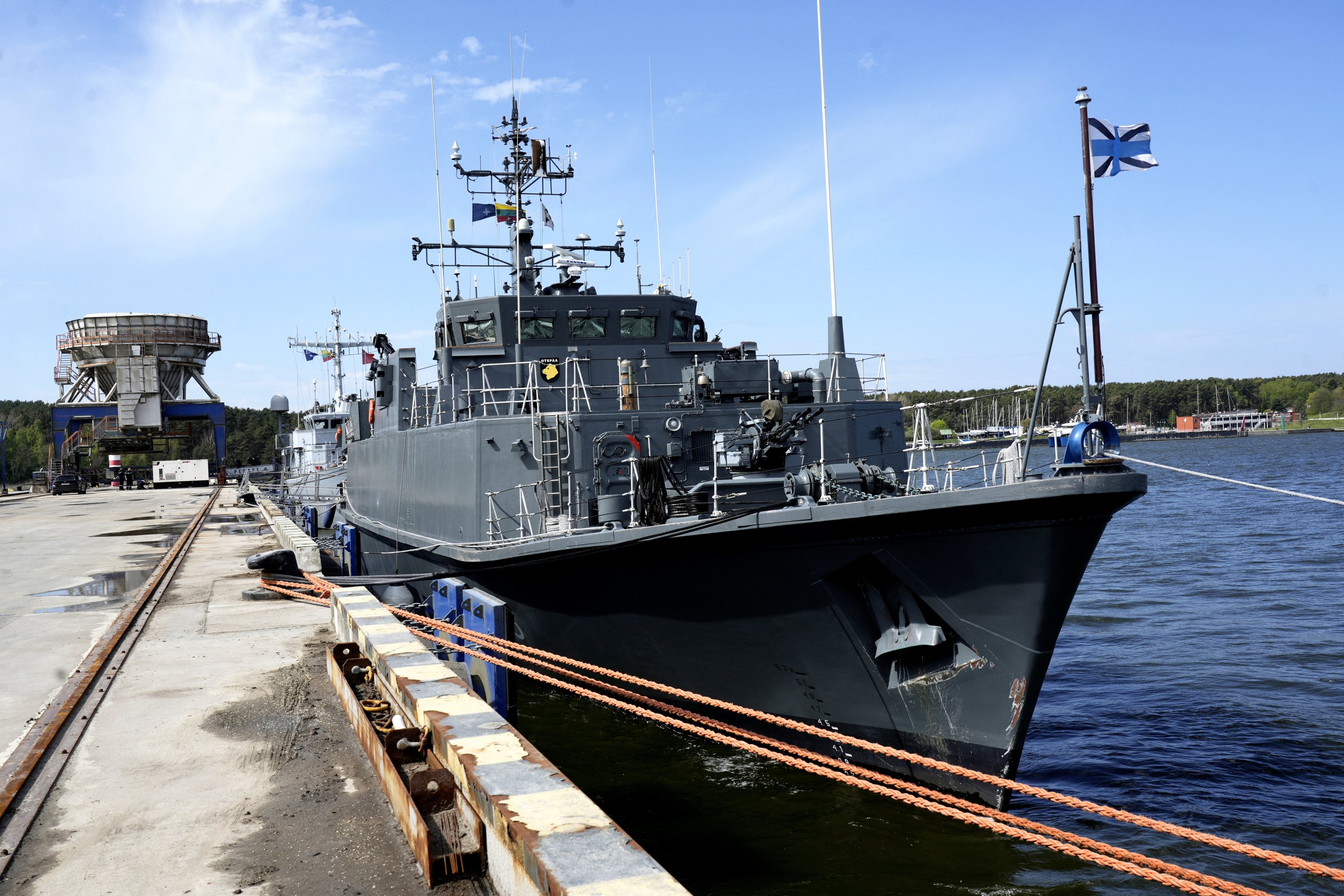
The Russian threat has always been an issue that the Baltic states needed to address, but the war in Ukraine has completely transformed the countries’ threat perception. The threat is now taken much more seriously and is viewed as an “imminent danger.”
The Baltic states (Estonia, Latvia and Lithuania), Finland and Sweden have initiated a transformation of the Northern European security architecture by adopting a common regional security strategy. They have launched exercises simulating potential Russian invasion scenarios, while operational elements are discussed regarding the Suwalki Corridor and the importance of Gotland Island in naval operations, and all amid stockpiles of dragon’s teeth and barbed wire along the border lines.
It is only natural to take such steps at a time when NATO’s credibility is being questioned. However, NATO’s Article 5 remains at the heart of this strategy: holding off the enemy until NATO forces arrive. At the same time, this strategy, which is based on making any attempt at occupation prohibitively costly, is largely conventional.
Estonia, in particular, has taken the lead within the alliance by spending 3.5% more of its GDP on defense. In addition to significant steps such as the reintroduction of mandatory military service in Lithuania and the expansion of Latvia's reserve forces, plans are underway at the alliance level to establish a German-Dutch rapid deployment corps comprising more than 60,000 troops.
While these measures appear strong on paper, the underlying issue remains: The Baltic states are preparing for hypothetical scenarios rather than addressing current threats. A strategy must account for scenarios, but without solutions to current risks, Russia may continue to test the Baltic and Eastern European borders.
Last month, a drone crash occurred in Latvia that was of little military significance but had a major political impact, and it involved a Ukrainian-made unmanned aerial vehicle (UAV). Russia likely used electronic jammers to divert the drone into its fuel tank. The security of Latvia’s airspace, a NATO member, has come into question. The defense minister resigned, and the government collapsed. This political fallout was not caused by a Russian missile or a tank unit crossing the border, but by a non-kinetic attack that could not be traced back to Russia.
This situation also serves as a test to measure the lock-on times of air defense systems and the takeoff speeds of interceptor aircraft. Just as in May 2024, Russia removed the Estonian maritime buoys deployed to prevent ships from straying off course. Observations are being made regarding whether there will be a military response against Russia.
The aim here is to test NATO’s response times, assess the strength of infrastructure through sabotage of undersea cables, and undermine internal stability in Estonia and Latvia through disinformation campaigns among Russian-speaking minorities. Frankly, Russia does not need to invade the Baltic states just yet, as it can destabilize them in a controlled manner without increasing the cost.
Russia is not currently in a position to invade a NATO country. The war in Ukraine is a disaster both in humanitarian terms and in terms of military capabilities. Lithuanian intelligence suggests that it would take Russia six to 10 years to prepare for a large-scale attack on NATO. However, they also state that preparations for a limited operation could be completed in just one or two years.
It is highly unlikely that a country would attack a security alliance while in such a situation. Moscow is aware that this would trigger consequences it cannot foresee. Even though Russia views the war in Ukraine as Russia versus NATO, it has not directly attacked any NATO country in retaliation. In fact, the war has always escalated in a controlled manner.
The likelihood of Russia launching a direct attack is low, and the Baltic states’ conventional capabilities serve primarily as a deterrent. Still, security remains fragile. The primary reason for this is insufficient focus on hybrid threats. Another is that Article 5 lies at the heart of this security. The opposing side is aware of Washington’s reluctance. Hence, European allies are attempting to fill this political vacuum through their own military spending, but a commitment to alliance reliability is a more effective deterrent than any military force.