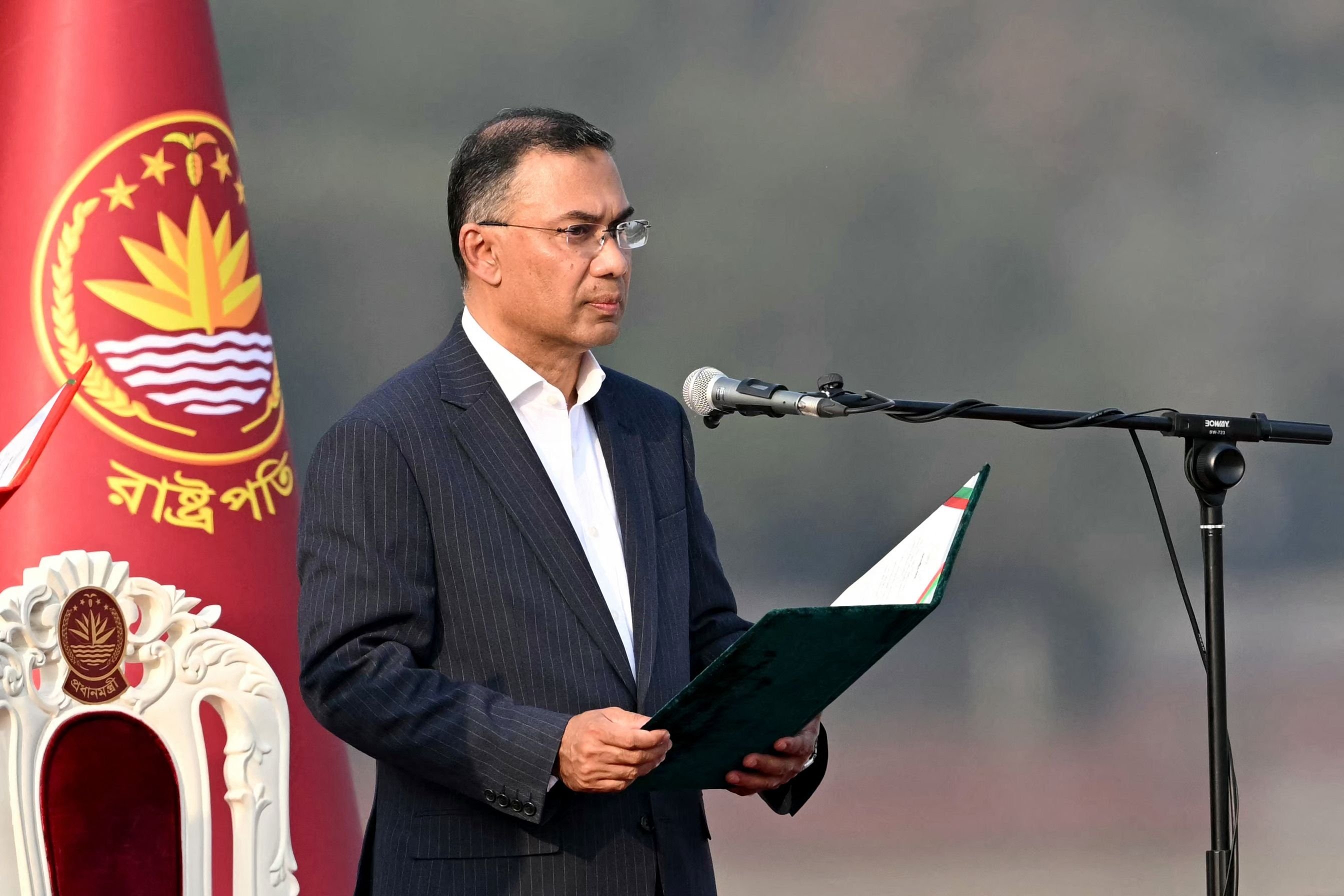
The Feb. 12 elections in Dhaka were not merely a routine in democratic transition, but a political moment with wider regional consequences. While the polls were largely held smoothly, which was an achievement in itself given Bangladesh’s turbulent electoral history, they have simultaneously opened a new chapter of expectations and apprehensions. The incoming administration, led by the Bangladesh Nationalist Party (BNP), inherits a country with a strong desire to reform, but also deeply divided over the direction of its politics, identity and external alignments.
At the domestic level, the BNP’s most immediate test will be governance. Bangladesh’s electorate has voted not only for a change in leadership, but also for a constitutional reform agenda endorsed through referendum during the general polls. This makes the mandate more exclusive and stronger. Unlike governments that enter office with vague promises, the new administration will be judged on whether it can implement reform, strengthen institutions and improve service delivery. If it delays or dilutes the constitutional package, the political costs could be severe, particularly because the reform vote has elevated public expectations beyond party loyalties.
Yet, reform will not be pursued in a political vacuum. The conservative Jamaat-e-Islami's (JI) strong electoral performance, securing the second largest vote bank and significant representation at the center, has created a new parliamentary reality. This is a major shift. For the BNP, Jamaat is not an unknown actor. It is a party with which it once shared political space, and at times, an alliance. But the current reality is different. Jamaat is now positioned as a strong opposition force, capable of shaping public discourse, pressuring the government from the right, and mobilizing street politics if its demands are ignored.
This is a particularly delicate dilemma for the BNP. If it accommodates Jamaat too closely, it risks international scrutiny and domestic backlash from liberal and centrist segments. If it marginalizes Jamaat aggressively, it risks polarization and instability. Either path could derail reform, because constitutional change requires political consensus and patience. This could be hard to achieve, specifically with sharp ideological differences.
Additionally, the burden of the political legacy of the BNP is what is also crucial. It can be said safely that the BNP is not only contesting governance, but it has to prove its credibility as well. The corruption and bad-governance narrative historically attached to Tarique Rahman remains a reputational burden. Even if the new government performs better than its predecessors, perception may lag behind performance. In Bangladesh, as in many South Asian democracies, legitimacy is not only built through policies but also through public trust, something that takes time to rebuild and can collapse quickly under any scandal.
On the foreign policy front, the BNP’s balancing act will be no less demanding. Bangladesh’s geography makes neutrality difficult in the region. It sits at the intersection of India’s security concerns, China’s infrastructure diplomacy, and the U.S.’ expanding so-called Indo-Pacific priorities. A BNP-led government will have to manage relations with Washington and Beijing globally, while calibrating its regional posture vis-a-vis Delhi and Islamabad.
China’s engagement with Bangladesh has remained steady regardless of which party is in power. That continuity is significant. It shows that Beijing’s Bangladesh policy is institutional rather than personal, rooted in ports, infrastructure, connectivity and long-term influence. For Dhaka, Chinese investment has offered tangible economic value, but it has also increased Bangladesh’s strategic visibility. Unsurprisingly, this has caused serious worry in Washington, which increasingly views South Asia through the lens of great-power competition.
This is where the BNP’s historical relationship with the U.S. becomes relevant. Washington has had a long record of engagement with the BNP, and it has often seen the party as a counterweight in Bangladesh’s domestic political landscape. However, U.S. engagement today is more conditional than in previous decades, so the BNP cannot assume automatic goodwill simply because of past ties.
A useful example here is the Yunus administration’s pragmatic approach to economic engagement with the U.S., particularly the tariff agreement, which signalled Dhaka’s willingness to anchor parts of its economic strategy in the U.S. trade frameworks. The lesson for the BNP is straightforward: Washington responds positively when Dhaka offers structured economic cooperation, not merely rhetorical alignment. If the BNP wants to stabilize relations with the U.S. while maintaining workable ties with China, it will need to prioritise trade, labor reforms and investment transparency and other areas where Bangladesh can demonstrate credibility without being forced into a geopolitical camp.
At the regional level, relations with India will remain unavoidable and complex. Delhi’s priority may be apparent stability in Bangladesh and a government that is responsive to India’s security sensitivities, especially regarding border management, migration and extremism. A BNP government will likely seek to correct what its supporters perceive as an imbalance in Dhaka-Delhi relations during the previous era, i.e., the internal interference of Delhi in Dhaka’s affairs. Moreover, it will have to satisfy the popular demand in Bangladesh for the repatriation of former leader Sheikh Hasina from Delhi, which seems unlikely. However, a confrontational approach would not be recommended, as also signalled by Tariq Rehman in his initial media interactions. Bangladesh’s economic integration and security interdependence with India are deep-rooted, so the new government will have to be more cautious in devising its strategy vis-a-vis Delhi.
Moreover, it is significant to note Dhaka’s renewed opening toward Pakistan. Following Hasina’s ouster in 2024, Pakistan’s engagement with Bangladesh has seen fresh momentum. This is not merely about bilateral sentiment, but it reflects shifting regional possibilities. For Islamabad, Dhaka represents a diplomatic opportunity in South Asia beyond the India-Pakistan binary. For Bangladesh, Pakistan offers an additional channel of regional diversification. However, this engagement will remain politically sensitive inside Bangladesh, where historical memory and identity politics continue to shape public opinion. The BNP will have to ensure that any thaw with Pakistan is framed in economic and diplomatic terms rather than ideological ones, otherwise it risks provoking domestic polarization. Here, the role of the JI will be difficult to ignore, but the BNP will have to balance the scales.
Last but not least, this election may also have a lesson for the youth of Nepal. The Ujyalo Nepal Party, founded after the Gen Z movement in 2025 in Nepal, is also preparing to take part in the upcoming elections in March 2026. It should be cautious and must learn from the youth-led National Citizens' Party (NCP) of Bangladesh. The popular narrative of the NCP challenging the status quo could not be translated into electoral success, as it could only secure six seats in the national assembly out of 300.
Finally, Bangladesh’s future will depend on whether its new administration can do what South Asian governments often struggle to do: deliver reforms while managing polarization, and pursue balanced diplomacy without turning foreign policy into domestic political theatre. The Feb. 12 elections may have been smooth. The real turbulence or the real success will be decided in what follows.