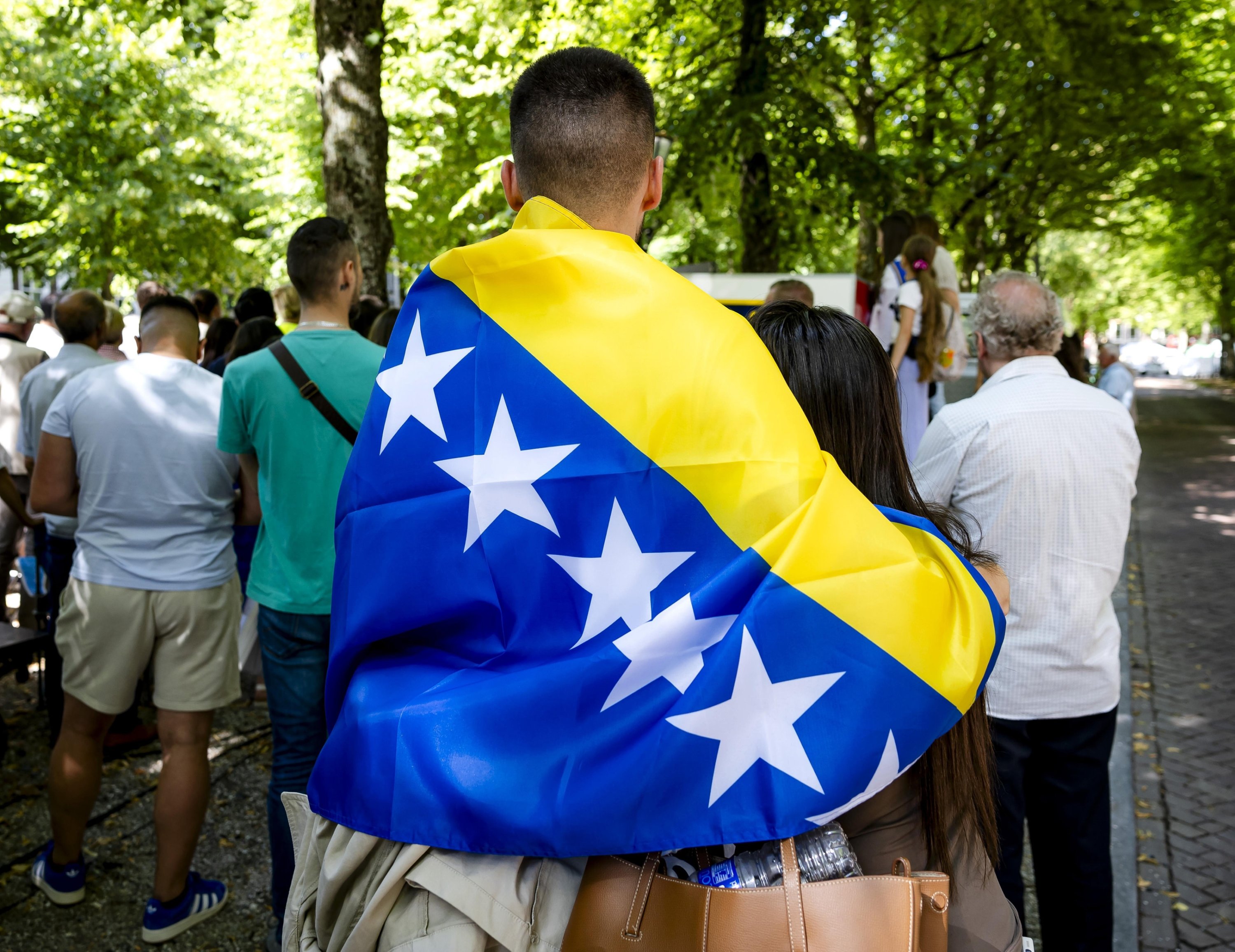
Thirty years after the signing of the Dayton Peace Agreement, which formally ended the 1992-1995 war, Bosnia-Herzegovina is once again in the international spotlight. But this time, the threat is not open violence. It is a subtle, calculated assault carried out through geopolitical narratives, foreign lobbying campaigns and the strategic manipulation of history in international media and politics. The country’s sovereignty, identity and European future are increasingly under pressure, not only from internal political forces but also from actors in Washington, Moscow, Belgrade, Zagreb and Brussels.
Bosnia-Herzegovina’s current political structure was shaped by war. The 1995 Dayton Agreement established a highly complex constitutional order, dividing the country into two entities: the Federation of Bosnia-Herzegovina and Republika Srpska, along with a small autonomous district (Brcko). This arrangement, meant to secure peace, also entrenched ethno-political divisions. It requires a delicate balancing act between Bosniaks (mostly Muslim), Croats (mostly Catholic) and Serbs (mostly Orthodox), an arrangement increasingly seen as outdated and obstructive.
In this context, former Illinois Governor Rod Blagojevich recently sparked international debate by publishing an op-ed in the conservative Washington Times, describing Bosnia as a “spiritual outpost” of the Iranian Revolution. He claims that Iran has infiltrated Sarajevo through cultural centers and scholarship programs, a message tailored to right-wing Western audiences, aiming to recast Bosnia-Herzegovina not as a partner, but as a security threat.
The claims are not supported by reliable sources. Nevertheless, the language resonates in Western political circles where fear of "radical Islam" is often politically instrumentalized.
Adnan Kapo, director of the Institute for Geopolitics, Economy and Security in Sarajevo, warns that such portrayals are part of a broader campaign to reverse historical memory and undermine Bosnia-Herzegovina’s democratic trajectory. “It’s an attempt to turn aggressors into victims,” Kapo says, “and those who defended a multicultural European Bosnia into destabilizing radicals.” Linking Bosniaks with extremism is, in Kapo’s words, “first-degree Islamophobia,” a calculated move to attract sympathy from far-right actors in the West.
These narratives align with calls from U.S. think tanks, such as the Heritage Foundation, to abolish the Office of the High Representative (OHR), a key international body responsible for overseeing the implementation of the Dayton Agreement.
Former U.S. diplomat Max Primorac proposes a full federalization of Bosnia-Herzegovina based on ethnic lines, essentially a de facto partition. While presented as a “local empowerment” measure, critics warn that it would weaken central institutions and reinforce the grip of nationalist leaders who benefit from ethnic divisions.
A recent investigation by Bosnian news portal Klix.ba reveals how Blagojevich and Primorac are cooperating to delegitimize Christian Schmidt, the current High Representative. They deploy buzzwords like “Hamas,” “terrorism” and “Iran” to frame Bosnia-Herzegovina as a breeding ground for extremism, shifting attention away from domestic governance issues and economic stagnation.
While external pressure grows, the greatest threat to Bosnia-Herzegovina’s unity, according to Kapo, comes from internal political elites, particularly from Republika Srpska, led by Milorad Dodik, who openly advocates for secession. Backed by Serbia’s government, these efforts aim to dismantle Bosnia from within. This is not a new strategy. The idea of dividing Bosnia dates back to 1939 and was revisited during the 1990s war. Yet each time, the push for disintegration has ultimately reinforced Bosnia’s statehood, as seen in the AVNOJ declaration of 1943, the 1992 independence referendum and today's renewed civic activism.
Under Annex 4 of the Dayton Agreement, Bosnia-Herzegovina’s Constitution incorporates the European Convention on Human Rights, thereby establishing it as a binding legal standard. The current political impasse stems from the tension between civic principles and ethnic quotas, which often override individual democratic rights.
The July 3, 2025, European Parliament resolution explicitly criticizes Republika Srpska’s actions as deliberate attempts to undermine Bosnia’s EU path. It signals a shift in EU perception: Bosnia-Herzegovina’s crisis is no longer seen as a domestic issue, but as a foreign-influenced destabilization campaign, especially with Russia’s involvement through diplomatic, media and intelligence channels.
Bosnia-Herzegovina's neighbors are also playing an active role. Croatia continues to push for electoral reforms that would guarantee a "legitimate" ethnic Croatian representative, a model based on ethnic veto power. Yet critics note that such a model would never be accepted within Croatia itself and would entrench ethnic segregation in Bosnia.
Serbia, on the other hand, remains a more consistent adversary. It denies the genocide in Srebrenica, opposes Bosnia-Herzegovina’s NATO accession and actively supports Republika Srpska’s secessionist ambitions. For Bosnia-Herzegovina, Serbia’s interference poses both a political and security challenge.
Kapo thus raises a key question: Is it in Croatia’s interest to have a weak, unstable Bosnia-Herzegovina next door, or a stable, European-oriented neighbor?
Bosnia-Herzegovina today finds itself at a critical geopolitical juncture. The debate is no longer about the country’s internal structure alone; it’s about whether the European project can withstand foreign subversion in its own backyard.
Kapo argues for a strong, civic and inclusive republic, rooted in the rule of law and human rights, not built against ethnic identities, but above them. “We don’t need laws to respect diversity,” he says. “We were raised with it.”
For Türkiye, the EU and the broader international community, the message is clear: looking the other way is not an option. The struggle for Bosnia-Herzegovina’s future is not just a local or regional issue; it is a test case for the credibility of Europe itself.