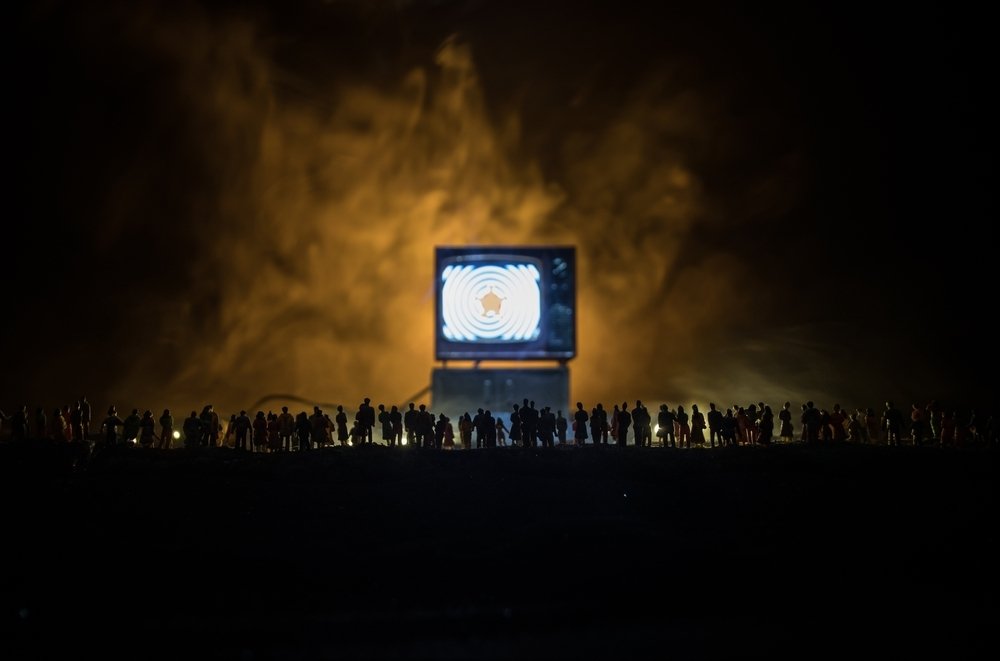
There was a time when wars did not appear live on television. It sounds strange now. Almost unreal.
For most of modern history, war existed somewhere else, far from the living room. News moved slowly. Photographs appeared days later, sometimes weeks. Radio reports described what had already happened. People imagined the battlefield more than they actually saw it.
Then television arrived. And something changed.
Many still remember the first moment war entered the screen as it happened. The First Gulf War, 1991. International networks broadcasting through the night. Missiles cutting across the dark sky above Baghdad. Bright streaks, brief flashes, small explosions seen from a distance; almost silent from that far away.
Watching it produced a strange feeling, hard to explain now. The images looked real, yet also oddly distant, almost staged.
War had always been reported. But this felt different.
What made it stranger still was the tone surrounding the broadcasts. Analysts explained which targets had been struck, which systems had been activated, and which aircraft had taken part; mostly live, on air. Graphics moved across the screen. Maps appeared. Military movements were broken down carefully. Sometimes the commentary sounded oddly familiar. Almost like sports coverage.
The intention was simply to explain events. But the format itself began shaping the experience. The American media critic Neil Postman once warned that television has a curious habit: Serious matters can slowly begin to resemble spectacle once they pass through its visual grammar. War is not entertainment. Yet when it appears night after night on screen, surrounded by commentary and graphics, it starts feeling different to those watching from a distance.
People adjust to what they see repeatedly. The first time missiles crossed the night sky, the moment felt shocking, even surreal. Later, similar images appeared in other conflicts. The shock faded. Wars themselves did not become less serious. Distance changed.
Earlier generations encountered war mostly through imagination. They read descriptions of battles, and they did not watch them minute by minute.
Television altered that relationship entirely. A conflict looked closer, yet it was always framed through a camera lens, and cameras never show the whole story. A missile crossing the sky can look almost abstract on screen. Light, movement, a flash that disappears quickly. What the camera rarely captures is everything else: fear inside apartment buildings, confusion in dark streets, the heavy silence after an explosion.
The gap between reality and representation was always there. Live broadcasting simply widened it.
Decades before satellite television, the American journalist Walter Lippmann observed that people rarely encounter the world directly; they encounter pictures of the world shaped by media. Watching modern war coverage, that observation feels more relevant than ever.
The Gulf War did not cause this transformation alone. It opened the door. Technology pushed that door wider in the years following. Satellite links became faster, cameras lighter and journalists carried equipment directly into conflict zones. Later, smartphones and social media brought a constant stream of battlefield images. Footage from distant wars now reaches the world within minutes.
Speed alone rarely brings understanding. If anything, the endless flow of images can produce the opposite effect. Dramatic scenes appear so frequently that they begin dissolving into the larger stream of daily information. Yesterday's shocking moment becomes today's headline, then disappears behind another story.
Perhaps the strangest shift was this: war stopped arriving as history and began arriving as programming. Not a distant chapter written later, but something unfolding between commercials, weather reports, headlines, minute by minute, almost in real time.
Behind every image there are lives disrupted, families displaced, neighborhoods altered in ways no camera fully records. The screen captures a moment. The consequences stretch far beyond it.
Older generations remember their first encounter with televised war. Not because the technology impressed them. Because the feeling was unsettling. The battlefield had entered the living room.
Today, the images travel even faster. The technology is far more advanced. But the essential fact remains: a war seen on a screen is only a fragment of the war itself. Sometimes the part that the camera cannot show turns out to be the part that matters most.