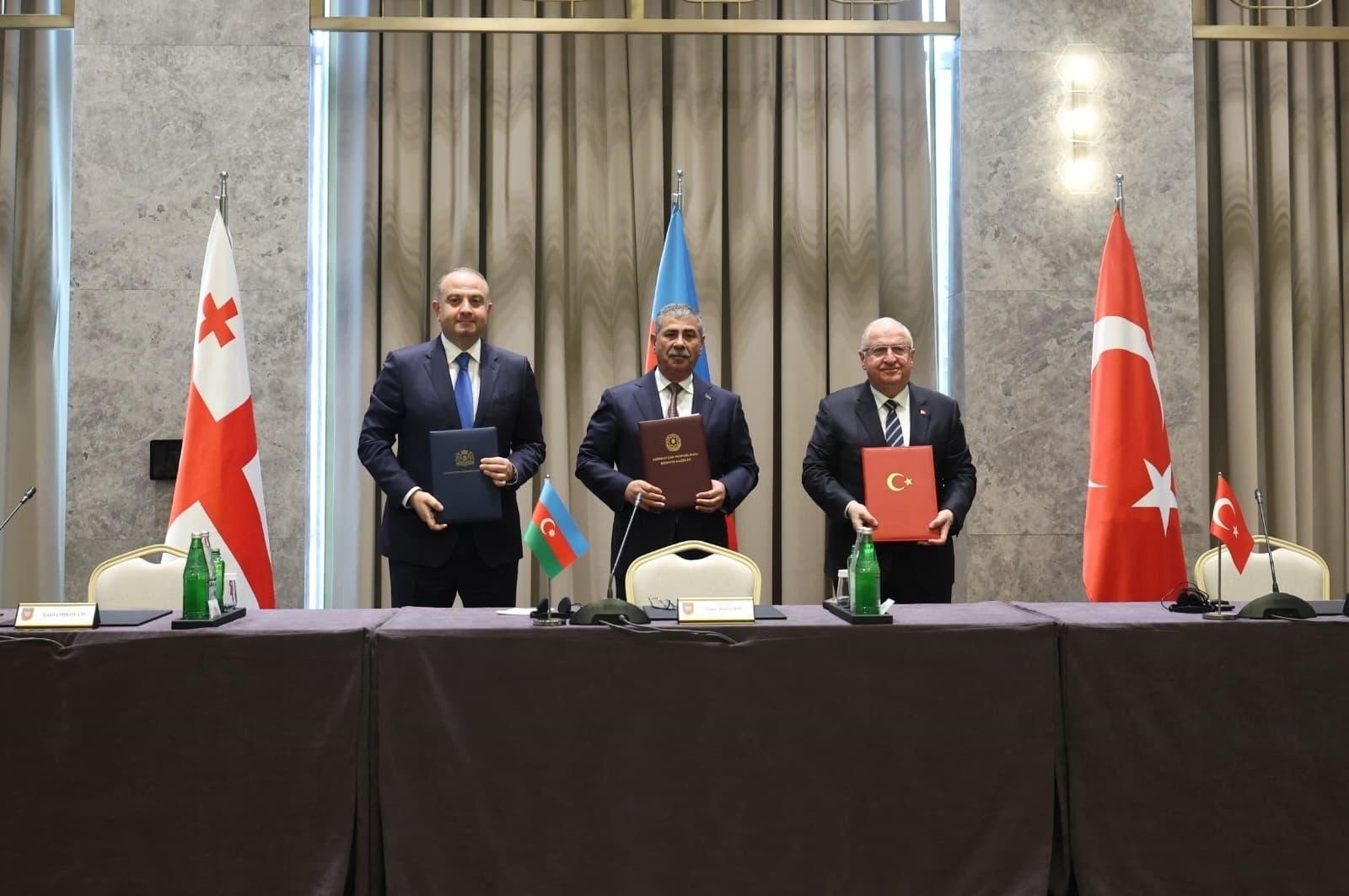
The 13th Trilateral Meeting of the Defense Ministers of Türkiye, Azerbaijan and Georgia, held in Shusha on Oct. 2, confirmed a proposition that has gradually hardened into the strategic grammar of the three capitals: the security of the Caucasus cannot be considered separately from the security of these countries. Hosted by Azerbaijani Defense Minister Colonel General Zakir Hasanov, and attended by Turkish National Defense Minister Yaşar Güler and Georgian Deputy Prime Minister and Defense Minister Irakli Chikovani, the meeting closed with a protocol and a joint press appearance. Its significance lies less in a single new commitment than in the consolidation of an already functioning minilateral mechanism.
Hasanov opened by recalling the meetings held in Türkiye the previous year and in Georgia the year before. That sequence matters. A format that has reached its 13th iteration, and that rotates among the three capitals, is no longer an ad hoc consultation. It is an institutionalized channel with memory, procedure and an accumulating agenda. Hasanov attributed the high level of relations in significant part to the sincere friendship among the heads of state, and described the Turkish-Azerbaijani-Georgian format as a successful regional cooperation mechanism that can serve as an example for other countries, and that continues to contribute to peace, security and stability.
The political tone was matched by a gesture of solidarity. The Azerbaijani and Georgian ministers again extended condolences over Turkish service members lost in a plane crash. In diplomatic terms, the gesture is secondary to the agenda; analytically, it illustrates that the channel carries a societal as well as a military register. The discussions themselves restated a longer historical claim: the peoples have lived in good-neighborly relations for centuries, bilateral and trilateral ties continue to develop dynamically, and cooperation based on mutual trust is important to the well-being of the three societies.
Güler’s formulation supplied the meeting’s conceptual core. Speaking in the city he called the heart of Azerbaijan’s culture, he described Türkiye, Azerbaijan and Georgia as friendly neighbors bound by shared history, shared geography, mutual trust and strong ties of friendship, and argued that those ties have evolved into an increasingly deep and multidimensional strategic cooperation. The South Caucasus, he said, is undergoing a significant transformation. Recent movement toward peace between Azerbaijan and Armenia was welcomed as a development that, through the joint efforts of the countries of the region, could open new opportunities for cooperation. In that setting, he assigned particular importance to the Türkiye-Azerbaijan-Georgia triangle.
The operational content of the argument concerned connectivity. Existing energy, transportation and communications projects among the three countries contribute not only to economic development but also to regional security and stability. “Ensuring the security of these projects is the common responsibility of our countries,” Güler said. Joint exercises, training and exchanges of experience were presented as the practical reflection of that responsibility. On that basis, he restated strong support for the independence and territorial integrity of Georgia and Azerbaijan, and readiness to advance existing trust and solidarity in the service of peace, security, stability and prosperity in the Caucasus.
The Azerbaijani record fills in the working agenda. The ministers underlined the challenges of the present period and the need to join efforts against factors that may threaten regional security. They stressed the expansion of trilateral exercises and training, citing “Eternity,” “Caucasus Eagle,” and other joint activities as instruments for enhancing cooperation, exchanging experience and strengthening defense capabilities. The discussions covered a broad range of defense-related issues, including military-technical cooperation, education, and medical support, while also exploring ways to expand the existing framework. In his bilateral meetings with Hasanov and Chikovani, Güler addressed regional security and prospects for lasting peace, underscoring how the trilateral format strengthens and complements established bilateral ties rather than replacing them.
Hasanov’s subsequent remarks give the format an explicitly systemic reading. He described it as an important platform for regional stability, security and development, noted that the ministers had discussed the prospects for expanding cooperation, the effectiveness of existing activities and military-political developments in the region, and argued that coordination had become more important amid growing global political tension, emerging challenges and economic uncertainty. At the press conference, he expressed satisfaction with the dynamics of cooperation and said the sides intend to expand and deepen these ties.
Three implications follow. The first is the consolidation of a minilateral security space. The three states are not announcing a formal alliance directed at a named adversary. They are constructing a zone of predictable behavior organized around territorial integrity, corridor security and the prevention of renewed destabilization. Güler’s notion of common responsibility moves pipelines, railways and communications links from the category of commercial assets into the security agenda. If the rhythm of exercises such as “Eternity” and “Caucasus Eagle” is maintained and enlarged, interoperability can deepen incrementally, producing a stabilizing effect that does not require treaty-level escalation.
The second implication concerns connectivity under conditions of uncertainty. Hasanov’s reference to global political tension and economic uncertainty supplies the external context in which East-West transit acquires strategic weight. Routes that function as economic multipliers are also strategic vulnerabilities. Treating their protection as a shared duty implies that future cooperation is likely to include infrastructure protection, joint risk assessment, and more coordinated responses to threats along the corridors. In a period when alternative Eurasian routes are being tested, the reliability of the Türkiye-Azerbaijan-Georgia segment becomes a regional public good.
The third implication is adaptive capacity. Both ministers pointed beyond the present agenda: Güler toward the identification of new areas of cooperation, Hasanov toward the expansion and deepening of existing ties. Whether that elevation occurs will depend in part on variables outside the format, the sustainability of Azerbaijan-Armenia normalization, the resilience of critical infrastructure, and the ability of the three capitals to insulate defense cooperation from extraneous pressure. The existence of a channel already able to discuss military medicine and military education alongside exercises and regional threat assessments means that new items can be added without first inventing an institution.
The Shusha protocol does not resolve every dispute in the wider Caucasus, nor does it substitute for bilateral peace processes. It does provide a concrete mechanism through which three states with converging security interests can align their reading of risk, protect the material links that bind them, and demonstrate that post-conflict sovereignty can be paired with cooperative stability. If the commitments recorded on Oct. 2 are carried forward, the 13th meeting will stand as a further step in treating the security of the Caucasus and the security of Türkiye, Azerbaijan and Georgia as mutually constitutive.