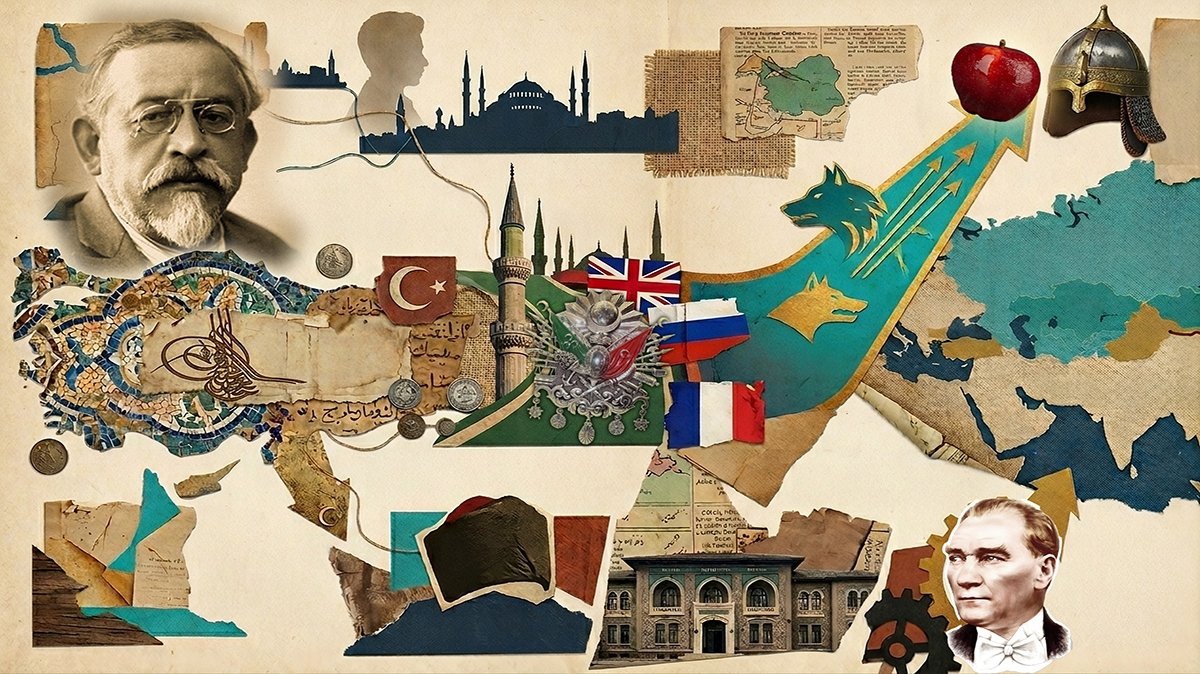
During one of the most turbulent periods in Turkish history, Yusuf Akçura stood at the forefront as one of the great figures who shaped the nation’s destiny not only with the sword but also with the pen and profound strategic insight. He dedicated his life, spanning from the banks of the Volga to the heart of Ankara, to the ideal of Turkic unity. He laid the intellectual foundations for the Turkish state that would rise from the ashes of a crumbling empire.
Yusuf Akçura was born on Dec. 2, 1876, in the Russian city of Simbir, as the son of a distinguished Turkish family. During his childhood, he moved back and forth between Kazan and Istanbul, the two great poles of the Turkic world. After losing his father at the age of 2, he relocated to Istanbul with his mother when he was 7, marking the beginning of his connections with the Ottoman sphere.
A pivotal moment in Akçura's career came with his essay “Three Styles of Politics,” written in Kazan in 1904. This event truly established him as the brightest star in the history of Turkish political thought. The text served as the first political manifesto of Turkish nationalism and a road map to the Red Apple" (”Kızıl Elma”). In this essay, Akçura examined the three paths on the table for saving the Ottoman Empire from collapse: Ottomanism, Islamism and Turkism, using a rational approach.
He viewed the idea of Ottomanism – the effort to create a common “Ottoman nation” from all elements within the empire – as impossible given the political climate of the time. While he saw the politics of Islamism as theoretically strong in its aim to unite the world’s Muslims, he argued that European powers, such as England, France and Russia, possessing Muslim colonies would never permit this in practice.
The true path in Akçura’s heart and mind was the unification of the Turkic world. He viewed the Turkic world as a single entity and argued that the Ottoman Turks must assume a leading role in this unification. The ideal of Turkic unity is not merely a fantasy but the sole political program that will enable Turks to secure their rightful place in the world. Akçura’s realistic approach has also become one of the cornerstones of the Republic of Türkiye's founding philosophy.
Akçura’s nationalism is rooted in a holistic understanding that transcends borders. Building on his ideas, he served as an ambassador and a bridge of ideas, introducing the Northern Turks to the Ottoman Turks. For example, during the 1905 Russian Revolution, he founded the “Alliance of Muslims in Russia” party to defend the rights of Turks in Russia and championed the common cause of Turks in the “Kazan Muhbiri” newspaper. Akçura was one of the figures who best understood and put into practice Crimean Tatar intellectual Ismail Gasprinsky’s motto: “Unity in language, thought and action.”
Akçura helped found the Turkish Homeland journal and Turkish Associations, creating spaces for nationalist intellectuals. For him, the Turkic world was a vast family from the Balkans to the Great Wall of China, sharing sorrow and joy. He opposed an age in which Turks were isolated, their languages and histories fading. Through works like The Year of the Turks (1928), he aimed to revive national memory.
Further demonstrating his impact beyond intellectual circles, Akçura was not merely an intellectual who generated ideas; he was also a hero who passed through the fiery trials of the National Struggle and a statesman who played a role in the founding of the republic. Arriving in Ankara in 1921, he joined the inner circle of Mustafa Kemal Pasha, who would become the founder of the Republic of Türkiye. From 1923 until his death, he served in the Grand National Assembly, representing both Istanbul and Kars.
In Parliament, Akçura emphasized the "populist" and "statist" sides of his nationalism. He advocated loans for poor farmers through the Agricultural Bank. After seeing miners’ tough conditions in Zonguldak, he denounced them in Parliament. His 1925 draft of a 99-article Labor Code, though not enacted, was the first bold step toward regulating workers’ rights, the minimum wage and hours of work. He stressed that the national economy was essential for real political independence.
Akçura, who served as president of the Turkish Historical Society in the final years of his life, made significant contributions to the development of the Turkish Historical Thesis. He sought to prove, through scientific evidence, that the Turks are the most ancient and noble nation in the history of civilization. His vision of Genghis Khan as one of the central figures of Turkish history is proof of his broad, inclusive understanding of history.
Yusuf Akçura’s understanding of Turkish nationalism was not narrow. He believed in the common historical, linguistic and cultural unity of Turks living across a vast geography stretching from the Balkans to the Great Wall of China. He argued that this unity should be transformed into political, economic and cultural cooperation.
Looking at the present, the relationships established with the Turkic republics that gained independence following the dissolution of the Soviet Union represent the realization of the vision Akçura outlined a century ago. The existence of the Organization of Turkic States, the Türkiye-Azerbaijan brotherhood in the liberation of Karabakh from occupation and the resolute stance demonstrated in the Cyprus issue are concrete examples of the seeds of Akçura’s ideals taking root.
When Akçura passed away on March 11, 1935, he left more than just writings; he bequeathed a unifying cause that inspired the republic and continues to guide generations striving for Turkic unity. A leading Tatar politician and writer, Sadri Maksudi Arsal, said: “Everything is fleeting. Only honorable names endure. How fortunate is Yusuf Bey, for he has truly left behind an honorable name.”