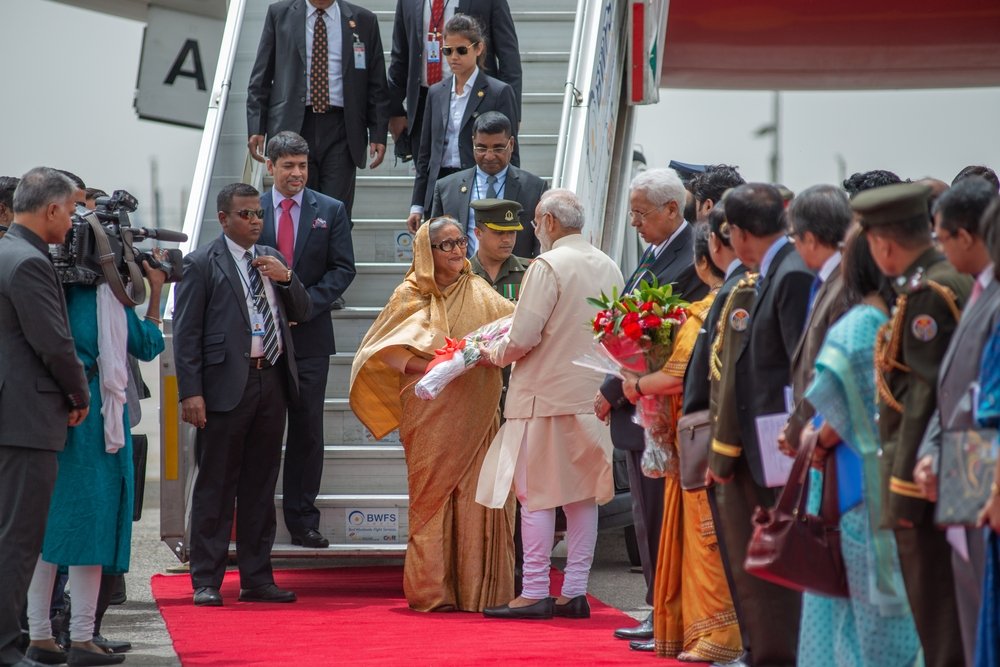
Ousted leaders rarely fade quietly, but few plot a comeback through the tedious mechanics of consular bureaucratic paperwork like Bangladesh’s ousted Prime Minister Sheikh Hasina.
From her self-imposed exile in New Delhi, the disgraced politician whose 15-year grip on power collapsed after the 2024 student-led uprising, has instructed London barristers to petition the Bangladesh High Commission for a fresh passport and National Identity Card.
The request argues that despite the reported cancellation of her travel documents, her citizenship remains intact under domestic and international law. Well, to Dhaka’s newly minted government under Prime Minister Tarique Rahman, the maneuver is an unwelcome legal curveball.
Hasina claims she intends to return home this December to face the music. Yet, her attempt to secure standard travel papers transforms a geopolitical issue into a convoluted test of statutory interpretation and diplomatic maneuvering between Dhaka and New Delhi.
The administration’s initial reaction has veered between procedural skepticism and outright fury. Officials in New Delhi questioned why a leader residing in the Indian capital sought representation through British KCs rather than approaching the embassy directly, demanding proof of formal authorization before processing the request.
State Minister for Foreign Affairs Humaiun Kobir was characteristically blunt, dismissing the initiative as "ridiculous."
"She is not visiting her maternal grandparents," he scoffed to reporters Monday, insisting she is a "terrorist who must return exclusively in handcuffs via the bilateral extradition framework."
Home Minister Salahuddin Ahmed took a cooler, more calculating line, confirming that the foreign and law ministries are meticulously auditing the 1973 Bangladesh Passport Order alongside citizenship statutes to construct an unassailable legal wall against her request.
The core friction lies in the ambiguities of Bangladeshi statutory law. Under Article 6 of the 1973 Passport Order, authorities may deny documents to individuals convicted within the past five years of offenses involving moral turpitude and sentenced to at least two years in prison.
Yet, Hasina’s situation presents a unique statutory paradox. In November 2025, the International Crimes Tribunal sentenced her to death in absentia for crimes against humanity linked to the violent suppression of the 2024 uprising.
The passport statute explicitly references sentences of imprisonment for two years or more, leaving open a narrow semantic debate over whether a capital sentence automatically fits that specific clause.
Furthermore, while the government retains broad discretionary powers to deny documentation on grounds of national security and public interest, a landmark 2023 High Court ruling established that executive authorities cannot arbitrarily withhold passports simply because criminal charges are pending.
Crucially, criminal conviction does not automatically strip a person of Bangladeshi nationality. Nor does the pending extradition request legally bar a citizen from applying for consular services.
Bangladesh and India share a robust 2013 extradition treaty, amended to ensure that offenses like murder and culpable homicide cannot hide behind the protection of political offense exceptions.
Dhaka has already lodged a formal request with New Delhi for her mandatory transfer.
International Crimes Tribunal Chief Prosecutor Md Aminul Islam has discarded her legal filing as a mere political stunt, pointing out that she has taken no concrete steps to surrender to the jurisdiction of the court, which has already ordered the total confiscation of her assets alongside those of her former home minister.
Yet, for New Delhi, Hasina’s diplomatic saga presents an agonizing tactical dilemma. India’s decision to host its longtime ally after her dramatic flight in 2024 severely strained relations with the incoming interim setup and the current administration in Dhaka.
If Bangladesh refuses her passport request, India remains trapped holding a convicted fugitive facing a death sentence, caught between its human rights obligations and its desire to reset fraught diplomatic ties with a vital eastern neighbor.
If Dhaka were forced by its own laws to issue the passport, Hasina could theoretically attempt a voluntary return as an ordinary traveler, bypassing the delicate machinery of formal extradition entirely.
Ultimately, Hasina’s legal team understands that a passport does not grant immunity. Armed with fresh papers or not, stepping onto Bangladeshi soil would mean immediate arrest, severe political agitation from her now-banned Awami League and an inevitable journey to face the tribunal's gallows.
But by forcing Dhaka to debate the fine print of its own passport codes, the former prime minister has effectively reminded her adversaries that while they may hold office, stripping a fallen ruler of her statutory rights requires a far tighter legal knot than the government has managed to tie so far.