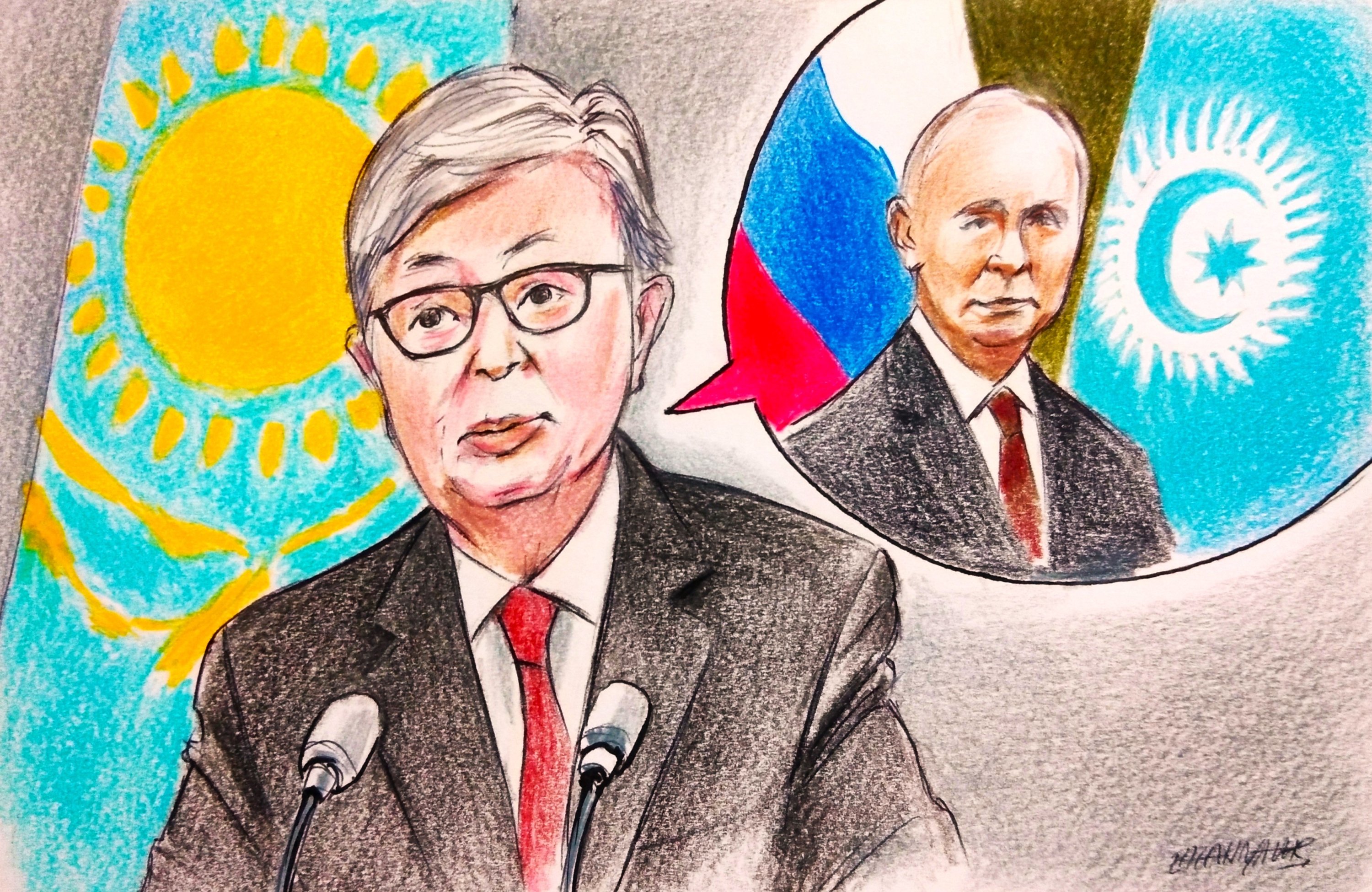
The proposal regarding Russia, raised by Kazakh President Kassym-Jomart Tokayev at the Organization of Turkic States (OTS) Summit held in Ankara on Oct. 30, sparked a significant debate about the organization’s future. First, let’s accurately assess the scope of the proposal. According to the official transcript released by the Office of the President of Kazakhstan, Tokayev proposes either inviting Russia to join the OTS+ format or allowing it to participate in the organization’s activities as an observer.
Tokayev, a distinguished and experienced statesman, makes his case clearly. He highlights Russia’s historical ties with the Turkic world, the Turkic peoples living within its borders, and the Turkic-origin words in the Russian language. He also references the “Altai – Cradle of Turkic Civilization” project, which is supported by Kazakhstan and promoted by Russia. He argues that this participation will enhance the organization’s prestige and benefit all members. His emphasis in the same speech on the need for the OTS not to turn into a military alliance is significant for understanding the proposal's political framework.
I assess that Tokayev, demonstrating masterful diplomacy, seeks to advance integration within the Turkic world while safeguarding relations with Moscow. This is a natural sensitivity and is also very important for the OTS. However, the value of any initiative must be measured by its contribution to the sovereignty and common interests of all Turkic states. The development of relations with Russia will only be meaningful to the extent that it strengthens the organization’s ability to determine its own priorities. The will of the member states will determine the direction of the partnership.
It is also necessary to establish the legal distinction correctly. Article 16 of the 2009 Nakhchivan Agreement allowed for the granting of observer status to states, international organizations, and international forums. This initial text did not impose a specific language requirement for observers. It left the procedures and principles governing the granting of such status to be determined by regulations.
However, the specific eligibility requirement was outlined in the observer status regulation adopted at the Istanbul Summit on Nov. 12, 2021. According to this regulation, only states that recognize a Turkic language or a related language as their state or official language at the state level may apply for observer status. As Kürşad Zorlu, deputy chair of the AK Party and head of Relations with Turkic States, emphasized in his Nov. 3 statement, this status must be valid throughout the entire country.
According to Article 68 of the Russian Constitution, Russian is the state language throughout the entire federation. The republics may designate their own state languages; however, the status of these languages within the respective republics does not confer official-language status across the entire federation. Consequently, the regional status of the Tatar language or other Turkic languages does not grant Russia the required eligibility. The presence of Turkic peoples within Russia is important for cultural relations; however, it does not meet the current criteria for observer status.
Here, the 2009 Agreement and the subsequent regulation should not be interpreted as alternatives to one another. The Agreement established the general framework and separately defined the authority to determine the conditions for observer status. Therefore, one cannot conclude that Russia can be accepted unconditionally today based solely on the original text. For a different outcome, Russia must either meet the language requirement or the relevant rule must be amended in accordance with due process. In either case, member approval and a decision by the competent body are also required.
The existing tool for cooperation is the OTS+ format. This mechanism, established by the Organization at the 2025 Gebele Summit, aims to develop flexible relationships with external partners in areas of mutual interest. As Zorlu explained, holding a meeting with a third country at the level of leaders or foreign ministers requires approval from all members. Contact with Russia can be established within this framework; such a meeting would not grant Moscow observer status. The scope and boundaries of such cooperation will be determined separately.
I find Zorlu’s approach highly valuable. It charts a viable path for diplomatic engagement while preserving the organization’s foundation of language and identity. His reminder of the rules reflects a prudent stance in defending the institutional integrity of the Turkic world. The transparency and predictability of joint decisions will be key to ensuring the OTS’s growing prestige remains enduring. Interest from outside should strengthen our confidence in our own rules.
Zorlu’s call to revitalize cultural relations through the International Organization of Turkic Culture (TÜRKSOY) also deserves recognition. He recalls that cooperation among the six Turkic republics within Russia and TÜRKSOY was effectively frozen in 2015 by a decision from Moscow and suggests that this situation be reassessed. A concrete expression of the desire for cultural rapprochement could be facilitating contacts with our compatriots in the fields of science, art, and language. This step would make mutual trust visible in everyday life and serve to establish sustainable ties between universities and cultural institutions.
From Türkiye’s perspective, the correct approach is to develop contacts that serve mutual interests while preserving the organization’s founding philosophy. The subject, scope and benefits of cooperation must be clearly defined. Although observers do not have the right to participate in the decision-making process, the political weight of a major power must be taken into account. The sovereign equality of member states and their ability to set their own agendas must be preserved. Projects that strengthen solidarity within the Turkic world and deepen our ties with our compatriots can be evaluated according to these criteria.
Under Ankara’s chairpersonship, the priority is to enhance the ability of Turkic states to act in unison. Tokayev’s proposal aligns with this objective. The legal answer is clear: Russia cannot become an observer to the OTS under the current language status and existing observer rules; it can cooperate through the OTS+ framework with the approval of all members. The distinction Zorlu emphasizes is apt in this regard. The lasting value of the Turkic world’s relations with the outside world will be measured by their contribution to its independence and collective will.